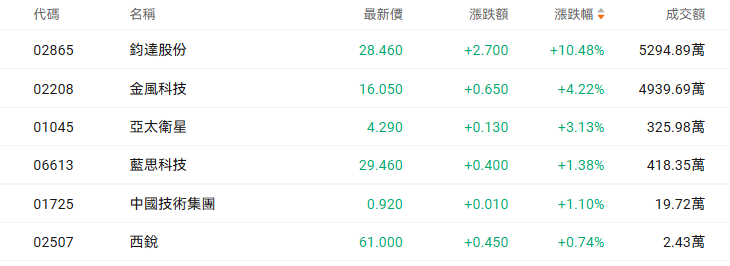
Hong Kong-listed commercial aerospace stocks rose again, $DRINDA (02865.HK)$ Increase by more than 10% again, $GOLDWIND (02208.HK)$ rose more than 4%, $APT SATELLITE (01045.HK)$ with some rising over 3%, $LENS (06613.HK)$ Surged over 1%.
SpaceX plans to launch its second-generation Starlink system in 2027, aiming to provide higher-speed internet services. Based on recent developments, the United States Federal Communications Commission (FCC) has approved SpaceX's application this month, allowing it to deploy an additional 7,500 second-generation Starlink satellites to further enhance its global internet service capabilities.
In addition, it is reported that SpaceX, under Elon Musk, has selected Bank of America, Goldman Sachs, JPMorgan, and Morgan Stanley to prepare for its IPO.
 On January 22, Beijing Chuanyuezhe Manned Space Technology Co., Ltd. held a 'Global Launch Event for Space Tourism,' where the full-scale test cabin of China's first commercial manned spacecraft, 'Chuanyuezhe-1 (CYZ1),' was displayed to the public for the first time. The technical team of 'Chuanyuezhe-1 (CYZ1)' stated prior to the event that more than three spacecraft seats have already been reserved, accommodating over 20 space tourists in total, with the maiden manned flight expected to take place in 2028.
institutions pointed out that in the broader context of global technological competition, the aerospace sector is rapidly transitioning from being a 'cost center' driven by national will to becoming a 'growth engine' propelled by commercial demand. In the United States, companies like SpaceX have achieved commercial closed-loop operations through extreme cost reductions and rapid technological iteration. China, leveraging national-level constellation projects such as the 'GW Constellation' and 'Qianfan Constellation,' is quickly catching up with dual drivers of policy support and market demand. The value chain of commercial aerospace can be divided into five core levels: 'space, ground, terminal, rockets, and applications.' From 2026 to 2030, each level is expected to present unique market opportunities and technical challenges.
Editor/Jayden