Li Auto has released several job openings related to humanoid robot R&D on its official career page, restarting the development of embodied robots.
In January 2024, Liao Pingping joined Li Auto as a robotics algorithm expert, primarily responsible for leading the team in developing wheeled dual-arm humanoid robots for specific industrial applications such as 'screw tightening' within Li Auto's manufacturing plants. He completed both his master’s and doctoral degrees at Beihang University and has approximately 10 years of experience in robotics research and development and management.
Due to limitations in technological advancements and the underdeveloped supply chain for humanoid robots, Li Auto temporarily halted its in-house humanoid robot project. Li Xiang, Founder and CEO of Li Auto, also stated during the AI TALK event at the end of 2024 that the probability of Li Auto developing humanoid robots is 100%, but the right timing has not yet arrived.
 This time, with the project's resumption, the job descriptions indicate that recruitment spans nearly the entire process of humanoid robot development, from core components to system integration:
Dexterous Hand: Embedded Software Engineer, Algorithm Development Engineer, Mechanical Design Engineer
Joint Module: Embedded Software Engineer, Mechanical Design Engineer
Bipedal Locomotion: Algorithm Development Engineer
Sensors: Embedded Software Engineer
Interaction Perception: Embedded Hardware Engineer
Whole-Body Motion Control: Algorithm Development Engineer
Main Platform Software Engineer
Integrated Deployment and Testing Engineer
Although the project was put on hold, Li Auto's layout in the general robotics field has not stopped. As we reported in June 2025, Li Auto established two new secondary departments, 'Space Robotics' and 'Wearable Robotics,' both under the Products Department led by Senior Vice President Fan Haoyu. The smart glasses Livis is the first product.
Li Xiang's interest in robotics reached its peak during last year’s Q3 earnings call. He stated that competition over electric vehicle parameters had reached a dead end, and developing intelligent terminals could easily lead to merely moving smartphone applications into cars, resulting in redundant efforts. Hence, Li Auto chose a third path, defining the car as an 'embodied intelligence' product, transforming it from a means of transportation into a 'robot' with perception, a brain, nerves, a heart, and a body.
The leap from vehicles to robots involves significant research and development challenges.
Firstly, automobiles only need to control two degrees of freedom for planar movement, with the core objective of autonomous driving being 'avoidance,' i.e., preventing physical collisions. Humanoid robots possess approximately 50 degrees of freedom, requiring coordination of limbs, torso, and complex joints throughout the body while actively interacting with humans and the external environment.
Secondly, although there is some overlap between the technologies used in electric vehicles—such as batteries, motors, and autonomous driving algorithms—and humanoid robots, the latter are more challenging. They demand higher precision in components and far more complex software. Elon Musk once remarked that the development difficulty of Optimus far exceeds that of the Model X.
From the perspective of recruitment needs, Li Auto's robotics R&D plan resembles that of companies like Tesla and XPeng, which pursue highly biomimetic humanoid robots. This approach is based on a fundamental assumption: the real world is designed for humans, and only by making robots as human-like as possible can they use human tools, master human skills, and thereby free humans from arduous labor.
An industry insider noted that the dexterous hand is the most challenging part of humanoid robot hardware and also a key indicator of the commitment to embodied robot R&D. It serves as both a mechanical component for executing movements and an important sensor for collecting tactile data. In current mainstream VLA (Vision-Language-Action) model training, the absence of tactile feedback from a dexterous hand results in missing critical modal data related to 'action,' impacting the robot’s level of intelligence. Some robot manufacturers initially adopted supplier solutions.
The timing of Li Auto's restart is somewhat delicate.
On one hand, there is the issue of funding. A CEO of a listed robotics company opined that, aside from BYD, most domestic automakers have an annual budget of around 500 million yuan available for continuous investment in emerging businesses—a level of investment insufficient to maintain leadership in the robotics field. Although Li Auto holds the largest cash reserves among new forces, every aspect—product iteration, autonomous driving development, and chip R&D—is extremely costly.
On the other hand, it is about people. According to our understanding, the humanoid robot research and development team at Seres has over 200 members, while Tesla's Optimus R&D team has more than 800 members. The aforementioned industry observer stated that if Li Auto starts from scratch, it would need to assemble a team of around 200 people and invest two years to potentially reach the level demonstrated by XPeng’s AI robot IRON in November last year.
Before deciding to restart its humanoid robot initiative, several intelligent driving technology professionals had already left to establish ventures focused on embodied intelligence. By the second half of 2025, key executives including Jia Peng, former head of autonomous driving technology R&D at Li Auto, Wang Jiajia, head of mass production, and former CTO Wang Kai, have co-founded an embodied intelligence company named Zhi Jian Dynamics. This startup quickly garnered investment interest from multiple leading dollar funds and internet technology companies.
Over the past two years, the surge in popularity of the embodied intelligence sector has driven up valuations for startups. Founding teams with backgrounds in intelligent driving technology executives have attracted significant attention from investors, with some startups surpassing valuations of 1 billion yuan. Therefore, figuring out how to incubate new businesses internally while effectively addressing the external wave of entrepreneurship drawing away technical talent remains a challenge for Li Auto.
During the Q3 earnings call last year, Li Xiang said robots can be categorized into two main types: one resembling humans and the other resembling vehicles. 'In the next decade, the most valuable product in the embodied intelligence field will undoubtedly be cars with automatic and proactive capabilities.'
Some industry analysts believe that since automobiles have been defined as a type of robot by Li Xiang, it is reasonable that Li Auto has decided to restart its humanoid robot R&D efforts. This move not only explores another product form within embodied intelligence but also aims to integrate core technologies like perception, decision-making, and action between cars and humanoid robots, enabling technology sharing and complementary advantages.
Previously, we conducted a cost-benefit analysis and found that the efficiency and cost of the most advanced embodied robots still fall short compared to human labor. While this might change in the future, as Keynes famously said, 'In the long run, we are all dead.' Over-anticipating the distant future may not necessarily be beneficial.
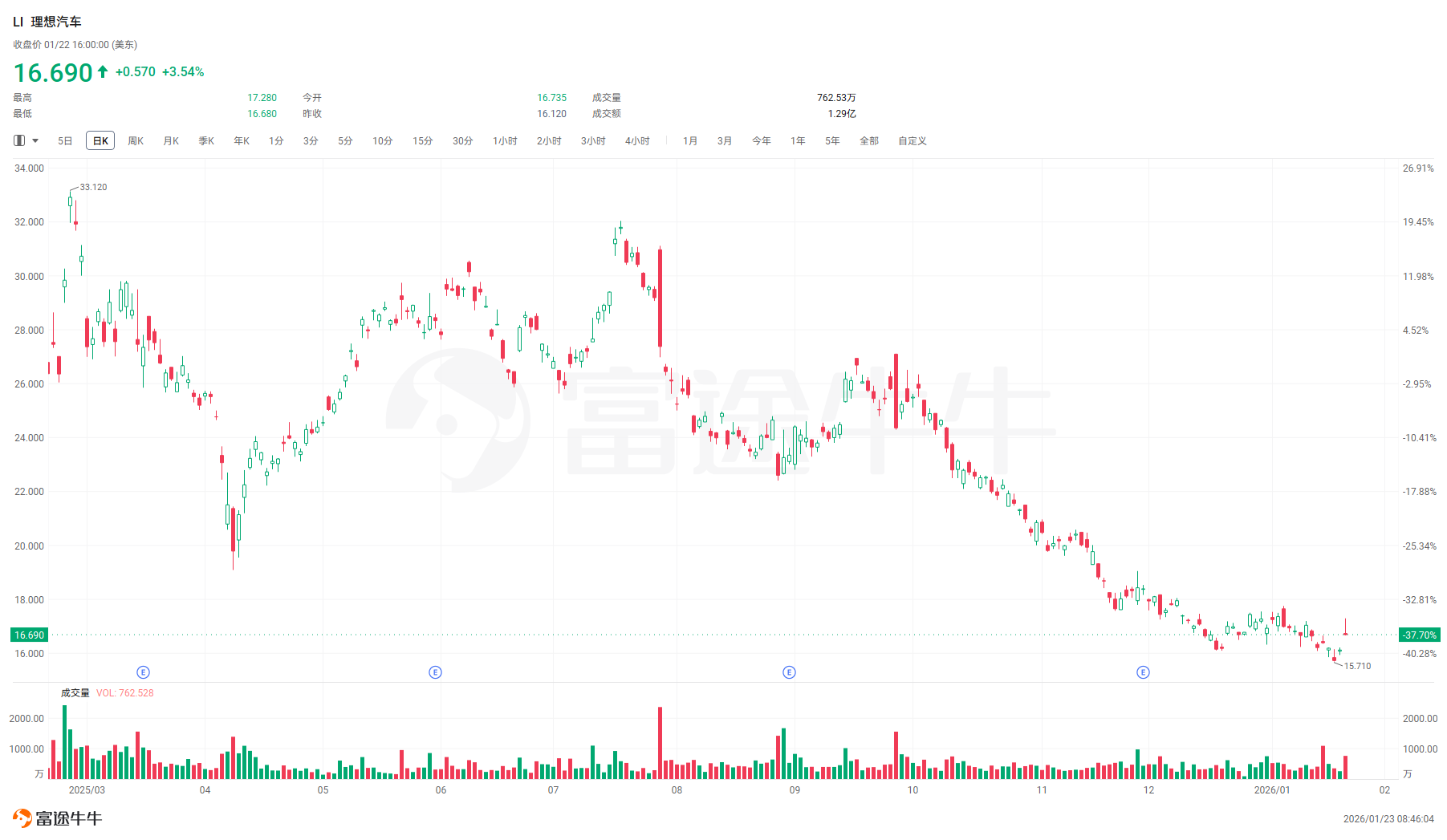
However, at this stage, the concept of embodiment appears to genuinely boost valuation. Li Auto's US stock price surged by approximately 7% at the opening. By the close of trading, the increase had moderated to around 3.54%.
Editor/Liam