
① A latest report released on Thursday by the Committee for a Responsible Federal Budget (CRFB), a bipartisan public policy institution in the United States, indicates that U.S. national debt has reached a dangerous milestone—hitting 100% of Gross Domestic Product (GDP); ② This is placing the U.S. on a path that could trigger six different types of fiscal crises.
A recent report released on Thursday by the Committee for a Responsible Federal Budget (CRFB), a bipartisan public policy organization in the United States, indicates that U.S. national debt has reached a perilous milestone—equaling 100% of the Gross Domestic Product (GDP). This development is placing the country on a trajectory that could potentially trigger six distinct types of fiscal crises.
In this report titled "What Could a Fiscal Crisis Look Like?", CRFB outlines an unprecedented and perilous future. The report states: "If U.S. debt continues to grow faster than the economy, the country may eventually face financial crises, inflation crises, austerity crises, currency crises, default crises, progressive crises, or multiple overlapping crises. Any one of these would be highly disruptive and significantly reduce living standards for people in the U.S. and globally."
 The report warns that unless U.S. policymakers implement a "thoughtful and growth-friendly deficit-reduction plan," disaster is likely just around the corner.
CRFB concluded: "The U.S. is heavily indebted, and its fiscal position is on an unsustainable long-term trajectory." While it is "impossible" to predict when calamity will strike, failing to change course makes "some form of crisis almost inevitable."
Below are detailed introductions to the six types of crisis scenarios:
① Financial Crisis
If investors lose confidence in the U.S. Treasury market, interest rates could spiral out of control. This would lead to the devaluation of existing bonds, potentially triggering a chain reaction of bank and financial institution failures.
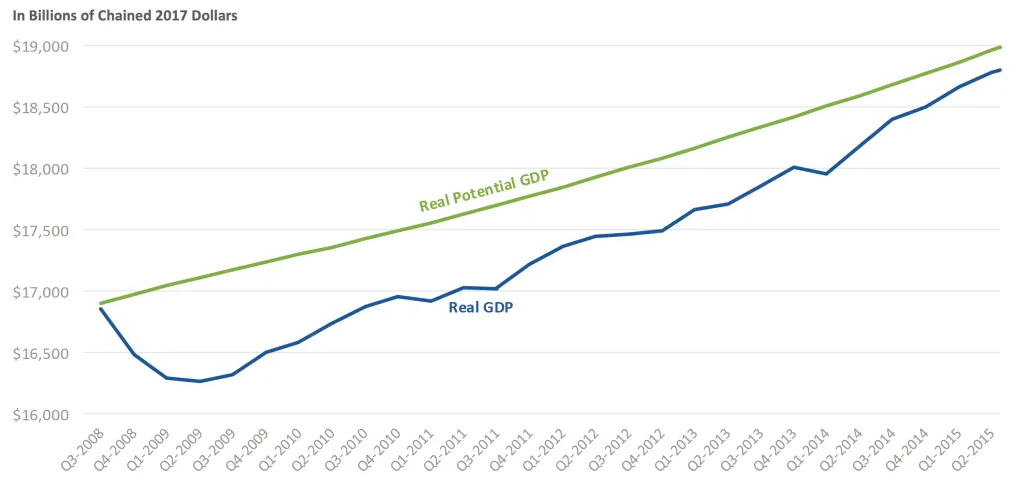
The report references the collapse of Silicon Valley Bank in 2023 as a "small-scale" preview of how rapid interest rate increases can destabilize the banking system. Over a longer horizon, the report points to the famous case of the 2007 global financial crisis. That crisis was driven by the collapse in valuation of subprime mortgage securities, resulting in hundreds of financial institutions closing, housing values dropping by a quarter, economic output contracting by 4%, unemployment rising to 10%, and the U.S. economy taking years to recover.
The committee noted: "Irresponsible fiscal policies have triggered global financial crises on multiple occasions, including Argentina's crisis in 1998, Greece and other European countries' crises around 2009, and Brazil's crisis in 2016." The report warns that although current U.S. debt levels appear manageable by financial markets, market trends are unpredictable, and investor confidence could quickly reverse.
② Inflation Crisis
Fiscal deficits can directly lead to inflationary pressures by increasing aggregate demand. Under a 'fiscally dominated' regime, attempting to avoid financial crises or defaults without addressing underlying debt growth may further exacerbate inflationary pressures, potentially leading to an inflation crisis.
In the most extreme scenario, the government or the Federal Reserve might monetize the debt—explicitly or implicitly printing money to finance debt. In addition to purchasing existing treasury bonds, the printed money could also be used to pay interest and principal or issue additional government debt without requiring external buyers. Such actions could trigger spiraling inflation, eroding savings and purchasing power, and repeating the historical crises of Argentina or the Weimar Republic.
Ray Dalio, the hedge fund giant, has recently been issuing continuous warnings about the risks of U.S. debt monetization. During this week's forum in Davos, Switzerland, he reiterated his stance. When discussing the U.S. economy, Dalio has long been outspoken in criticizing the surge in national debt. He stated that the current crisis has become so severe that it faces the collapse of the 'monetary order,' presenting a stark choice: 'print money or let a debt crisis unfold?'
③ Austerity Crisis
Among the scenarios detailed by CRFB, the most concerning is perhaps the austerity crisis. In this potential future, the loss of market confidence would force lawmakers to implement sudden and massive spending cuts or tax increases to quell panic. While deficit reduction is necessary, CRFB warns that implementing such austerity measures rapidly during periods of economic weakness could trigger the most severe economic contraction seen in nearly a century.
According to the report's estimates, fiscal tightening equivalent to 5% of GDP could reverse weak economic growth into a 3% economic contraction. This would mark a recession more severe than any recorded since World War II, as annual economic output in the U.S. has never contracted by more than 2% since 1950. Such a scenario could lead to surging unemployment rates, a sharp increase in business failures, and create a self-reinforcing cycle of depression.
As a typical example of such an austerity crisis, CRFB cited Greece in the 2010s, when economic weakness led to an 'unsustainable spike' in the country's borrowing costs and bond yields, forcing the Greek government to implement a series of painful austerity measures. These measures ultimately devastated the economy and drove unemployment to historic highs. During the same period, Portugal and Spain experienced similar but less severe crises.
④ Currency Crisis
Persistently high and rising levels of debt and deficits can depress a nation’s currency by increasing inflation risks, reducing market stability, and undermining fiscal credibility. Naturally, interest rates will rise to offset currency weakness and reduced demand for government securities, which could further deteriorate fiscal prospects and form a self-reinforcing cycle. Forced actions such as lowering short-term interest rates, capping long-term yields, or monetizing debt would lead to currency depreciation. Currency depreciation would also exert upward pressure on import prices, weaken U.S. geopolitical influence, and disrupt economic stability.
The US dollar is the world's leading reserve currency, accounting for the majority of foreign exchange reserves held by global central banks. Additionally, the US dollar dominates global trade and international finance, allowing US Treasury bonds to serve as the global risk-free benchmark interest rate. In the past, a strong dollar further fueled US economic growth by reducing borrowing costs, benefiting the federal government, businesses, and consumers alike.
If the dollar were to weaken significantly due to reckless fiscal policies and currency depreciation, it would become harder to attract investors to US Treasury bonds, and by extension, to investments across the United States. Compensating for a depreciating dollar by raising interest rates would only exacerbate fiscal crises. As the dollar weakens, the geopolitical power of the United States might also decline. Should the dollar lose stability, it could prompt both foreign official entities and private investors to reduce their holdings of dollar-denominated assets, thereby undermining the dollar’s role in the global financial system.
⑤Default Crisis
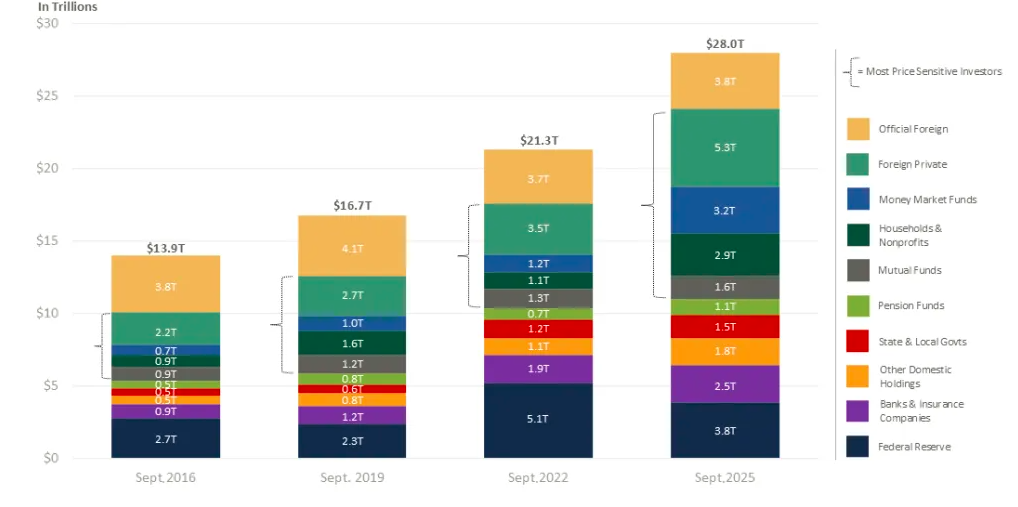
The Committee for a Responsible Federal Budget (CRFB) pointed out that, although unlikely, the most direct form of fiscal crisis would be a default on US debt. Currently, the US federal government owes approximately $31 trillion to the public, with creditors including banks, local governments, foreign governments, corporations, individuals, and the Federal Reserve. A default crisis occurs when the federal government fails to pay principal or interest on its obligations.
The consequences of a default could be catastrophic. Globally, US Treasury bonds—the cornerstone of the global financial system—would suffer enormous valuation losses, weakening their status as reliable safe-haven assets. Banks would collapse, credit markets would freeze, stock markets would crash, pension funds would default, and countries around the world would plunge into deep recessions. A 2023 report by Moody's Analytics estimated that even a temporary default lasting just a few weeks would result in a 4% reduction in economic output, an increase of six million unemployed individuals, and the wiping out of one-third of the stock market's value.
Many countries have experienced debt defaults throughout history. Notable examples include Mexico in the early 1980s, Russia in 1998, and Argentina in 2001. While the United States is highly unlikely to default—as countries borrowing in their own currencies can always print money (though this may lead to inflation or a currency crisis)—rising debt and interest costs could make default appear more attractive relative to other options. In a debt spiral, policymakers might eventually conclude that some form of default, such as debt restructuring, represents the best, simplest, and least costly solution.
⑥Gradual Crisis
The CRFB stated that the most insidious crisis may be a slow decline without any obvious trigger point. Although high and rising debt levels could lead to acute crises, they might also gradually erode living standards, with equally devastating effects. This gradual deterioration could result in progressively worsening conditions such as higher interest rates, inflation, currency depreciation, and economic instability.
In the spring of 2025, the Congressional Budget Office (CBO) simulated a scenario in which debt approached 250% of GDP within 25 years without triggering severe economic contraction—effectively modeling a gradual crisis. Compared to stabilizing debt at 100% of GDP, the CBO found that after 25 years, per capita Gross National Product (GNP) would decline by 8%, average interest rates on government debt would rise by 24%, and interest payments would consume an additional 38 percentage points of income. Annual economic growth would slow by about one-third.
Japan offers a case study of a gradual crisis: despite maintaining extremely high debt levels for decades and avoiding acute crises, its real GDP has grown by only 10% over the past two decades (an annual average of 0.5%). Other countries like France, Italy, and the UK are also experiencing sluggish growth and rigid fiscal policies, partly due to their substantial debt burdens.
Causes of the Crisis and Warning Signals
The CRFB noted in its report that the crisis itself may not require a single 'tipping point' but could be triggered by various catalysts, including economic recessions, government implementation or tolerance of large-scale new borrowing, 'poor' treasury bond auctions, declines in foreign demand for U.S. Treasury bonds, breaching the debt ceiling, and debt-interest spirals.
This warning from the CRFB comes as the fiscal situation in the United States continues to deteriorate. Last year, U.S. government debt interest payments surged to approximately $1 trillion, consuming nearly 18% of federal revenue — a proportion close to historical highs and equivalent to the entire federal Medicare budget.
The report emphasized: 'When debt reaches 100% of GDP, the United States’ fiscal space to respond to wars, pandemics, or economic recessions has dropped to a historical low.'
Editor/Rice