As the international gold price breaks through the $5,000 per ounce mark, as London silver doubles in just two months, as copper, aluminum, lead, zinc, and tin stage a 'periodic table' rally, and as sulfur prices double within a year and lithium carbonate hits new highs repeatedly... This series of seemingly independent market surges is converging into an epochal tide, heralding that the global commodities market is entering a new 'super cycle'.
The duration and intensity of this cycle may far exceed our expectations.” Recently, several fund managers expressed similar views to reporters. Driven by a confluence of factors including global monetary oversupply, a crisis of confidence in the US dollar, demand for technological innovation, and supply chain restructuring caused by geopolitical conflicts, global commodities could be on the verge of a cyclical boom that surpasses market expectations. Publicly offered funds, known for their keen insight, are swiftly adjusting their investment compass toward the "lifeblood" and "cornerstone" of modern industry—non-ferrous metals and basic chemicals. These sectors not only mark the historical coordinates of this global commodity feast but also reveal specific paths for industrial opportunity amid the rising tide.
Global Commodities Enter Third 'Super Cycle'
History does not repeat itself exactly, but it often rhymes. Looking back over the past century, the 'super cycles' of commodities have been closely tied to dramatic changes in the global economic landscape, waves of technological revolution, and the reconfiguration of monetary systems. Now, we once again find ourselves at a crossroads where multiple historical factors intersect.
 "The root of this super commodity cycle can be traced back to global monetary oversupply," noted Wang Xu, Director of Equity Investment at Huitianfu Fund. Since the subprime mortgage crisis in 2008, Modern Monetary Theory (MMT) has gradually moved from the fringes to the center of policy practice. The outbreak of the COVID-19 pandemic in 2020 further entrenched this theory, leading to massive monetary expansion that not only fueled inflation but also inflated asset and commodity prices. Over the past five years, major developed countries' stock markets have generally risen by more than 50%, while commodities with strong financial attributes have surged by about 100%. Gold and silver, in particular, have seen increases of 128% and 171%, respectively. This trend spread to industrial metals such as copper, aluminum, and tin by the fourth quarter of 2025, ushering in a super commodity cycle that brings unprecedented investment opportunities in resource stocks.
Monetary oversupply is like the flutter of a butterfly's wings, triggering a storm in the global commodities cycle. A cyclical-style fund manager from South China summarized this evolution: "The U.S. debt cycle, structural demand pull, supply chain security, and supply constraints are forming a perfect resonance."
First, the U.S. debt cycle and the restructuring of dollar credibility. "The rising U.S. debt and deficit ratios have sparked deep concerns globally about the credibility of the dollar," the fund manager analyzed. Interest payments on U.S. Treasury bonds have now surpassed defense spending, raising serious questions about the sustainability of the debt. Against this backdrop, central banks worldwide are voting with their actions—selling U.S. Treasuries, buying gold, and building more diversified reserve systems. This is not merely hedging; it represents a 'rebalancing' of the existing international monetary system, significantly amplifying gold's monetary attributes.
Second, structural demand driven by the transition between old and new growth drivers. Every historical commodities bull market has been underpinned by emerging demand, and this time, the protagonists are artificial intelligence (AI) and the green energy transition. "Behind AI lies electricity," emphasized the fund manager. "Industrial development imposes unprecedented demands on power reliability and grid stability. Whether it's data center construction or grid upgrades, copper remains indispensable. Meanwhile, at the core of the energy transition—electric vehicles, photovoltaics, and energy storage—a massive demand matrix for metals such as copper, aluminum, lithium, and nickel is forming. This is a 'leapfrog' type of demand whose scale and persistence may far exceed the framework of traditional economic cycles."
Third, supply chain security amid geopolitical shifts. "The great transformation of the century is accelerating, and the logic of supply chains is shifting from prioritizing 'efficiency' to emphasizing 'security'," the fund manager opined. Countries are seeing a sharp increase in strategic reserves of critical minerals, energy, and food. Simultaneously, supply chain restructuring led by the United States is trending toward regionalization and decentralization. This process itself requires significant infrastructure and equipment investment, directly boosting demand for commodities. The strategic value of minor metals is particularly prominent, given their extensive application in technology and military industries, making them important bargaining chips in great power competition.
Fourth, supply constraints following a decade-long contraction in capital expenditure. The fund manager pointed out that after peaking in 2011, global capital expenditure on key non-ferrous metals entered a prolonged contraction phase. Persistent low exploration investment, combined with the natural decline in global ore grades, has led to increasingly evident output gaps in key metals. Supply-side constraints represent the most rigid aspect of this cycle.
Ye Peipei, the fund manager of ZEO Resource Selection, stated directly, 'We are currently in the third global commodity supercycle of the past 60 years, and the price boom is far from over.' The characteristic of this cycle is its longer duration amid supply chain restructuring,ESG(Environmental, Social, and Governance) and China's 'anti-involution' era backdrop may lead to scarce resources maintaining high levels for a period longer than the previous two cycles.
Domestic price recovery fosters pro-cyclical market momentum
As the tide of global commodity prices surges, China, as a major producer and consumer of industrial goods globally, has reached a pivotal turning point in its domestic price trends.
Data released by the National Bureau of Statistics showed that in December 2025, the Producer Price Index (PPI) for industrial producers nationwide rose by 0.2% month-on-month, marking the third consecutive monthly increase. The growth rate expanded by 0.1 percentage points compared to November 2025. Year-on-year, PPI fell by 1.9%, with the decline narrowing by 0.3 percentage points compared to November 2025. After years of adjustment, the PPI is now at an inflection point of recovery.
2026 is highly likely to be a year of significant change in price trends," said Ye Yong, fund manager of the equity investment department at Wanji Fund. He believes this could trigger a major shift in market sentiment, supported by three core factors:
The first factor is the powerful base effect. Ye Yong explained that components determining PPI, such as the black chain, petrochemical chain, and non-ferrous metals chain, account for up to 70%. Among them, the prices of black commodities hit an eight-year low in June 2025 but have since risen significantly. The base effect alone is sufficient to provide positive momentum in the first half of 2026. Regarding the petrochemical chain, even if oil prices remain in the low range around $60 per barrel, it will not negatively affect the PPI. Factors such as increased geopolitical conflicts, reduced capital expenditure on shale oil, and Saudi Arabia's production increases are tilting the balance toward higher oil prices. Similarly, significant increases in the price centers of gold, silver, copper, and aluminum will strongly contribute to PPI. In summary, based on the base effect calculation, PPI is expected to turn positive by June 2026 at the latest, possibly earlier.
The second factor is the profound impact of 'anti-overheating' policies. Ye Yong believes that as a major economic policy affecting the whole situation, the central government has a deep understanding of the issues caused by excessive competition within certain industries and has started implementing targeted measures. These include direct production controls in the steel sector, overproduction governance in coal and cement, cost pricing guidance in photovoltaics and express delivery, and elimination of backward capacity in refining through energy consumption and environmental standards. A series of coordinated measures is gradually showing results. Optimization on the supply side will effectively improve profitability in related industries, providing intrinsic momentum for price recovery.
The last factor is the bottoming out and stabilization of the real estate cycle. After four consecutive years of decline, the proportion of the real estate industry chain in GDP has dropped below 15%, and nominal housing prices have fallen for 23 quarters (more than five years). "It is highly unlikely and undesirable for housing prices to continue falling sharply; otherwise, there might be a risk of tail-end problems," Ye Yong assessed. "Although a significant rebound is improbable, housing prices in major medium-to-large cities are expected to bottom out in the second half of 2026. Stabilization of the real estate industry chain will positively consolidate the recovery of PPI.
In summary, Ye Yong believes that the technical recovery of PPI is highly probable and may enter a sustained upward trend after turning positive. This would be driven by the gradual effectiveness of 'anti-overheating' policies, stabilization and recovery of real estate prices, and demand-side policy stimulus. The time window for this trend could be in the second half of 2026.
The recovery of PPI is a crucial factor, indicating a favorable rise in asset prices and signaling a major shift in market sentiment. After five years of long-term adjustments, pro-cyclical assets are poised for a value return. If such significant macroeconomic changes occur, the primary response should be guided by a major shift in market sentiment, strategically allocating pro-cyclical assets.
Strategic allocation of funds to non-ferrous metals and chemical industries
The tidal force of macroeconomics is profoundly reflected in the investment compasses of fund managers. Facing global commodity cycles and expectations of domestic price recovery, a strategic increase in cyclical assets, particularly in the fundamentally robust non-ferrous metals and chemical sectors, has become a consensus among an increasing number of fund managers.
Research reports from Dongwu Securities show that in the fourth quarter of 2025, the top three industries where actively managed equity funds increased their positions were non-ferrous metals, non-banking finance, and basic chemicals. Among these, the overall position of resource products represented by non-ferrous metals reached 13.3%, setting a new historical record.
In terms of representative individual stocks, a trillion-dollar market cap mining leader$ZIJIN MINING (02899.HK)$has entered the list of major holdings for 1,794 funds, with the number of holding funds second only to$CATL (03750.HK)$and$Zhongji Innolight (300308.SZ)$, and has even become the top holding for 445 funds; its share price has risen fourfold since last year.$Inner Mongolia Xingye Silver&Tin Mining (000426.SZ)$, which went from being almost completely ignored by funds two years ago to now being held by over a hundred funds, recently pushed its market value past the 100 billion yuan mark.$Yunnan Aluminium (000807.SZ)$、$Zangge Mining (000408.SZ)$、$Qinghai Yanhu Industry (000792.SZ)$Several non-ferrous chemical stocks have ranked among the top twenty stocks most heavily added by active funds in Q4 2025, with these three stocks having doubled in price since last year.
This strategic reallocation is not a short-term game but is based on a profound reshaping of industrial logic and valuation systems. As Ye Peipei noted, against the backdrop of a new era, some commodities will shift from being 'cyclical' to offering 'dividends,' with their pricing and valuation systems restructured—for example, electrolytic aluminum, where stable dividends attract long-term capital. Meanwhile, others will transition from 'cyclical' to 'growth' assets, such as gold and copper, benefiting from both earnings growth and valuation expansion in what is known as a 'Davies double.'
A roadmap for 'gold mining' in the new cycle emerges.
After determining the strategic direction, precise tactical deployment tests the 'alchemy' of fund managers. Among numerous pro-cyclical sectors, the key to success lies in how to select investments and construct portfolios.
The first echelon consists of industrial non-ferrous metals and minor metals, according to Ye Yong. As globally priced commodities, industrial metals have seen continuous price increases over the past two years, with sound investment logic that will further strengthen amid expectations of a domestic macroeconomic recovery. This could lead to both profit enhancement and valuation uplift, making them core holdings.
Ye Peipei stated that the five most promising commodities in 2026 are copper, aluminum, lithium carbonate, gold, and minor metals (such as tungsten), while also recommending attention to turnaround opportunities in sectors like chemicals, coking coal, steel, and building materials.
For instance, the core logic for copper lies in supply-demand contradictions driven by the transition between old and new growth drivers. Demand from new energy, power grid upgrades, and U.S. AI infrastructure collectively form new growth engines. If AI infrastructure development exceeds expectations, it may bring forward potential supply shortages. The aluminum sector offers an attractive risk-reward ratio, with capabilities for sustained high dividends on one hand and demand elasticity on the other; energy storage and AI infrastructure are clear incremental sources. Additionally, after gold, silver, and copper reach new highs, substitution opportunities such as aluminum replacing copper or magnesium replacing aluminum warrant attention, Ye Peipei noted.
Chen Ziyang, the fund manager of Great Wall Cyclical Selection, expressed a relatively stronger preference for the chemical sector: 'The non-ferrous metal sector nearly doubled in value last year, and institutional allocation is already at a relatively high level. In contrast, the chemical sector's valuation percentile remains at historically low levels, with earnings expectations gradually improving. Therefore, chemicals are one of our key focuses this year.'
Chen Ziyang further analyzed: 'Firstly, capital expenditure in the chemical industry has declined, and new capacity additions are nearing completion. The industry is transitioning from oversupply to balance or even shortage, which will restore profitability. Secondly, regulatory authorities have proposed addressing disordered internal competition, meaning environmental protection and energy consumption requirements for chemical projects will become stricter, potentially making capacity a scarce resource or licensed advantage. Lastly, from a global perspective, China’s chemical industry boasts comprehensive, efficient, and cost-effective advantages, while some overseas chemical capacities are exiting. Once profitability rebounds, chemical assets will likely undergo revaluation.'
From the 'growth' narrative of the non-ferrous metals sector to the 'reversal' logic of the chemical industry, a new cycle of global commodities has set sail.
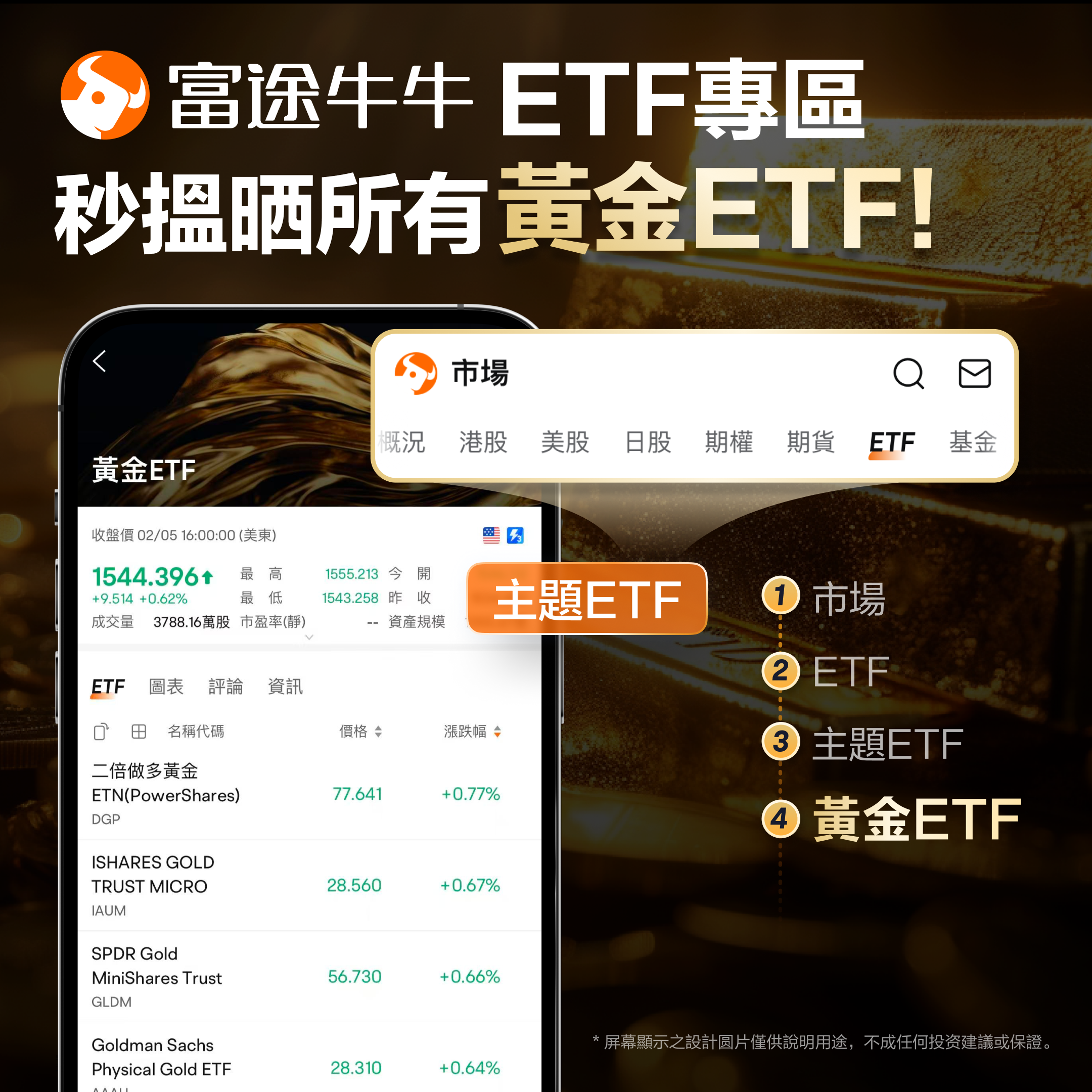
 How to quickly invest in gold? Visit the Futubull ETF section for direct access to all gold ETFs!
Open Futubull > Market > ETF > Thematic ETF > Gold ETF, and choose from all available gold ETFs!
Editor/Rice