Source: Tencent Technology
Author: Helen Li
A piece of news has simultaneously exploded on Wall Street and in Silicon Valley.
On January 30, it was reported that Elon Musk is orchestrating an unprecedented business restructuring: according to foreign media, his rocket manufacturing company SpaceX is considering a merger with AI startup xAI, and even the electric vehicle giant$Tesla (TSLA.US)$might be incorporated into this vast blueprint.
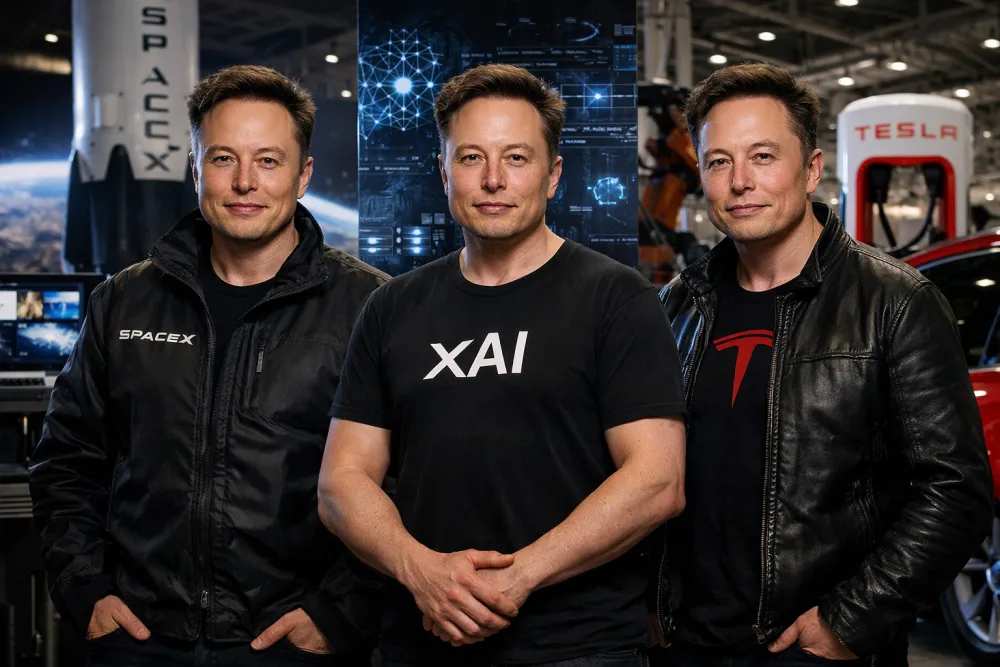
 This is not a simple capital operation. Industry analysts pointed out that Musk is attempting to consolidate rockets, Starlink satellites, the social media platform X, the chatbot Grok, and even autonomous driving and humanoid robots, all 'into one pocket,' representing a high-dimensional strategic reorganization. If successful, it would completely reshape the power dynamics of the technology industry.
Following the news, Tesla’s stock price surged rapidly in after-hours trading, with gains reaching up to 4.5% at one point. Global capital will also focus on SpaceX’s upcoming initial public offering (IPO), which is expected to value the company at over one trillion dollars—the largest IPO in history.
In the AI arms race, surrounded by rivals like OpenAI, $Alphabet-C (GOOG.US)$ 、$Amazon (AMZN.US)$why has Musk chosen to press this 'red button' on the eve of the IPO? What profound impacts might arise from the potential integration of these major business units?
01. Musk's 'Galactic Fleet': Fragmented Efforts, AI Competition Forces Consolidation
To understand the underlying logic of this high-stakes gamble, it is essential to first grasp the current state of Musk’s commercial empire.
The business landscape constructed by Musk features core companies that have achieved dominant or disruptive positions within their respective fields, showcasing a highly vertically integrated structure:
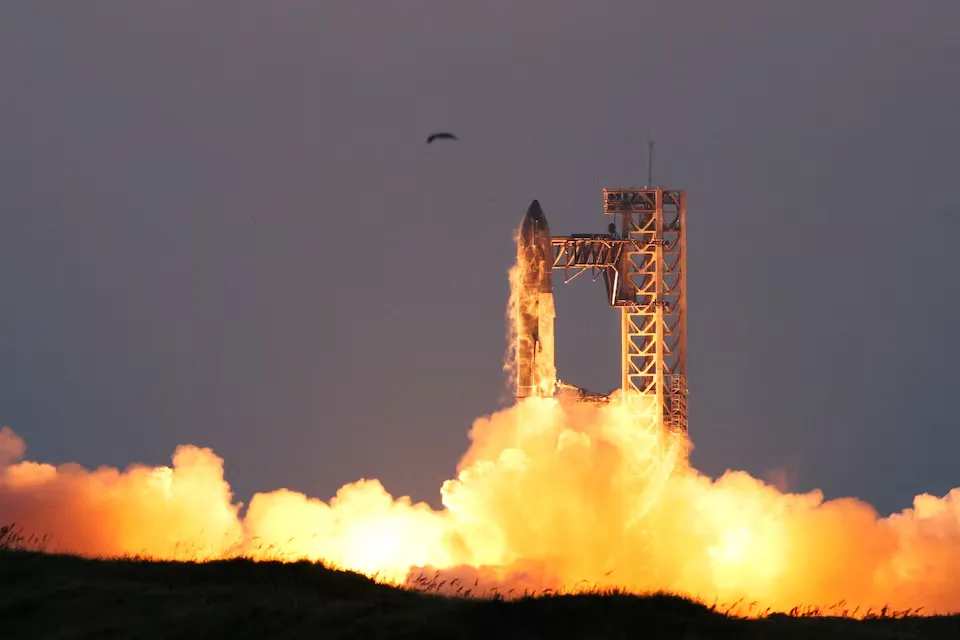
SpaceX firmly holds the dominant position in the global commercial rocket launch market. Its reusable rocket technology not only significantly reduces costs but also lays the foundation for the rapid deployment of its Starlink satellite internet. Today, Starlink has formed a global communication network consisting of thousands of satellites and has become an important source of cash flow.
xAI, an artificial intelligence company founded by Elon Musk in 2023, although a latecomer, has developed rapidly with its Grok series of large models. In 2025, through an all-stock transaction, it officially incorporated the social media platform X (formerly Twitter) into its portfolio, thereby gaining unparalleled real-time data streams and user interaction platforms.
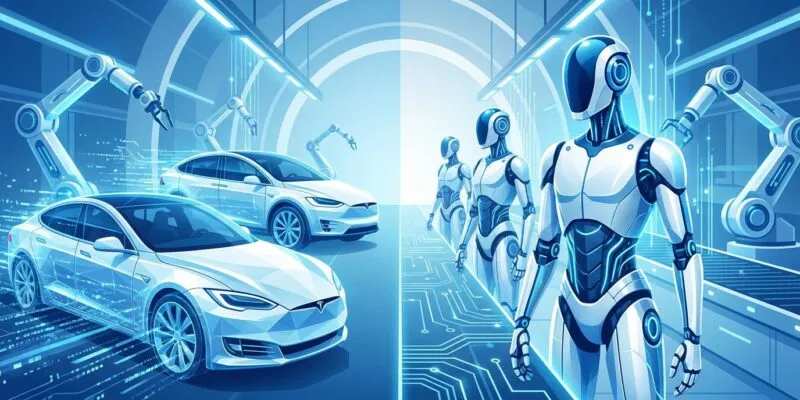
Tesla is not only a benchmark for global electric vehicles but also continues to invest in its Full Self-Driving (FSD) system, the humanoid robot Optimus, and energy storage solutions such as Megapack, striving to become an autonomous intelligent agent and energy hub in the real world.
However, beneath this seemingly powerful empire lie hidden structural challenges.
This 'decentralized control, each fighting their own battles' model, while bringing flexibility and focus, is having its inherent bottlenecks drastically magnified in the AI era.
After all, the essence of AI competition is a three-dimensional war revolving around computing power, energy, and data:
xAI’s training of the next-generation Grok model requires massive computing resources and electricity.
The evolution of Tesla’s FSD and Optimus relies on a constant stream of real-world video and sensor data.
Elon Musk’s repeatedly envisioned 'orbital data center' requires substantial capital and cutting-edge aerospace technology support.
The issue here is that while these companies are racing ahead in their respective fields, they may also be covertly competing for the same pool of resources.
After all, Elon Musk's time, attention, and the financial and engineering resources available to the entire group are limited. This dispersion leads to internal competition for resources rather than synergy. Facing 'carrier fleets' like Google, Meta, and OpenAI, which have unified command and vast resources, Musk’s scattered 'galaxy fleets' may be at a disadvantage in terms of coordination efficiency.
Thus, this forms the fundamental starting point of the 'merger' rumors: by restructuring the organizational framework, internal resource competition can be transformed into closed-loop synergy to address unprecedented external survival challenges.
02 Countdown to IPO: Elon Musk Faces a Merger Dilemma
Why has Elon Musk chosen this particular time frame for restructuring? The answer lies in a critical timeline.
Once SpaceX goes public, its equity structure will be locked, regulatory constraints will significantly increase, and the difficulty of large-scale restructuring will rise exponentially. Therefore, the pre-IPO window becomes the last opportunity to adjust the capital structure and articulate a grander vision. It is against this backdrop that Elon Musk has pressed the 'merger' button.
Based on leaked information, Elon Musk is advancing two distinct merger pathways, reflecting different strategic priorities and operational complexities.
Pathway One: SpaceX + xAI, integrating satellites, data, and AI into one cohesive unit
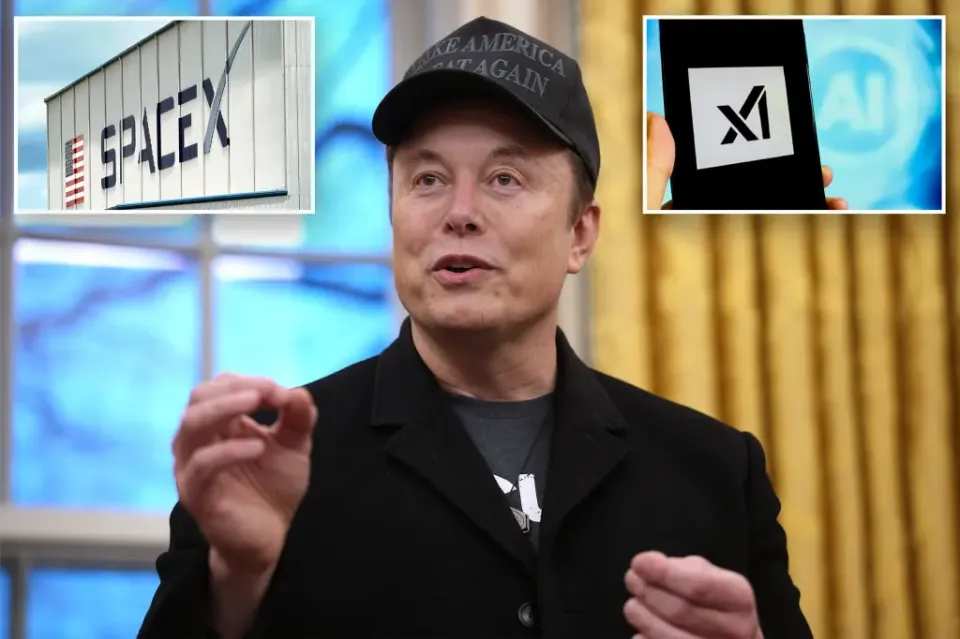
According to sources familiar with the matter and filings from Nevada corporate records, SpaceX is discussing a potential pre-IPO merger with xAI. Under the proposed plan, xAI shares would be exchanged for SpaceX shares at a specific ratio.
Upon completion of the transaction, the merged entity would encompass: SpaceX's rocket launch capabilities, the Starlink global satellite network, the X social platform and all its data, as well as xAI's Grok AI model. This would create an end-to-end chain from physical space access, to data transmission, and finally to AI processing and interaction.
Currently, this plan has shown substantial signs of progress. On January 21, two new entities with names implying 'merger subsidiaries' were registered in Nevada. Corporate documents reveal that the individuals in charge of these entities are linked to Bret Johnsen, SpaceX’s Chief Financial Officer. This is widely interpreted as a legal vehicle set up to facilitate the transaction.
As part of the deal, some executives of xAI may be given the option to receive cash instead of SpaceX shares. This could be a design aimed at balancing internal interests and appeasing early investors.
Path Two: SpaceX + Tesla, forming an integrated space-earth super industrial entity
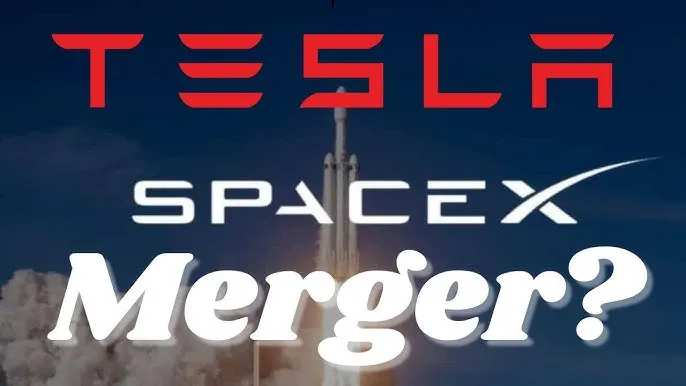
According to foreign media reports, SpaceX is also exploring the feasibility of merging with Tesla, the publicly traded company, and some investors have been continuously promoting this idea.
The imaginative scope of this plan is even more astonishing: after all, both companies have enormous valuations, and if their businesses merge, they would directly integrate space transportation and communications with autonomous fleets and energy networks on Earth, forming a near 'planetary-scale' technological empire.
However, the complexity of such a merger increases exponentially. Tesla, as a publicly listed company with a market capitalization of approximately $1.4 trillion, involves extremely complex procedures for any mergers or acquisitions, including but not limited to board approval, shareholder votes (possibly requiring a supermajority), stringent regulatory reviews (especially antitrust), and protracted valuation negotiations.
In contrast, both SpaceX and xAI are private companies, allowing their merger decision-making process to be faster and less transparent, primarily determined by Elon Musk and his core board members.
Path Three: A full merger of all three entities, presenting an extremely high level of difficulty
Beyond these two plans, the market naturally speculates about a third, more extreme scenario: a complete merger of Tesla, xAI, and SpaceX. However, this is considered the least likely option due to its unimaginable complexity.
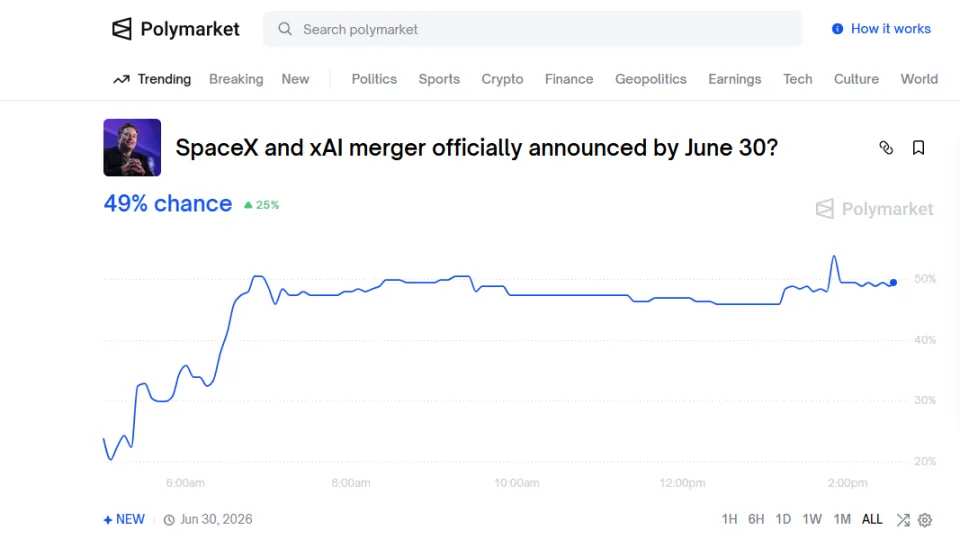
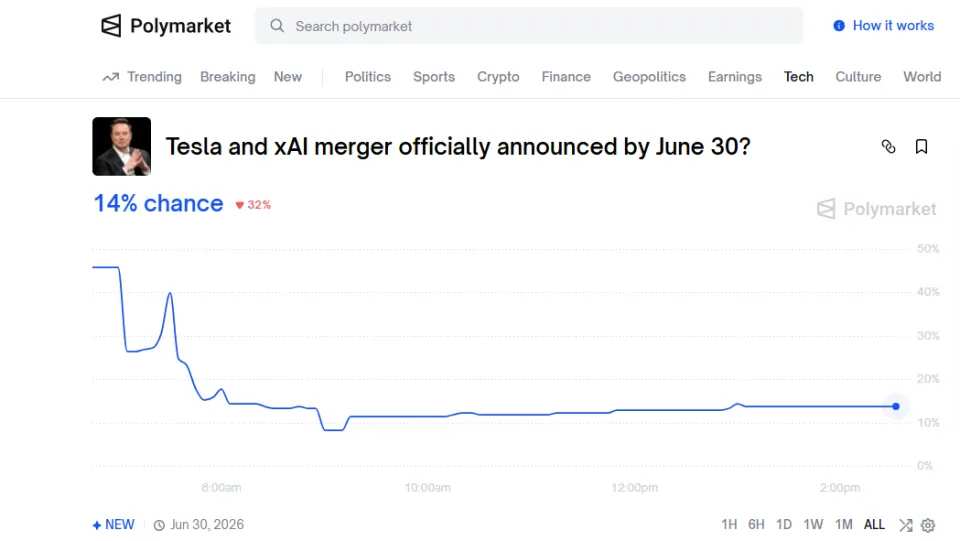
Real-time market predictions reflect this uncertainty. Data from the forecasting platform Polymarket shows that the probability of an official announcement of a SpaceX-xAI merger by June 30, 2026, is approximately 48%, while the likelihood of a Tesla-xAI merger is only 14%. This roughly confirms the logic of 'starting with the easier task first': a merger between private companies (Plan A) is a more pragmatic and likely path to achieve breakthroughs sooner.
The ultimate vision: seeking a 'space brain' for AI.
Earlier, we mentioned Elon Musk's approach to mergers, which pertains only to the question of 'how.' More crucially, what is the ultimate purpose behind Musk's actions?
On the surface, it appears to be about optimizing the capital structure and improving management efficiency. However, the real answer is far more radical. He is betting on a strategic judgment that could rewrite the rules of the AI competition: the decisive battleground for AI in the future will be in space.
At the Davos Forum in early 2026, Musk stated, 'The place with the lowest deployment cost for AI will be in space, and this will be achieved within two years, no later than three years.' This judgment is based on a simple physical fact: space offers nearly infinite solar energy and remains at a low temperature, which can significantly reduce the enormous energy costs required for cooling massive numbers of AI chips. By deploying data centers on orbits connected by Starlink satellites, a distributed supercomputing network powered directly by solar energy can be constructed.
In short, for xAI, which is fiercely competing with OpenAI and Google, having sufficient space-based computing power represents an 'exclusive ace.'
Currently, xAI is constructing a massive ground-based supercomputing center named 'Colossus' in Memphis, Tennessee. However, it has already encountered bottlenecks: enormous electricity consumption, high cooling costs, and pressure from environmental regulations. In contrast, a space-based data center can be powered by nearly limitless solar energy and utilize the low-temperature environment of space to reduce cooling costs, theoretically enabling unlimited expansion.
A merger with SpaceX would open up a new frontier of computing power for xAI: while competitors are still grappling with electricity bills and environmental issues for ground-based data centers, xAI could expand infinitely in space.
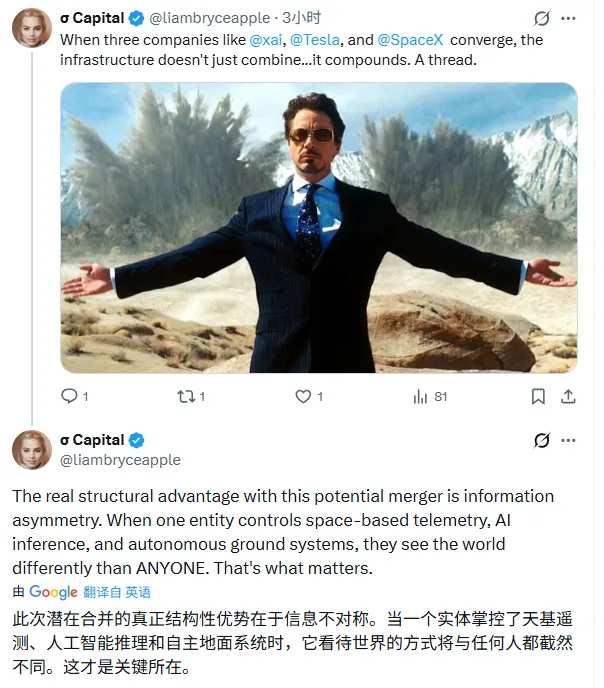
As one netizen pointed out in an in-depth analysis on social media, the 'information asymmetry' advantage brought by such integration is decisive: 'When an entity controls space-based telemetry, AI reasoning, and autonomous ground systems, its perspective on the world will differ fundamentally from anyone else’s—information speed is the true moat.'
04, Conclusion: Elon Musk’s 'Lego Empire'
Reviewing Elon Musk’s history of commercial expansion reveals that he follows a unique 'puzzle methodology'.
In 2016, Tesla acquired SolarCity, completing the energy loop of 'solar power generation - battery storage - electric vehicles'; in 2025, xAI acquired X (formerly Twitter), gaining access to real-time data streams essential for AI training. Each acquisition was not aimed at scaling up but rather at filling in the critical missing pieces of the ecosystem.
This potential merger between SpaceX, xAI, and Tesla represents the ultimate application of this methodology: evolving from 'small puzzles' within individual companies to a 'super puzzle' that spans Earth and space while integrating hardware with AI.
If successful, we may witness a landmark moment in business history by the summer of 2026: the emergence of an 'interstellar enterprise' prototype, using Starship as its carrier, Starlink as its neural network, Grok as its intelligent core, and Tesla as its terrestrial reach. This entity will not only pursue commercial profits but also directly embody Elon Musk's ultimate vision of multi-planetary survival and AI coexisting with humanity.
Even if it fails, pressures and competition will not allow these companies to return to complete independence. The intertwining of capital, technology, and data has become irreversible, and they will continue to strengthen cooperation in the form of a 'loose alliance', albeit potentially missing the optimal window to consolidate organizational synergy and secure dominance at once.
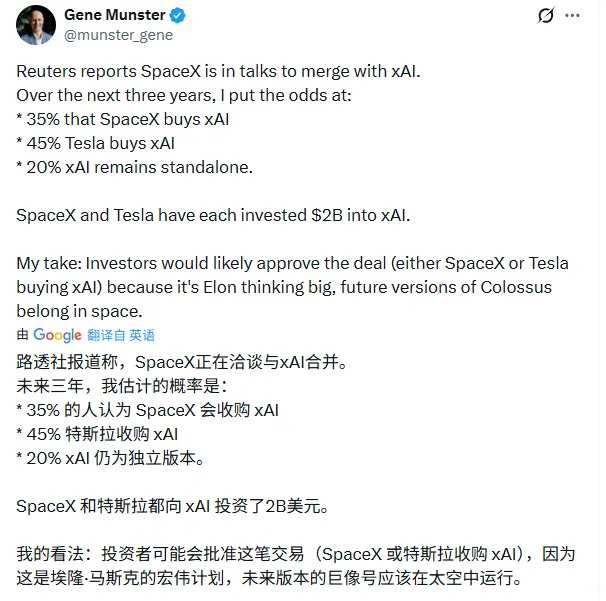
The analysis by Gene Munster, managing partner of Deepwater Asset Management, reflects the pragmatic view of some investors: the probability of Tesla acquiring xAI (45%) is even slightly higher than that of SpaceX acquiring xAI (35%), because 'this is Elon Musk's grand plan', and 'Elon Musk’s companies always get along well.'
The year 2026 may become a watershed moment for Elon Musk’s business empire. All eyes are now waiting for his next strategic move.
Editor/Rice