
Sanae Takai's statement on "strengthening the economy's resilience to exchange rate fluctuations" has been interpreted by the market as a cautious downplaying of direct yen intervention. Against the backdrop of a strengthening US dollar, the yen not reaching the critical intervention level of 160, and neither the US nor Japanese officials signaling support for the currency, the yen is once again exposed to fundamental pressures stemming from negative real interest rates and policy divergence. The risk of the yen reverting to a downward trend in the short term is increasing.
The Japanese yen may continue its decline against the US dollar this week.
According to the latest report by Bloomberg, this trend is primarily driven by two factors: one being the stronger resilience of the US dollar, and the other being remarks made over the weekend by Japanese Prime Minister Sanae Takachi, which have led traders to increasingly believe that the likelihood of Japanese authorities directly intervening to support the yen is diminishing.
 When addressing exchange rate issues over the weekend, Sanae Takachi initially emphasized the positive impact of a weak yen on exports, stating that 'a weak yen presents a significant opportunity for the export sector and can also provide a buffer for the automotive industry against US tariffs,' before adopting a more restrained tone.
She expressed her hope to 'build a robust economic structure resilient to exchange rate fluctuations.'
Market interpretation suggests that this statement did not signal a strong intention to defend the currency, but rather may have raised the threshold for official direct support of the yen. The report notes that this has objectively weakened the previous effect of curbing yen depreciation through 'verbal intervention.'
Traders widely believe that this could imply that the threshold for potential supportive measures by the authorities has been raised.
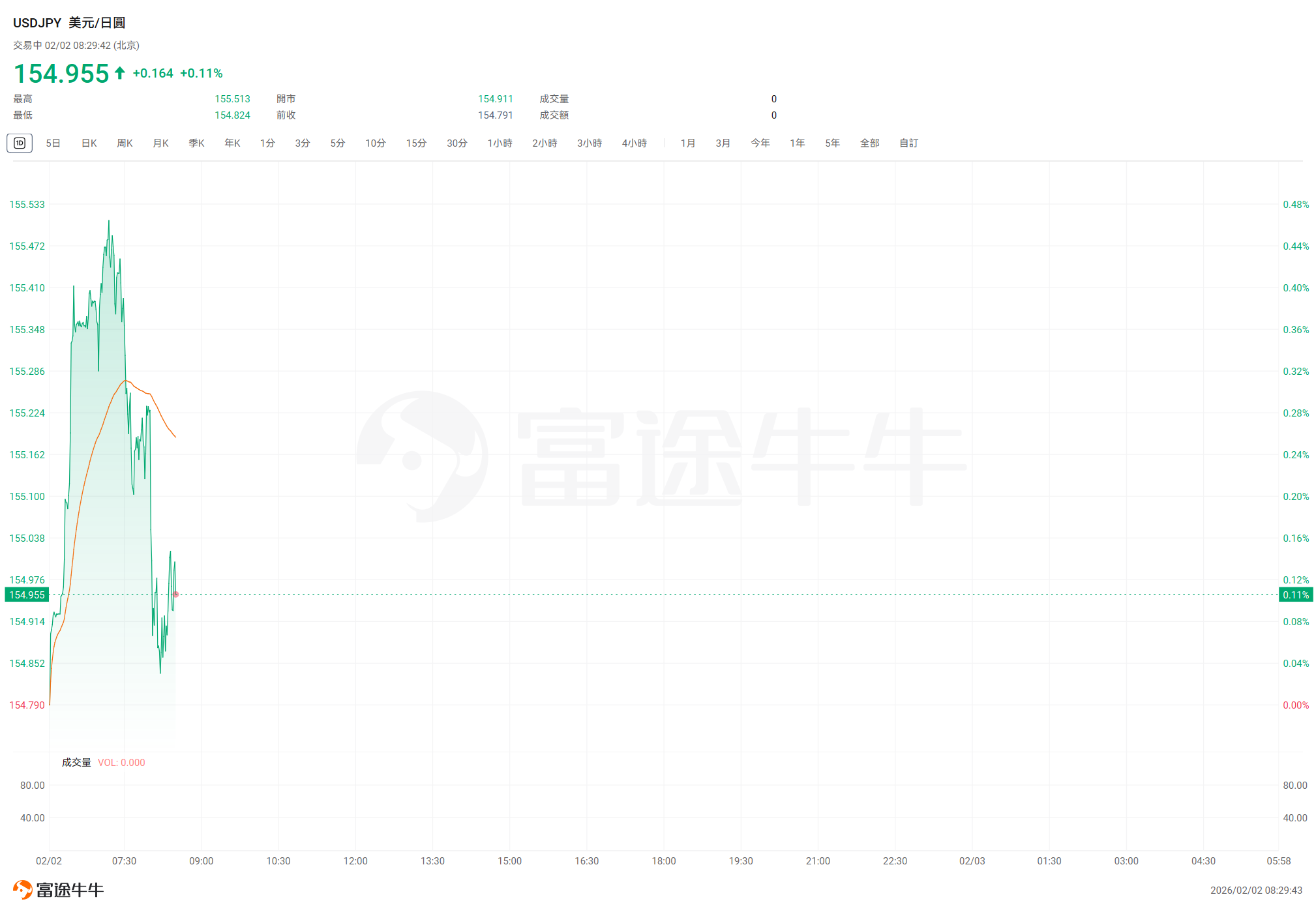
Following Sanae Takachi's remarks, the yen fell further on Monday, dropping 0.5% at one point to reach the 155.51 level.
Resonance of monetary policy signals between the US and Japan exposes the yen to renewed fundamental pressures.
In addition to Japan’s cautious stance, the US position has also failed to provide support for the yen.
Bloomberg pointed out that last week, US Treasury Secretary Bessent clearly stated that the US prefers a strong dollar. More importantly, the US government has not taken any action to support the yen.
Meanwhile, data released by Japan's Ministry of Finance last Friday showed that as of January 28, Japan had not conducted any official foreign exchange interventions, further diminishing market expectations for policy support.
In the absence of policy protection, the yen has once again been exposed to its long-term structural pressures, including negative real interest rates and the expansionary fiscal policy stance consistently advocated by Sanae Takahashi.
As elections approach, market attention has shifted back to the question of whether there is still a bottom line.
Analysis indicates that currently,$USD/JPY (USDJPY.FX)$there is still significant room before reaching the 160 level, which is widely regarded by the market as a potential trigger zone for intervention. In the absence of policy resistance, the likelihood of the yen continuing its depreciation trend before Japan's general election is increasing.
Political and policy signals on both sides of the Pacific collectively point to one conclusion: in the short term, the US and Japanese governments are unlikely to provide clear support for the yen.
In the recent past, expectations of official intervention have repeatedly acted as a key factor in preventing the yen from falling to multi-year lows.
Editor/Melody