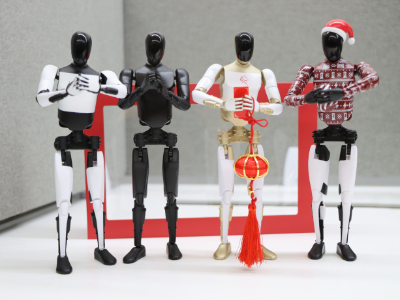
①Tesla stated that it has not adopted any existing supply chain system; ②Optimus V3 can learn by observing human behavior; ③Production is expected to commence by the end of 2026, with plans to begin public sales in 2027.
Editor Song Ziqiao, The STAR Market Daily, February 2nd $Tesla (TSLA.US)$ Tesla's official WeChat account announced today that the third-generation Tesla humanoid robot, Optimus V3 (Qingtianzhu III), is about to debut. It will be a general-purpose humanoid robot capable of learning new skills by observing human behavior. Tasks can be assigned to the robot through demonstrations, verbal descriptions, or video presentations, with an expected annual production of one million units.
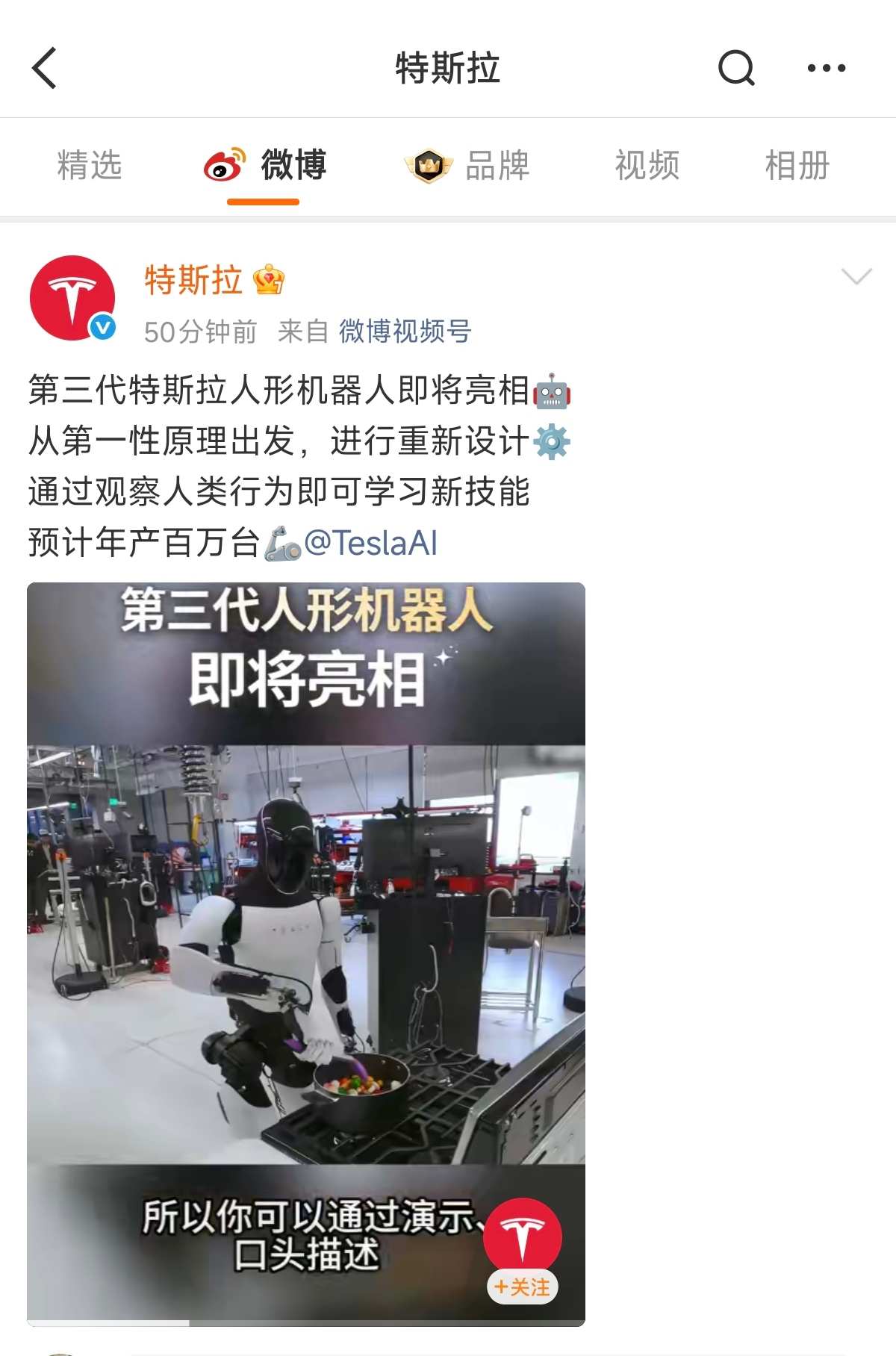
Tesla stated that this robot does not rely on any existing supply chain system. The team redesigned it from first principles.
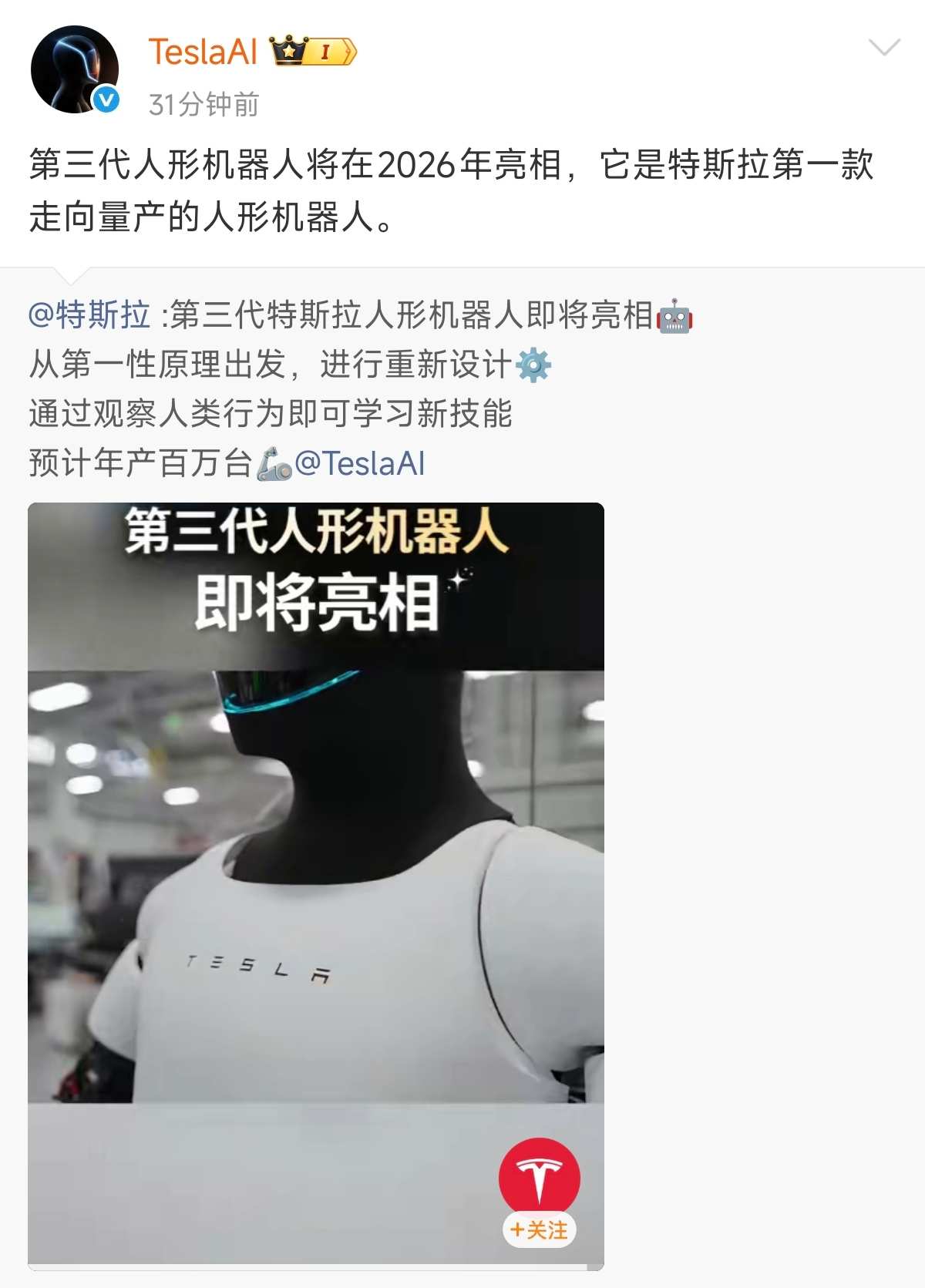
 Tesla AI stated that it is Tesla’s first robot to move into mass production.
To date, Tesla has unveiled three generations of its Optimus humanoid robots.
The first generation was a walking prototype named “Bumble C,” showcased at Tesla’s second AI Day in 2022. It could walk, wave, and perform simple carrying tasks, marking the transition of the project from concept to engineering phase. Additionally, Tesla presented the design for the first-generation Optimus (Gen 1), which was closer to mass production. The second-generation robot focused on functional demonstrations. Compared to the first generation, its walking speed improved by approximately 30%, its weight decreased by 10 kilograms, and it was equipped with a new 22-degree-of-freedom dexterous hand capable of performing delicate operations such as “picking up an egg with two fingers.” Between 2023 and 2024, Tesla demonstrated the robot’s ability to walk, grasp objects, and perform simple tasks in factories, and in 2024, it began testing tasks like battery sorting in Tesla factories. The yet-to-be-released third generation will be the mass-produced version for consumer sales, requiring solutions for dexterous hand operations and large-scale production challenges.
Based on available information, Tesla’s timeline for its robots is becoming increasingly clear: production of the third-generation humanoid robot is expected to commence by the end of 2026, with plans to begin public sales in 2027.
On January 28 local time, Tesla provided updates on its Optimus humanoid robot during its earnings call. Regarding the prototype, the earnings presentation indicated that Optimus V3 would be launched in the first quarter. Concerning mass production, Tesla will repurpose the Model S/X production space at its Fremont factory to manufacture Optimus, with a long-term production target of one million units, and for the first time included this in its production schedule. Tesla stated it would further invest in autonomous robotics infrastructure. The first-generation product line of the humanoid robot Optimus is currently being established.
Earlier in January, Elon Musk stated at the World Economic Forum in Davos, Switzerland, that Tesla might sell the Optimus robot to the public by the end of 2027. Currently, Tesla is using some robots in its factories to perform simple tasks. He predicted that by the end of 2026, Optimus would be able to “perform more complex tasks.” Musk emphasized that Tesla would only begin selling to the public when it was confident the robot had achieved very high reliability, very high safety, and broad functionality.
Robots are a crucial component of Musk’s vast technological empire. According to Futurism, amid the dual pressures of plummeting global auto sales and regulatory challenges surrounding driver-assistance software, Tesla CEO Elon Musk is urgently seeking new directions for the company, with the Optimus humanoid robot becoming his latest obsession. Musk claims that this robot will propel Tesla’s transformation into a robotics company valued at $25 trillion, with its value far surpassing Tesla’s current business operations.
However, Futurism also reported that Tesla's original target of producing 5,000 Optimus units by 2025 has completely failed, with actual production reaching only several hundred units, which do not meet factory operational standards. Although breakthroughs have been made in dynamic balance and upgrading dexterous hands, autonomous operation of the robots still depends on remote control. In previous demonstrations, the robots even struggled to walk steadily down an empty corridor. The mass production of dexterous hands and missing supply chains remain key bottlenecks.
Market analysis suggests that the upgrade in Tesla’s Optimus V3 production capacity planning will act as a catalyst for the humanoid robotics industrial chain in A-share markets. Huaxin Securities believes that this round of growth in the humanoid robotics sector has already begun, recommending investors focus first on high-certainty T-Chain targets before the release of Optimus Gen3. If the actual release exceeds expectations, it will provide significant investment opportunities across the entire humanoid robotics sector.
Orient Securities stated that the performance improvements in V3 are expected to drive breakthroughs in downstream application scenarios, further expanding the demand for humanoid robots. Previously, Musk's close friend Jason Calacanis visited Tesla's lab and gave high praise to the Optimus V3 prototype. During Tesla’s Q4 2025 earnings call, Musk revealed that V3 would achieve a higher level of anthropomorphism, with potential breakthroughs in the design of dexterous hands and AI-powered robotic brain thinking capabilities. The institution anticipates that after V3 is launched, equipment performance will significantly improve, driving demand acceleration in industrial applications and even consumer (C-end) scenarios. This is expected to further expand the market demand for humanoid robots, enhance growth prospects, and create investment opportunities.
Editor/Jayden