
The most critical issue in the current market is: at what speed will Japan's Ministry of Finance increase fiscal leverage, and when will it trigger the 'red line' in the bond market — the same red line that ultimately brought down former UK Prime Minister Liz Truss, which has now been repeatedly compared to Japan's situation.
With the ruling party of incumbent Japanese Prime Minister Sanae Takachi and its allies holding an absolute majority of over two-thirds in the House of Representatives, this figure—referred to as the 'Iron Lady of Japan'—has achieved a high concentration of political power for the first time since Shinzo Abe.
This grants her near-presidential powers, enabling her to decide on tax policies, defense strategies, and relations with the Bank of Japan. Influenced by this, the 'Takachi trade' has once again drawn market attention: the yen exchange rate has fallen to multi-year lows, while yields on Japanese government bonds are rising in tandem.
 Although many politicians have expressed approval of Sanae Takachi's policy direction, the key challenge lies in the need to carefully balance its implementation: how to increase government spending without exacerbating the debt burden; and how to establish a sustainable yen carry trade strategy—which could be profitable when plans proceed smoothly but may pose risks if market conditions shift.
For the purpose of$S&P 500 Index (.SPX.US)$For investors whose primary objective is income generation, the significance of Japan's general election does not lie in whether it deserves attention, but rather in the extent of its impact. This is because it is a pivotal variable that tangibly influences global interest rates, flows of funds into Japanese bonds, shifts between growth and value styles in stock markets, and ultimately determines the next phase of the global reflation cycle.
Who truly emerged victorious? What new powers will Sanae Takachi gain?
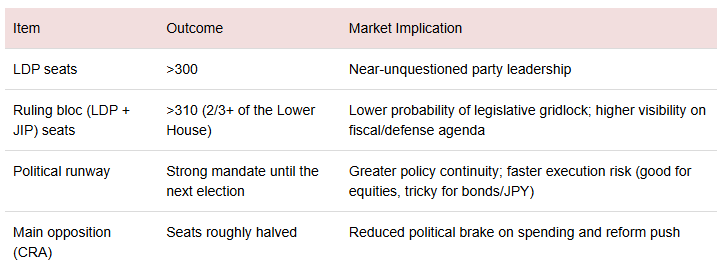
The February 8 election results have granted Japan’s government the authority to make efficient decisions. Currently, the Liberal Democratic Party (LDP) led by Sanae Takachi has secured approximately 316 seats, and the governing coalition with the Japan Innovation Party holds 350 seats collectively, surpassing the supermajority threshold in the House of Representatives.
This means that the governing coalition will control committee agendas, and more crucially, the legislative process will be significantly streamlined, with minimal resistance to policy implementation.
Simply put: The ruling coalition (LDP + Japan Innovation Party) holds over two-thirds of the 465 seats in the House of Representatives. In Japan’s political system, the House of Representatives has legislative decision-making authority, while the House of Councillors can only delay or temporarily veto but cannot ultimately prevent bills from becoming law.
Once the ruling party secures an absolute majority in the House of Representatives, any obstruction by the House of Councillors becomes essentially meaningless, at most causing brief delays. In other words, the 350 seats in the House of Representatives are highly valuable: previously, the government had to negotiate compromises with opposition parties and wavering allies, but now it operates as an efficient legislative machine capable of passing almost any proposed bill.
The impact of the general election on the stock market is direct: campaign promises will be enacted into law faster and reflected more quickly in the prices of equities, the yen, and Japanese government bonds. This might even reignite discussions on constitutional amendments, though it must be noted that such amendments still require approval from the House of Councillors.
"High Market Transaction" 2.0
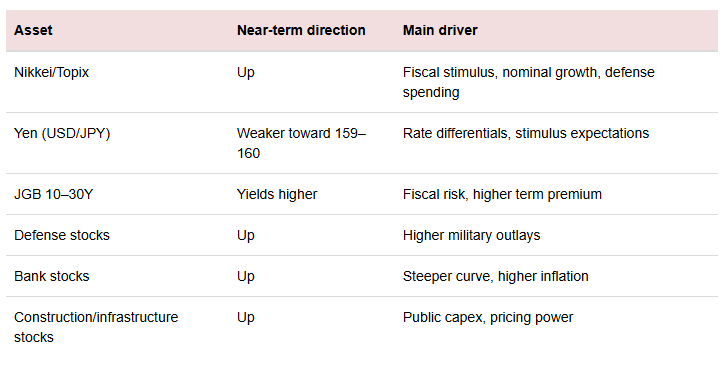
To be candid, the market landscape was already set before the election; the vote merely determined the intensity of the impact. Following the announcement of the snap election, $Nikkei 225 (.N225.JP)$and$TOPIX (.TOPIX.JP)$both reached all-time highs; $JPY/USD (JPYUSD.FX)$once fell below the 159 mark, while yields on Japan's long-term government bonds rose to multi-year highs.
As of 2026, the TOPIX has risen by more than 8%. The core logic is that the market is betting that "fiscal expansionist Sanae Takashi" will drive economic growth and corporate earnings higher. It is widely expected in the market that a strong Takashi cabinet will implement more expansionary fiscal policies (larger stimulus packages, increased investment), driving nominal economic growth, which will ultimately support corporate profits.
Therefore, the core strategy of the "High Market Transaction" is: going long on Japanese stocks, opportunistically shorting the yen during rebounds, and allocating Japanese long-term government bonds with extreme caution (considered the asset with the highest fiscal risk).
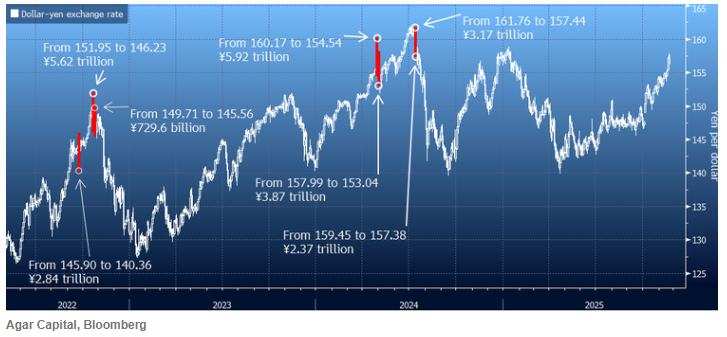
In terms of exchange rates, $USD/JPY (USDJPY.FX)$The exchange rate is still fluctuating around 155, nearing the 160 mark where Japan's Ministry of Finance has historically intervened. Although the ruling Liberal Democratic Party’s overwhelming victory eliminated political risks, ironically, it has opened the door for further yen depreciation – the market is convinced that Japan’s fiscal spending, debt levels, and yields on Japanese government bonds will rise in tandem, while the interest rate differential between the US and Japan continues to favor the dollar.
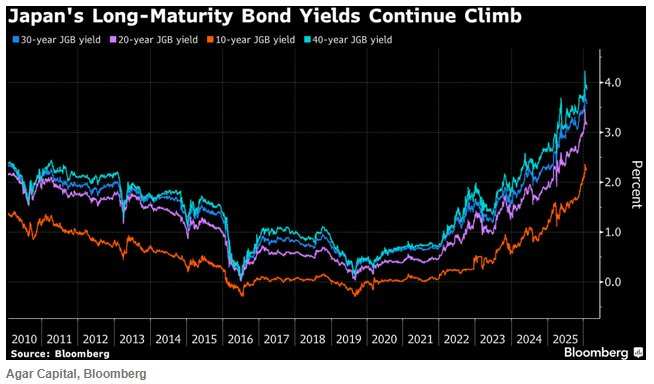
Signs resembling the 2022 UK gilt sell-off have begun to emerge in Japan’s long-term government bond market. Back then, the UK government’s fiscal plan lacked credibility and was rejected by the bond market, leading to a spike in yields. While the situation in Japan is currently less severe, the logic is similar:$Japan 30-Year Treasury Notes Yield (JP30Y.BD)$、 $Japan 40-Year Treasury Notes Yield (JP40Y.BD)$Bonds faced substantial sell-offs as investors worried about the government's plans to cut consumption tax (on items such as food) without clear measures to offset the resulting budget deficit.
Yen Carry Trade
It is certain that the yen is no longer just an ordinary currency. Over the past decade, it has consistently served as the 'cheap fuel' for global investors to finance purchases of dollar-denominated assets.
The interest rate differential between the US and Japan has created carry trade opportunities: borrowing yen at extremely low cost, converting it into dollars, and using the proceeds to purchase higher-yielding assets such as US Treasuries, corporate bonds, the S&P 500 index (ETFs), high-yield bonds, and private credit, thereby earning interest spreads while hoping that the yen does not unexpectedly appreciate significantly.
However, the primary risk of the yen carry trade lies in the fact that if the yen appreciates sharply, investors will need more dollars to buy back yen to repay their debts when unwinding positions, and the exchange costs could directly erode or even wipe out their gains.
Therefore, once fluctuations in the yen disrupt the strategy, the only action for investors is to sell dollar assets financed with yen.
This is why Japan’s situation requires close attention – when risk sentiment is tense, it has the potential to trigger significant impacts.$S&P 500 Index (.SPX.US)$The more stable the Japanese Prime Minister’s power and the greater the policy flexibility, the higher the risk of global investors unwinding carry trades, which could lead to market shocks.
Three Key Scenario Outlooks
Based on the above analysis, SeekingAlpha analyst Agar Capital outlined the following three key scenario assumptions.
Scenario One: Moderate Reflation (Base Case)
Under this scenario, Japan's Ministry of Finance will implement moderate but sustained fiscal stimulus, while the Bank of Japan gradually raises interest rates, and consumption tax may be reduced. Agar Capital expects the yen to fluctuate within the range of 155–165, with Japanese government bond yields relatively high but manageable. Supported by nominal growth and corporate governance reforms, Japan's stock market will continue to outperform.
Scenario Two: Bond Vigilantes 2.0
After the ruling coalition secures an absolute majority, the prime minister implements tax cuts, but the scale and duration exceed expectations, with rapid expansion in defense spending and no clear offsetting measures. The bond market will not easily accept these policies; risks in super-long Japanese government bonds will be repriced, with yields potentially exceeding 4%, and term premiums widening. Rating agencies and the U.S. government (concerning imbalances and exchange rates) are expected to adopt a harsher tone.
Agar Capital stated that this is not the base case, but represents the worst tail risk—it has a low probability of occurring, but its impact would be extremely severe if it does.
Scenario Three: Yen Shock and Carry Trade Unwinding
In the third scenario, the Bank of Japan and the government gradually adopt a more hawkish stance, increasing the frequency of interest rate hikes, and even the U.S. Treasury releases signals.
If the market detects a policy shift, the yen may surge by 10%-15% within two to three months. The unwinding of carry trades is never an orderly retreat but rather a priority sell-off of the most liquid assets.
This risk will not be confined to Japan but will spread globally. In times of high market leverage and rising risk aversion,$S&P 500 Index (.SPX.US)$risky assets often experience sharp declines; conversely, defensive assets and long-duration instruments become safe havens – not because they are risk-free, but because the core objective of investors at this point is self-preservation rather than profit-seeking.
Agar Capital concluded by stating that the core issue in the current market is: how quickly will Japan's Ministry of Finance increase fiscal leverage, and when will it trigger the 'red line' in the bond market—the same red line that ultimately brought down former UK Prime Minister Truss, which has now been repeatedly compared in Japan.
Editor/Melody