
After Sanae Takai's election victory, she adopted a restrained stance on reducing the consumption tax and emphasized that no new bonds would be issued to cover expenditure gaps, easing market concerns over fiscal deterioration.
The high yields of long-term bonds attracted funds to replenish long positions, improving sentiment in the bond market. Analysts noted that the downward trend in ultra-long Japanese government bond yields 'may persist for some time.' Bloomberg pointed out that how to fill the funding gap remains a key focus if tax cuts are implemented.
Japanese ultra-long-term government bonds continued to strengthen after the general election, as Saeko Takamichi's cautious remarks on the plan to cut food consumption tax eased investors' concerns about fiscal policy, driving yields further down.
 According to a Bloomberg report,$Japan 40-Year Treasury Notes Yield (JP40Y.BD)$fell by 10 basis points,$U.S. 30-Year Treasury Bonds Yield (US30Y.BD)$dropped by 9.5 basis points, retreating to levels close to early January, continuing the post-election rebound.
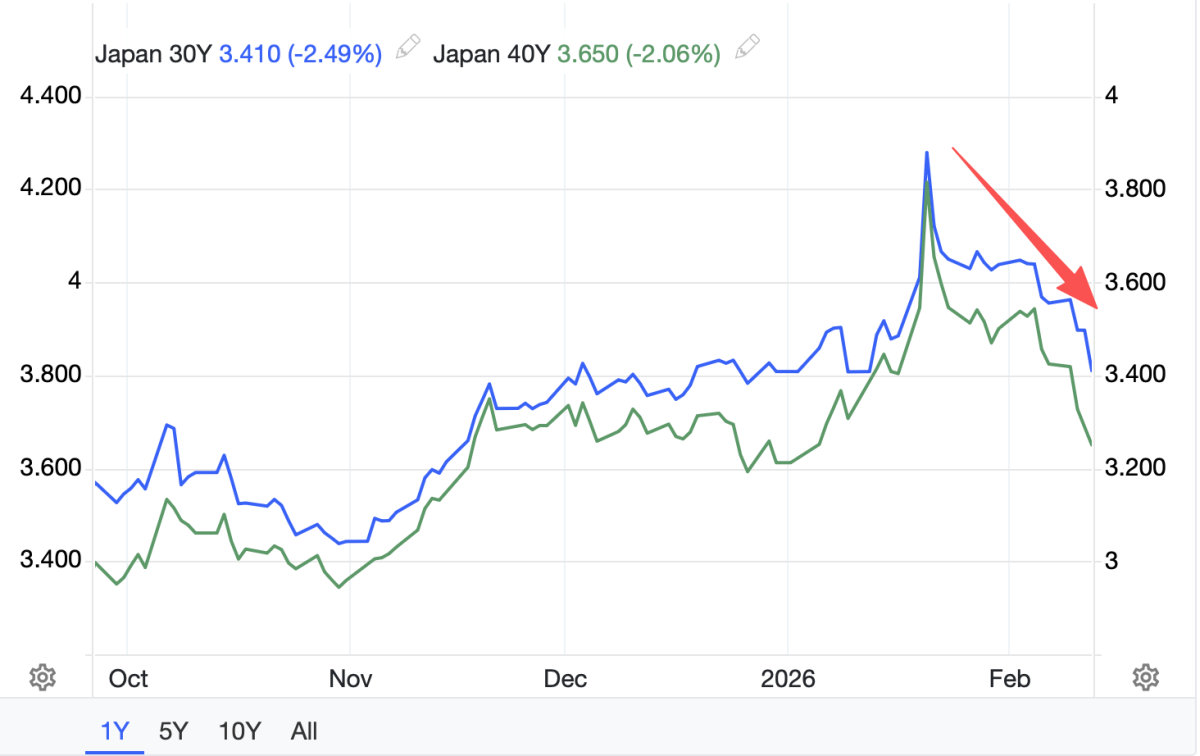
The key to market reaction lies in Saeko Takamichi's latest statement. During her first press conference after the election victory, she mentioned the market's attention on a two-year plan to reduce food consumption taxes and discussed the goal of increasing defense and strategic industry expenditures but did not make a strong commitment to cutting food consumption taxes, easing bond market concerns about fiscal sustainability.
Meanwhile, the yen has strengthened against the US dollar for three consecutive trading days this week, but Atsushi Mimura, Japan’s top foreign exchange official, stated on Thursday that the government remains vigilant. While investor sentiment has improved, the market is still assessing how the funding gap will be 'sustainably' addressed if tax cuts are implemented without issuing additional bonds.
Ultra-long-term yields retreat, with the post-election rebound continuing.
In previous weeks, concerns about fiscal sustainability had triggered significant volatility in ultra-long-term government bonds. Bloomberg reported that as yields retreated to levels close to those in early January — when news of Saeko Takamichi's surprise election bid was first reported — the market's pricing of 'tail risks' began to converge.
This round of declines was concentrated in the long-end segment,$Japan 40-Year Treasury Notes Yield (JP40Y.BD)$and$U.S. 30-Year Treasury Bonds Yield (US30Y.BD)$reflecting capital flowing back into longer-duration instruments that are more sensitive to fiscal expectations.
More restrained policy signals ease concerns about tax cuts and bond issuance.
Bloomberg noted that one interpretation of the bond market's reaction to Saeko Takamichi's election victory is that the political outcome may lead to a clearer policy path, thereby reducing the likelihood of fiscal policy moving toward extreme scenarios.
In terms of her statements, Saeko Takamichi acknowledged market concerns about cutting food consumption taxes while emphasizing that the Ministry of Finance would not cover expenditure gaps by issuing new bonds. Instead, it would review subsidies, special tax systems, and non-tax revenues to identify what she termed 'sustainable' funding sources.
Her lack of a strong commitment to reducing the food consumption tax has also been seen by the market as a signal to alleviate the pressure from new supply in the short term.
Institutional Viewpoint: High yields attract position recovery, and the downward trend in interest rates may continue.
Ryutaro Kimura, Senior Fixed Income Strategist at AXA SA Sponsored ADR, stated that the absence of a firm commitment by Sonoko Takagi to cut the food consumption tax has given bond investors 'a strong incentive to restore long-dated Japanese government bond long positions.'
These bonds had previously offered 'historically high yields.' He also noted that the downward trend in ultra-long-term interest rates 'may persist for some time.'
This perspective aligns with market movements, indicating that after marginal relief in policy uncertainty, funds are more willing to replenish long-end positions that were previously reduced due to volatility.
Tail risks remain: If tax cuts proceed, how will funding gaps be addressed?
Despite improving market sentiment, Bloomberg notes that investors remain alert to the possibility of renewed market volatility.
The reason is that even without issuing additional bonds to cover the shortfall, if the government aims to reduce sales taxes without increasing debt, alternative funding sources may still be necessary. The feasibility of such arrangements will continue to influence the pricing and fluctuations of subsequent ultra-long-term government bonds.
Editor/Melody