
During the Spring Festival in 2026, China's consumer market sent positive signals: the repair of household balance sheets drove structural recovery, high-income groups showed strong spending intentions, and AI tools were deeply integrated into daily life. The appreciation of the renminbi breaking through the 6.9 threshold increased risk appetite but also exacerbated profit divergence among enterprises. Rising upstream costs are forcing industries to deflate bubbles, and companies with pricing power and high-quality experiences will become more investment-worthy.
As the Spring Festival of 2026 approaches, China's consumer market is showing some positive signals. From the recent wave of flagship model releases in the domestic Internet and AI industries to the Renminbi breaking through the 6.9 mark on the 12th, the market is observing consumer sentiment and corporate pricing power during this crucial window.
Based on JPMorgan’s strategy framework around the Spring Festival and Bank of America’s latest consumer survey, the market is trading on three key themes: structural recovery in consumption, shifts in risk appetite due to a stronger Renminbi, and the redistribution of profits driven by rising upstream costs. These three themes are not contradictory but will make stock-picking logic in 2026 more 'refined.'
 Notably, this report also disclosed the usage of AI among Chinese consumers: 39% of respondents use AI tools multiple times per week, and 24% use them daily, primarily for shopping advice and itinerary planning. Over a third of users reported saving 3-5 hours per week, while another 32% save 6-10 hours.
Consumption: 'A More Rational Upgrade'
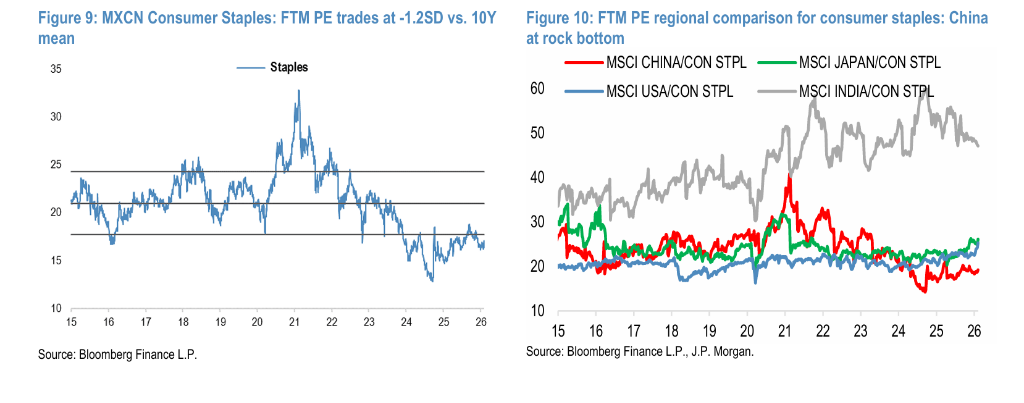
JPMorgan defines one of the Spring Festival trading themes as an 'upside option for consumption,' with the core assessment being that household balance sheets have been improving since peaking in the first half of 2021. Household leverage has fallen to slightly below 60% (GDP basis), indicating that the ability to consume remains intact, but consumer psychology has become more pragmatic—willing to pay for 'quality' and 'reliable experiences' while exercising greater caution toward discretionary impulse purchases.
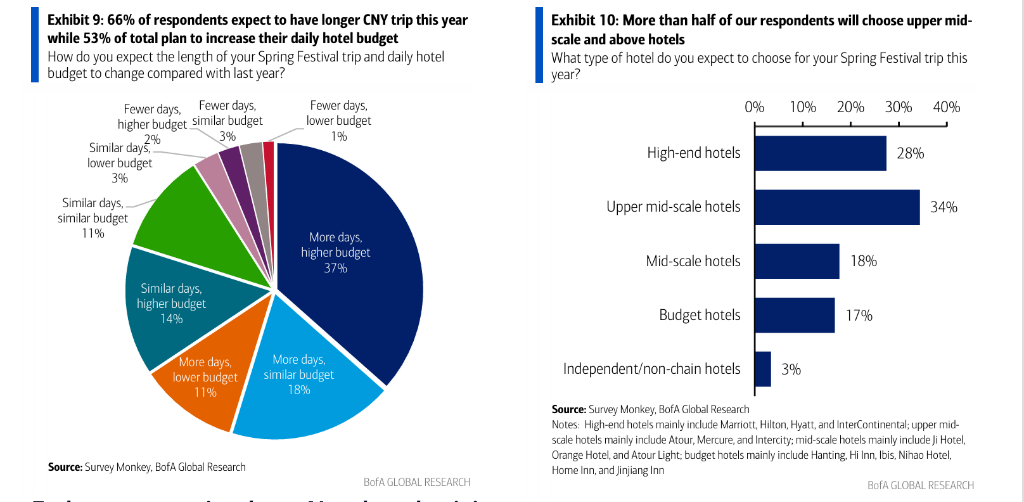
This aligns with Bank of America’s survey findings: in February, 45% of respondents reported increased outings and spending over the past two months (compared to 38% in December), and 49% expect to increase spending over the next six months (versus 30% in December). However, Bank of America emphasized that much of this improvement stems from seasonal factors related to the approaching Spring Festival and the boost in service consumption and travel brought by this year’s nine-day holiday.
More notably, the 'segmentation' of consumption continues. Bank of America noted that the incremental willingness to spend during the Spring Festival mainly comes from high-income groups: among those earning over 500,000 yuan annually, 76% expect their Spring Festival spending to increase, compared to only 44% of low-income groups. This suggests that for businesses, pursuing both premiumization and cost-effectiveness will become a more realistic market structure: companies that can capture 'premium upgrades' will see faster improvements in revenue quality.
The goods and scenarios where JPMorgan cited consumers being 'willing to spend' during the Spring Festival are quite typical: high-end smartphones, baijiu, premium food and beverages, gold and jewelry, and travel. For example, $Kweichow Moutai (600519.SH)$ Wholesale prices rebounded before the festival (data cited by JPMorgan shows that the wholesale price of 53-degree Feitian Maotai rose from approximately 1,495 yuan per bottle in mid-December to about 1,710 yuan per bottle by the end of January), reflecting the concentrated release of gifting and banquet demand as well as supply-side adjustments.
Travel and Services: Strong short-term certainty, but beware of high base effects
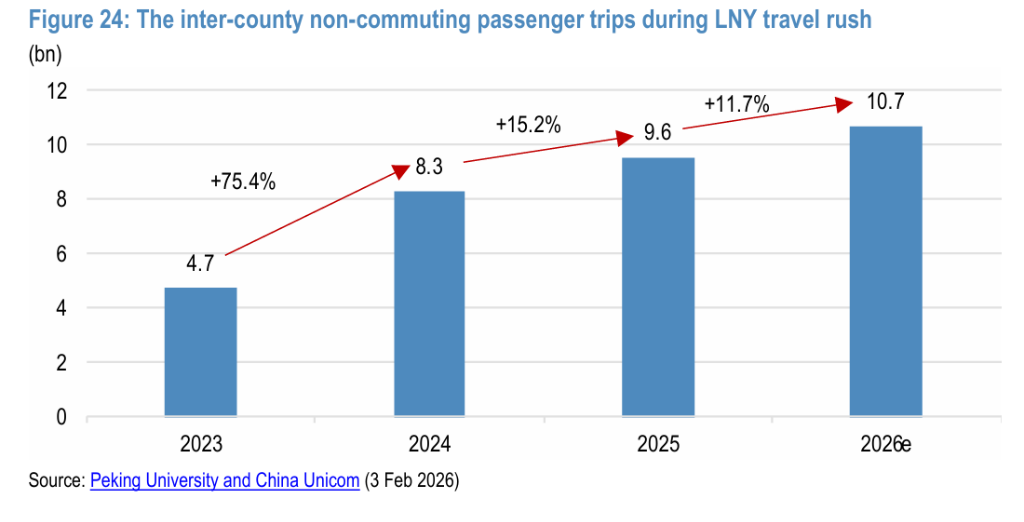
If the recovery in goods consumption is more 'structural,' then the most predictable aspect of service consumption remains travel. According to a Bank of America survey, intentions for Spring Festival travel have increased across the board: plans for domestic short trips rose to 36% (from 25% in February last year), and plans to visit Hong Kong and Macao rose to 21%. JPMorgan also cited institutional forecasts indicating that inter-county non-commuting travel during the Spring Festival migration might reach 10.68 billion trips (+11.7% year-on-year).
However, service consumption is not 'unidirectionally upward.' JPMorgan provided a more cautious forecast for the Spring Festival box office: with a high base in 2025 and the absence of blockbuster hits, the 2026 Spring Festival box office may experience a slight year-on-year decline. This serves as a reminder to the market that the 'long holiday dividend' has a more direct impact on travel, but for substitutable consumption such as online entertainment, marginal elasticity may not be equally strong.
Renminbi: Favorable winds for risk appetite, but highly divergent impacts on profitability
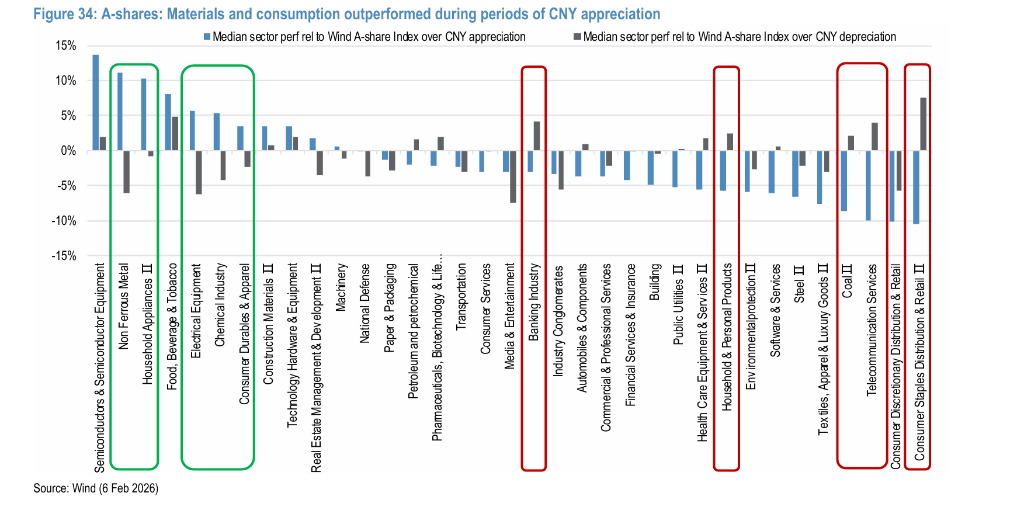
A key observation by JPMorgan is that the strengthening of the renminbi often corresponds to a decline in the risk premium of Chinese assets, historically creating favorable conditions for Chinese equities, particularly benefiting growth and cyclical sectors. Its statistics show that, since the end of 2016, during multiple periods when the renminbi appreciated significantly against the US dollar, the MSCI China Index saw considerable average gains.
More importantly, JPMorgan set the 2026 trajectory for the renminbi as 'moderate appreciation.' Under this assumption, two layers of market impacts would emerge:
Valuation level: A more stable exchange rate expectation would help restore foreign capital’s willingness to allocate to renminbi assets, typically reflected first in relative gains in high beta sectors.
Profitability level: Differences among industries and companies would be rapidly magnified. JPMorgan identified airlines as typical beneficiaries due to significant profit elasticity from US dollar liabilities and aviation fuel costs; conversely, manufacturing chains with high export exposure, thin margins, and price sensitivity would face more pressure.
This is why JPMorgan emphasized that 'stock selection becomes more granular': faced with renminbi appreciation and rising costs, some companies can pass these on (e.g., certain Apple supply chains, automation, power batteries), while others are more easily squeezed (JPMorgan highlighted pressures concentrated in automobiles, consumer electronics, and home appliances).
Rising costs: A re-audit of 'pricing power' is underway
Entering 2026, one variable different from 2025 is that price increases in metals, chips, and materials are becoming more 'systematic.' JPMorgan listed increases in copper, aluminum, lithium salts, and DRAM, pointing directly to cost pressures on the manufacturing sector. For the market, this would trigger a repricing of corporate earnings quality: those with pricing power, product upgrades, overseas layouts, and hedging capabilities are more likely to maintain profit margins.
What is noteworthy is the 'rational upgrade' on the consumer side and the 'cost reflation' on the supply side: on one hand, consumers are paying more attention to quality and experience, willing to pay for certainty; on the other hand, rising upstream costs make it harder for business models based on 'low-price competition' to sustain. The combination of these two factors may lead to a relatively positive outcome: if 'quality-oriented' consumption extends to high-frequency categories (food, condiments, dairy products, etc.), JPMorgan believes this could provide potential support for CPI, nominal growth, and corporate EPS – a variable that might have been underestimated in the low-inflation environment of recent years.
Comprehensive assessment: After the Spring Festival, the market needs to address three key questions.
Combining the perspectives of the two institutions, the Spring Festival provides more of a 'window period for sentiment and data' rather than the endpoint of macro narratives. What the market truly needs to verify after the festival may be three things:
Whether the recovery in consumption can extend from being driven by the 'long holiday effect' to 'normalized upgrading' (high-frequency data to observe subsequent trends in catering, hotels, and travel; on the corporate side, watch for price increases and new product rollouts).
Whether the stronger-than-expected RMB can bring about a sustained improvement in risk appetite and the continuity of foreign capital inflows.
Under rising costs, whether the divergence in corporate profits will exceed expectations – especially in industries like automobiles, consumer electronics, and home appliances, which are both highly competitive and material-intensive. The market may quickly revise downward its earnings forecasts.
From an investment perspective, JPMorgan tends to position itself around the upside options of 'consumption + services' before and after the Spring Festival, emphasizing more refined selections centered on pricing power. Meanwhile, Bank of America's survey highlights a more pragmatic backdrop: consumption is improving but still reflects significant stratification and a relatively cautious approach to asset allocation. This determines that the narrative around China's assets in 2026 is likely to be one of 'moderate recovery + structural differentiation,' rather than a comprehensive rally driven by a single variable.
Editor/Doris