
Investor concerns over 'excessive investment' in AI and its negative externalities have intensified, pressuring stocks related to SaaS and private credit. Meanwhile, consumer confidence among the affluent segment in the U.S., defined as those with annual incomes exceeding $100,000, has deteriorated significantly, signaling downside economic risks. Coupled with weaker-than-expected CPI data in January, capital is flowing out of risk assets and into the U.S. Treasury market, driving yields lower since the start of the year.
As cracks emerge in the narrative of AI investment returns, investors are beginning to retreat and pivot towards embracing US Treasuries.
According to ZF Trading Desk, a research report released by Morgan Stanley's US interest rate strategy team on February 13 indicated that market indicators have shifted. Amid an increasingly swelling wave of AI investments and elevated market valuations, investors are pulling back from risk assets and turning to US Treasuries as a safe haven.
 In the report, while Morgan Stanley raised its forecast for US real GDP growth in 2026 from 2.4% to 2.6%, citing capital expenditure by 'hyperscalers' as a driver of growth, its economics team simultaneously issued a stern risk warning.
Morgan Stanley pointed out that this growth does not come without costs. The logic is clear:
"The more the AI-related capital expenditure cycle drives economic activity, the greater the risks posed by an overinvestment cycle if returns ultimately fail to materialize."
The market has evidently grasped this logic. Investors are becoming increasingly sensitive to the negative externalities of the AI investment cycle and are no longer blindly chasing high valuations. As Morgan Stanley strategists noted:
"Investors have grown weary of new narratives attempting to justify extremely risky asset valuations, leading to a diffusion of market styles and a shift towards US Treasuries, which has driven yields lower since the start of the year."
AI Narrative Fatigue Pressures SaaS and Private Credit
Cracks in the market have become apparent. While the S&P 500 index has repeatedly reached new highs, companies whose business models have been 'disrupted' by the AI wave (AI Disrupted Stocks) have already started to collapse.
Morgan Stanley constructed a basket of 108 stocks impacted by AI. Data shows that these stocks had already decoupled from the broader market by the end of last year and continued to decline even as the broader market reached new highs.
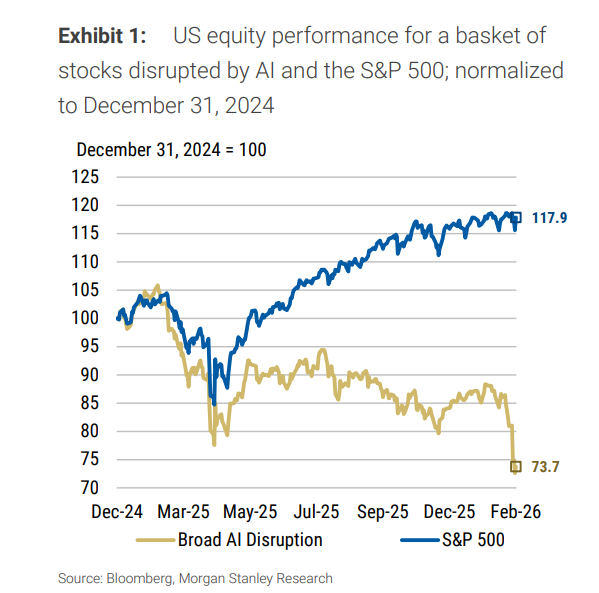
This divergence sends a dangerous signal: the narrative surrounding AI optimism may have already peaked.
In addition to directly affected stocks, the Software-as-a-Service (SaaS) sector is also under significant pressure, while a more concealed risk lies in Private Credit. Morgan Stanley warns that due to the opaque and lagging fundamental indicators of Private Credit portfolios, the stock price performance of alternative asset management companies with Private Credit exposure in the public market has become a real-time barometer of risk.
Data shows that a basket comprising seven key alternative asset management firms faced immense downward pressure earlier this year. The market is voting with its feet, avoiding the potential credit default risks stemming from excessive AI investment.
The 'wealthy' are also panicking: A warning sign of an asset bubble burst?
The weakness in the stock market is spilling over into confidence levels in the real economy, particularly among high-income groups.
Morgan Stanley observed that the upper-income group, who are the main drivers of consumption (with annual incomes exceeding $100,000), has undergone a significant shift in their view of the current economic situation since the beginning of this year.
“Although starting from a higher level compared to the end of 2021, this shift in sentiment closely resembles what occurred at the beginning of 2022—when the U.S. economy subsequently experienced two quarters of negative growth.”
Why is there a decline in confidence among high-income groups? The direct cause points to fluctuations in asset prices. Economists at Morgan Stanley believe that “the bursting of an asset investment bubble will pose a greater risk to the economy.”
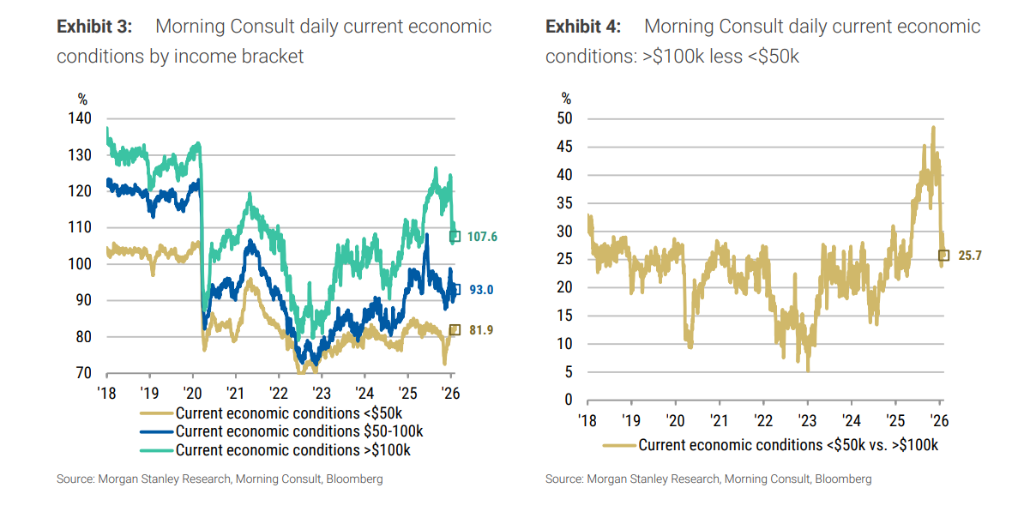
When the wealthy begin tightening their belts, it is typically one of the best leading indicators of an economic recession. In such an environment, U.S. Treasuries have once again become the best asset class for hedging against recession risks. The strategy team at Morgan Stanley stated outright:
“We believe that, as the market-implied policy rate still reflects little downside risk premium, U.S. Treasuries appear quite attractive as a safe-haven tool.”
Inflation surprises on the downside, making US Treasuries the best hedge.
If concerns about an AI bubble represent the long-term rationale for buying US Treasuries, the latest inflation data serves as the immediate catalyst.
January CPI data came in universally below expectations, dealing a significant blow to the persistent inflation narrative:
Overall CPI rose 0.17% month-over-month, lower than economists' forecast of 0.27%.
Core CPI increased by 0.30% month-over-month, slightly below the expected 0.31%.
Even more noteworthy is the underlying data after excluding extreme volatility. The trimmed mean CPI and median CPI released by the Cleveland Fed both grew by only 0.19% in January.
“These readings are the lowest for the same period since 2021. Given that January is typically the strongest month for month-over-month data in the calendar year, we believe this unexpected decline will weigh heavily as investors assess inflation data for the entire year.”
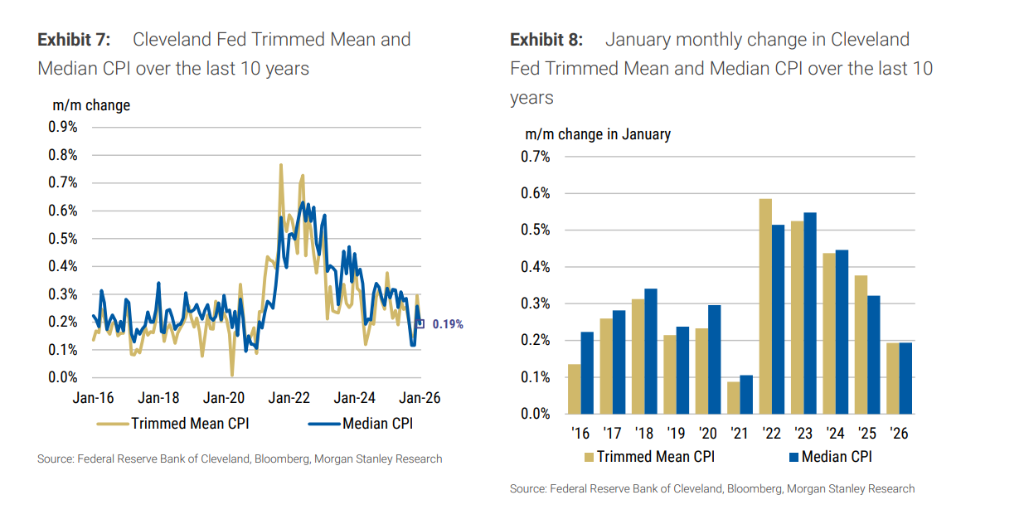
The weak inflation data directly reshaped market expectations for Federal Reserve policy. Markets reacted swiftly, with traders beginning to price in a lower terminal rate. Current market pricing suggests 21 basis points of rate cuts by the June meeting and a cumulative 62 basis points of cuts by the end of 2026.
Morgan Stanley believes that the retreat in inflation expectations will allow the Fed to further ease its policy stance to prevent real interest rates from becoming excessively restrictive. This implies that US Treasury yields still have room to move lower.
Meanwhile, the Federal Reserve’s bill purchases are also providing liquidity support to the market. In the past 14 operations, the Fed purchased $109.2 billion worth of bills, with each operation reaching maximum scale (100% absorption rate), maintaining an accommodative environment in the funding market and further benefiting short-term US Treasuries.
Editor/Lambor