
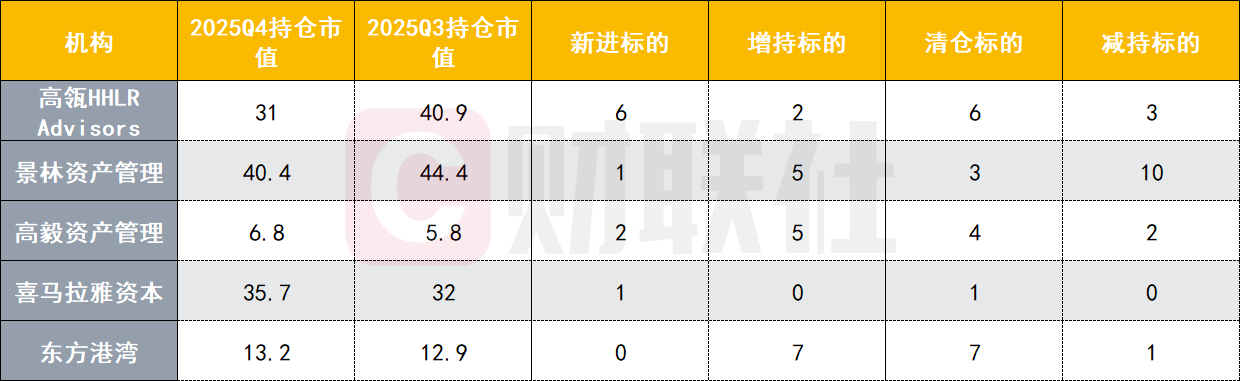
In the fourth quarter of 2025, the US stock holdings dynamics of five leading Chinese investment firms—Hillhouse, Jinglin, Gaoyi, Oriental Harbour, and Himalaya Capital—showed that PDD Holdings was collectively increased in position, becoming the largest consensus across institutions. Additionally, Google replaced NVIDIA as the new investment core for multiple institutions, indicating a shift among major investment firms from a focus on "computing power enthusiasm" to "application and platform certainty" in the AI sector.
Cailian Press reported on February 20 (edited by Liu Rui) that with the conclusion of the SEC's 13F filings for Q4 2025, the US stock holding dynamics of five leading Chinese investment institutions—Hillhouse (HHLR), Jinglin, Gaoyi, Oriental Harbour, and Himalaya Capital—have come to light.
Against the backdrop of marginal changes in global liquidity and differentiation within the AI industry, the portfolio adjustments of these five major institutions present the distinct characteristic of "coexistence of consensus and divergence": PDD Holdings (PDD.US) PDD Holdings received a collective increase in position, becoming the largest cross-institutional consensus; Google-A (GOOGL.US) replaces $NVIDIA(NVDA.US)$ became the new investment core for multiple institutions; Hillhouse achieved an extreme contraction focusing on its "dual-core" strategy, while Himalaya Capital demonstrated long-term value investing discipline through cautious operations.
 Overall, leading institutions generally chose to streamline their positions and increase portfolio concentration, shifting from "computing power enthusiasm" to "application and platform certainty" in the AI sector. Consumer recovery and e-commerce leaders within Chinese stocks became the core areas for capital deployment.
Hillhouse (HHLR): Extreme contraction, with the e-commerce dual-core accounting for over 60%.
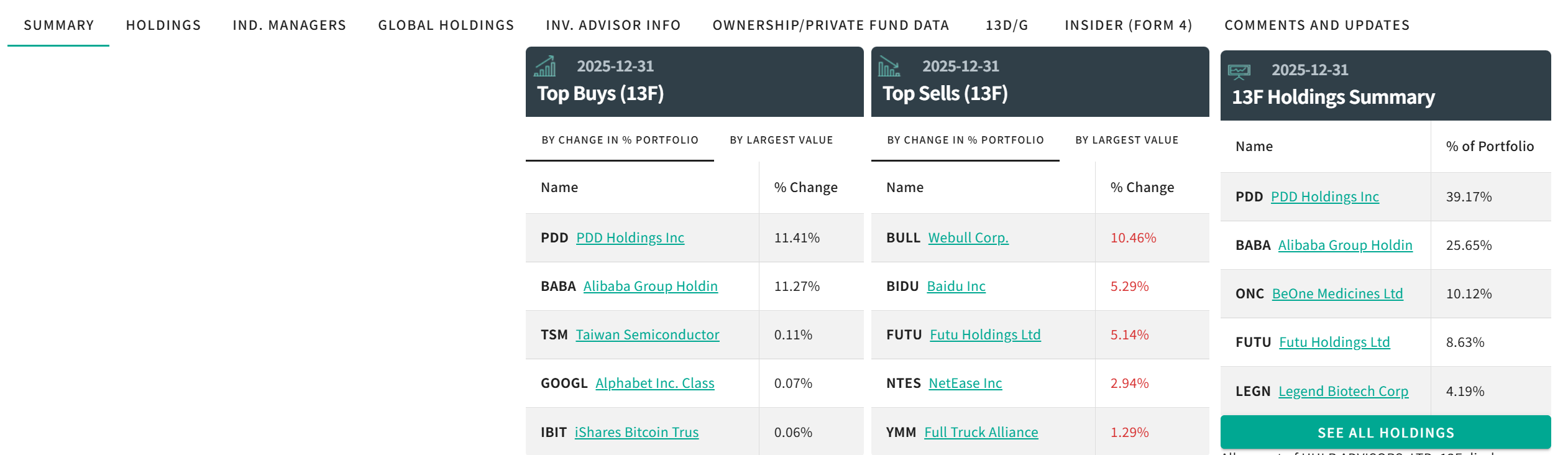
The total market value of HHLR Advisors' US stock portfolio under Hillhouse was approximately $3.104 billion in Q4, down 24% quarter-on-quarter, with holdings maintained at 33 stocks, showcasing a significant feature of "overall reduction and structural concentration." However, Chinese stocks remain the core asset allocation, accounting for 92% of the portfolio's value.
Specifically, HHLR’s portfolio adjustments in Q4 focused on leading Chinese e-commerce stocks, PDD Holdings (PDD.US) followed by $Alibaba(BABA.US)$ forming the portfolio's "dual-core," which collectively accounted for 65%. Among them, the top holding, PDD Holdings, saw a substantial increase in position, with a holding value of $1.216 billion, increasing its share from 28% to 39%; the second-largest holding, Alibaba, had a holding value of $796 million, with its proportion significantly rising from 14.4% to 26%.
The innovative drug sector continues to hold strong, $BeiGene (ONC.US)$ 、 Legend Biotech (LEGN.US) 、 $ArriVent BioPharma (AVBP.US)$ still ranks among the top ten holdings. Other key moves include increasing positions in Taiwan Semiconductor (TSM.US) , establishing a new position in $iShares Bitcoin Trust (IBIT.US)$ ; completely divesting from Baidu (BIDU.US) 、 $NetEase (NTES.US)$ 、 $Full Truck Alliance (YMM.US)$ and other non-core Chinese concept stocks. Among the top ten holdings, Chinese concept stocks occupy seven seats, with a market value proportion as high as 92%, further strengthening the allocation status of core Chinese assets.
Jinglin Asset Management: Google tops the list as the largest holding, NVIDIA's position cut by more than 60%
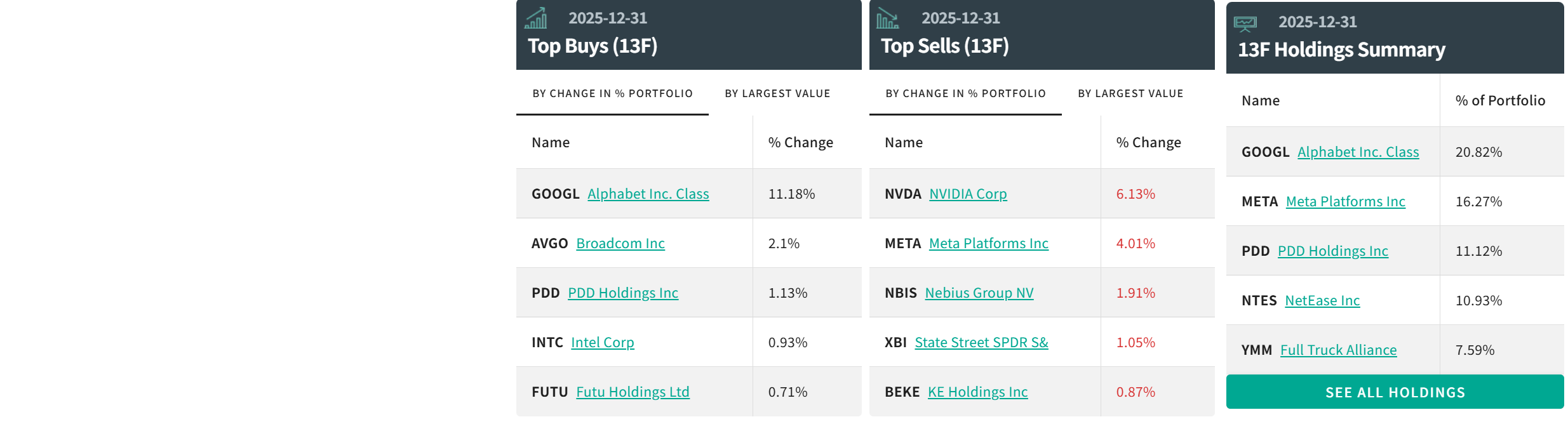
Jinglin Asset Management (Hong Kong) Co., Ltd.'s total U.S. stock portfolio value for the fourth quarter was $4.045 billion, down 8.92% quarter-on-quarter, with significant changes in the portfolio structure.
The most significant change comes from the rotation of technology leaders: Google-A (GOOGL.US) replaces $Meta Platforms(META.US)$ became the largest holding, with an increase of 929,700 shares to approximately 2.69 million shares, representing a market value of $842 million and accounting for 20.82% of the portfolio; whereas the previous AI computing leader, $NVIDIA(NVDA.US)$ , saw a substantial reduction of 1.54 million shares, with the position cut by more than 60%, reducing its market value to $156 million and its share to just 3.86%, dropping from the third-largest holding to seventh place. $Meta Platforms(META.US)$ was also reduced by 229,100 shares, falling to become the second-largest holding.
In terms of Chinese concept stocks, PDD Holdings (PDD.US) received an increase of 611,300 shares, solidifying its position as the third-largest holding, while $Alibaba(BABA.US)$ 、 $NetEase (NTES.US)$ maintained its position unchanged, reflecting continued confidence in China’s consumer and e-commerce sectors. Additionally, Jinglin newly invested in Broadcom (AVGO.US) and reduced its stake in Taiwan Semiconductor (TSM.US) 、 $KE Holdings (BEKE.US)$ among other positions. The top ten holdings collectively account for 82.85% of the portfolio, maintaining a high level of concentration.
Hillhouse Asset Management: Sticking to Chinese consumer stocks, Huazhu and PDD Holdings remain the top two holdings.
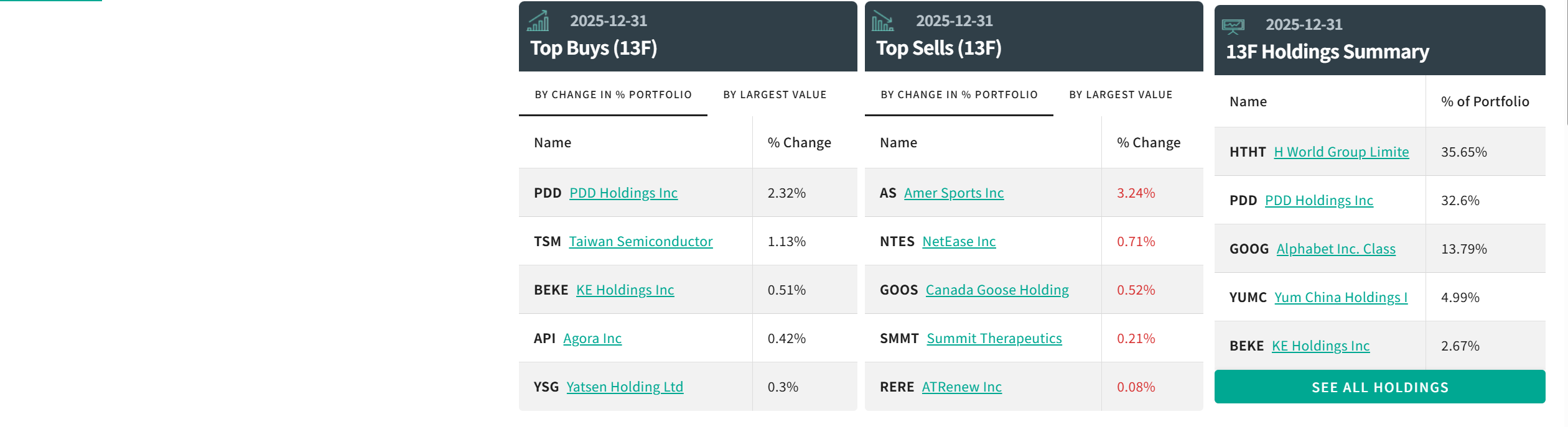
The total market value of Gaoyi Asset's overseas fund holdings in U.S. equities reached $683 million in the fourth quarter, with only 13 positions held. The top ten holdings account for over 98%, indicating a highly concentrated portfolio.
Chinese概念股 remain the absolute core of the portfolio. Huazhu Group (HTHT.US) remains the largest holding with a market value of $243 million, accounting for 36% of the portfolio. The stock surged over 20% in the fourth quarter, reflecting institutional optimism about the recovery in consumer spending. PDD Holdings (PDD.US) is the second-largest holding with a market value of $222 million. The position was increased by 629,000 shares to 1.333 million shares during the quarter, aligning with similar moves by Jinglin and Hillhouse Capital, forming a consensus on adding to the position.
Other additions include: $KE Holdings (BEKE.US)$ a 496,000-share increase in RLX Technology (RLX.US) , a 325,000-share increase iniQIYI (IQ.US). 1.41 million shares, newly added Yatsen E-commerce (YSG.US) 。 Google-A (GOOGL.US) 、 $Yum China (YUMC.US)$ and $KE Holdings (BEKE.US)$ ranked as the third to fifth largest holdings, forming a dual-core strategy of 'Chinese consumer stocks + global technology'.
Eastern Harbor Capital: Google takes the top spot, completely divested Alibaba and six other stocks, significantly increasing portfolio concentration.
The total value of overseas fund holdings managed by Butan Dong in the fourth quarter reached $1.316 billion (approximately RMB 9.1 billion), with a slight quarter-on-quarter increase. The number of holdings dropped sharply from 17 to 10, significantly raising the portfolio's concentration.
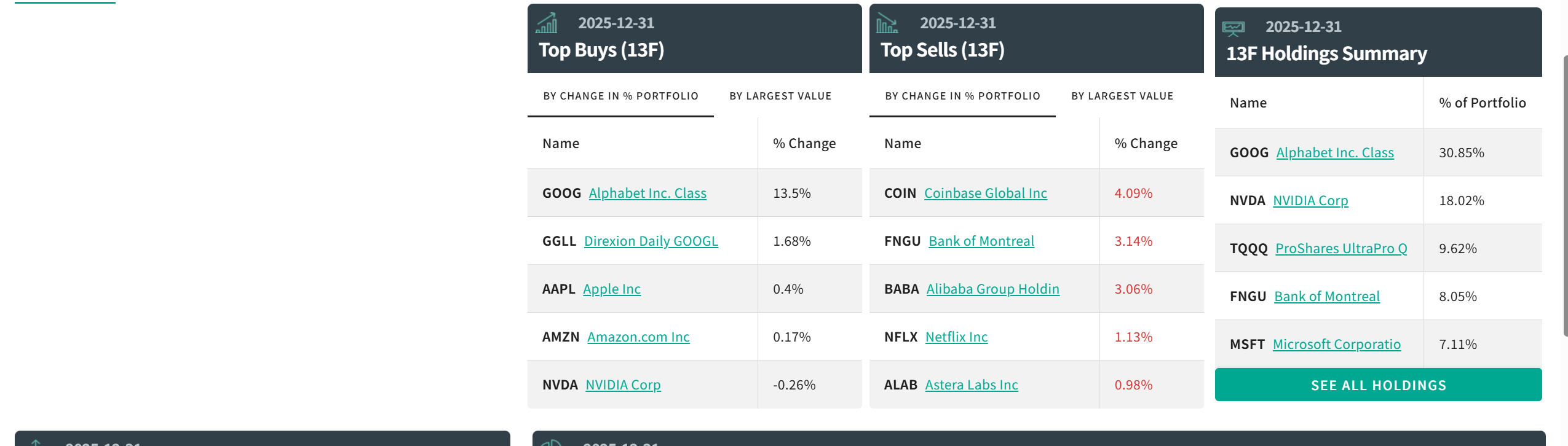
Butan Dong’s core adjustments in the fourth quarter echoed those of Jinglin: $Google-C(GOOG.US)$ replaces $NVIDIA(NVDA.US)$ became the largest holding, with a 40.55% increase in the fourth quarter. The number of shares rose to 1.293 million, combined with an approximate 29% rise in stock price, resulting in a market value of $406 million, accounting for 30.85%. NVIDIA, despite a minor increase in holdings, dropped to second place with a market value of $237 million, representing 18.02%.
To focus on core assets, Eastern Harbor Capital liquidated $Alibaba(BABA.US)$ 、 $Coinbase(COIN.US)$ 、 $Netflix (NFLX.US)$ 、 Taiwan Semiconductor (TSM.US) seven targets across cryptocurrency assets, content platforms, semiconductors, and more. Meanwhile, they increased positions in Microsoft (MSFT.US) 、 $Apple(AAPL.US)$ 、 $Meta Platforms(META.US)$ 、 $Amazon(AMZN.US)$ major U.S. technology giants such as $ProShares UltraPro Nasdaq ETF (TQQQ.US)$ and leverage instruments such as the two-times leveraged Google ETF to enhance the portfolio's offensive positioning.
Himalaya Capital: No changes demonstrate steadfastness, with Google and Bank of America acting as 'stabilizers'
Himalaya Capital, managed by Li Lu, continued its classic style of 'long-term holding and concentrated stock positions' in the fourth quarter. While adhering to its core strategy, it optimized the structure with precision, increasing the total market value of its holdings from $3.23 billion to $3.57 billion, achieving market value growth driven by both active portfolio adjustments and rising stock prices.
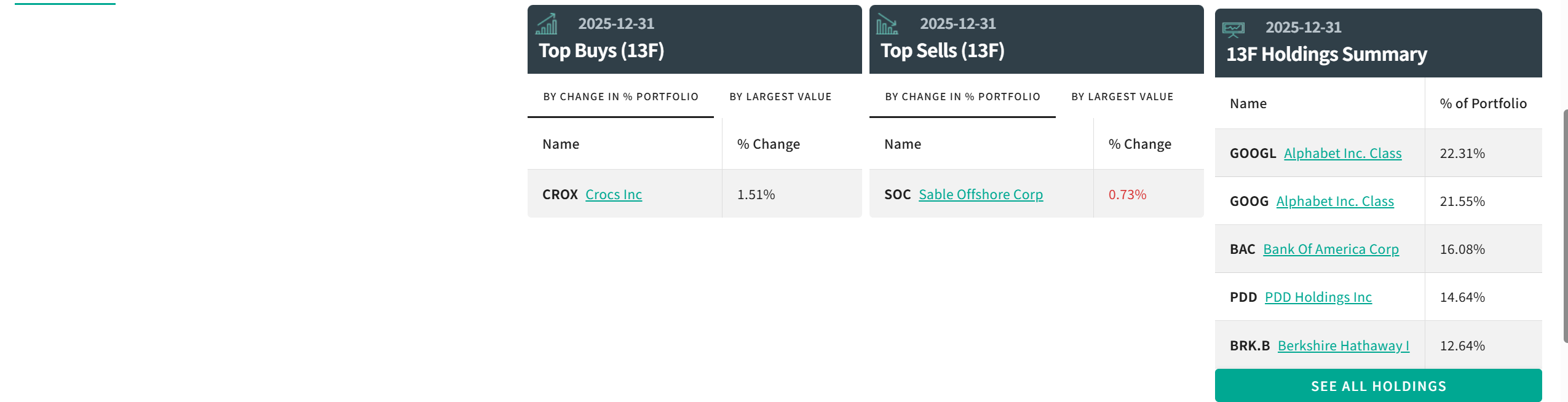
The portfolio structure remains highly concentrated, with the top four holdings ( $Google-C(GOOG.US)$/ Google-A (GOOGL.US) 、 $Bank of America(BAC.US)$ 、 PDD Holdings (PDD.US) 、 $Berkshire Hathaway-B (BRK.B.US)$ ) accounting for over 87% combined.
Among these, Google (including Class A/C shares) is the largest holding, with a market value of $1.565 billion, representing 43.86% of the portfolio.
Bank of America is the second-largest holding, with a market value of $574 million, accounting for 16.08%. Together with Berkshire Hathaway-B (accounting for 12.64%), they form the financial 'stabilizers' of the portfolio.
PDD Holdings, as the third-largest holding, maintained an unchanged number of shares, accounting for 14.64%, aligning with the consensus allocation among four other leading institutions. Occidental Petroleum (OXY.US) 、 $East West Bancorp (EWBC.US)$ Positions in stocks such as East West Bancorp remained unchanged, continuing the core framework of long-term value investing.
Li Lu's key operations in the fourth quarter focused on 'increased allocation to consumer stocks' and 'reduction in energy exposure': establishing a new position in a leading consumer company and a well-known American casual footwear brand, $Crocs (CROX.US)$ with a holding value of approximately USD 0.53 billion, accounting for 1.50% of the portfolio, betting on global consumer recovery and improvement in the company’s fundamentals; completely divesting energy-related holdings, $Sable Offshore(SOC.US)$exiting niche oil and gas exploration sectors to optimize the portfolio's risk structure.
Editor/Jayden