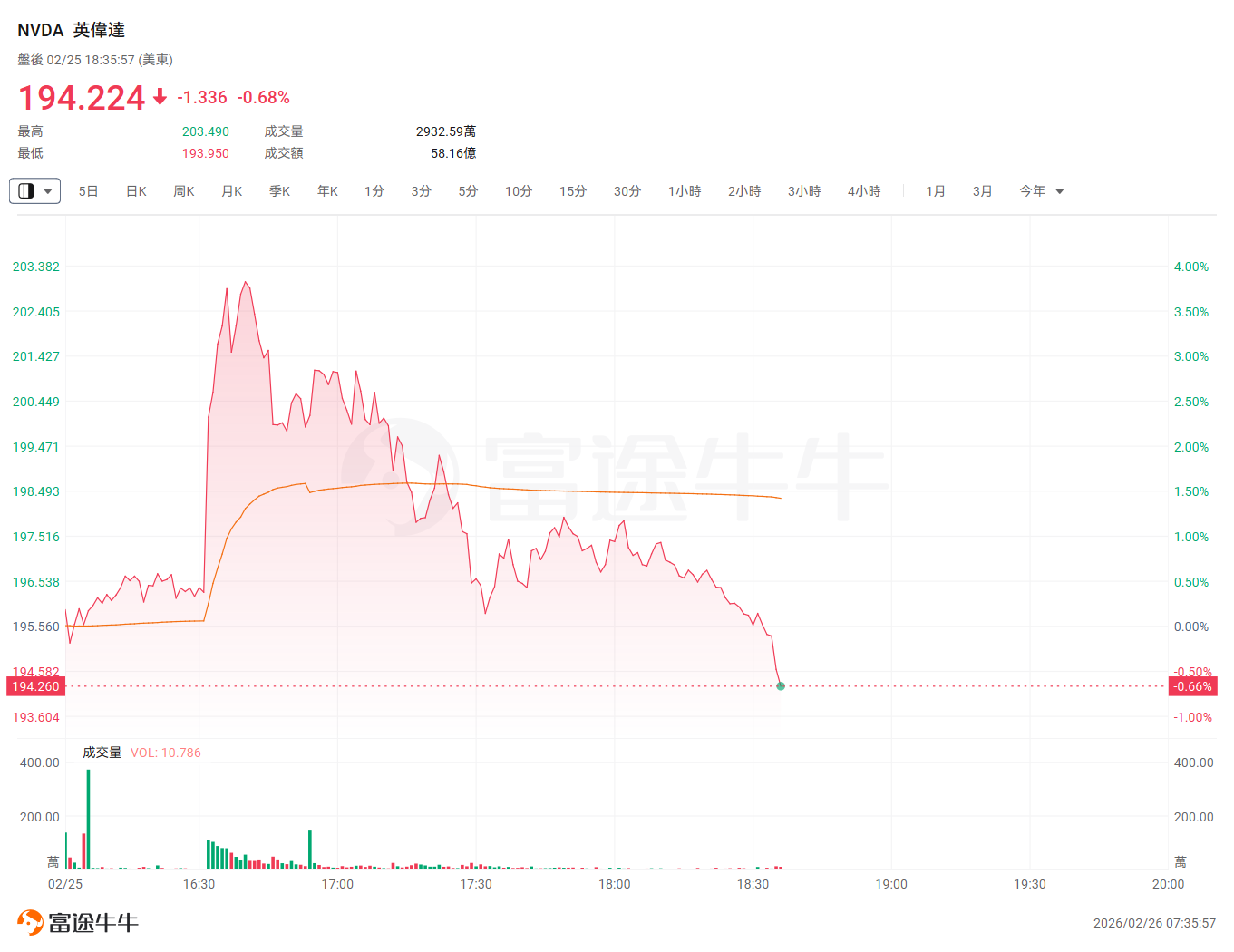
NVIDIA's total revenue and data center income in Q4 both hit record highs; driven by the ramp-up of Blackwell, gross margin exceeded 75%, reaching a new high in one and a half years; data center revenue grew by over 75% year-over-year, surpassing expectations, with network revenue surging more than 260%; gaming revenue missed expectations, declining 13% sequentially due to channel inventory impacts. NVIDIA anticipates supply constraints to be a headwind for business starting from Q1 and beyond; the midpoint of Q1 revenue guidance exceeds the most optimistic buyer expectations by 4%, with nearly a 77% increase year-over-year, excluding China's data center compute revenue; non-GAAP will incorporate stock-based compensation starting from Q1. Jensen Huang stated that computing demand is surging, with proxy applications skyrocketing, set to surpass the previously targeted $500 billion chip revenue goal. The current space data center economy remains 'sparse.' NVIDIA shares rose nearly 4% in after-hours trading but have since turned negative.
Amid a series of product releases by Anthropic and Citrini's "Doomsday Report" exacerbating investor panic, the artificial intelligence (AI) boom has withstood direct scrutiny as NVIDIA delivered a groundbreaking performance, demonstrating that AI-driven demand remains robust.
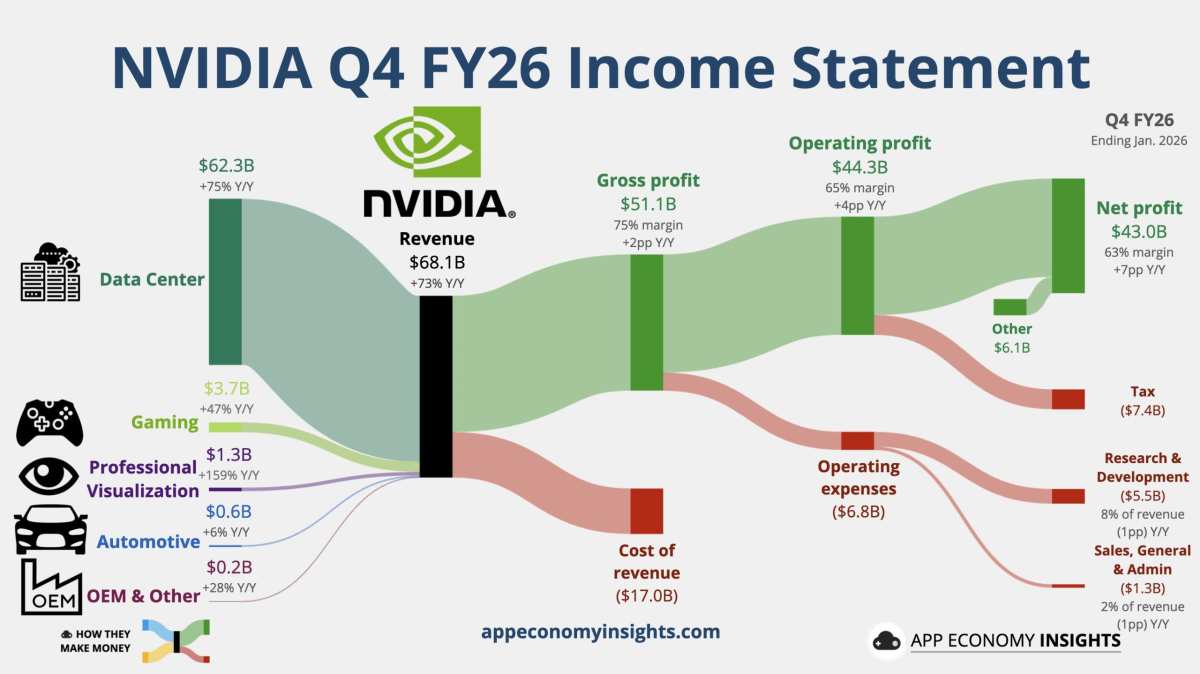
On Wednesday, January 25, Eastern Time, NVIDIA announced that for the fourth quarter of its fiscal year 2026 ending January 31, 2026, revenue reached a record $68.1 billion, increasing nearly 70% year-over-year. The core data center business, which contributes over 90% of revenue, also hit a new quarterly high, surpassing analysts' expectations by more than 3%.
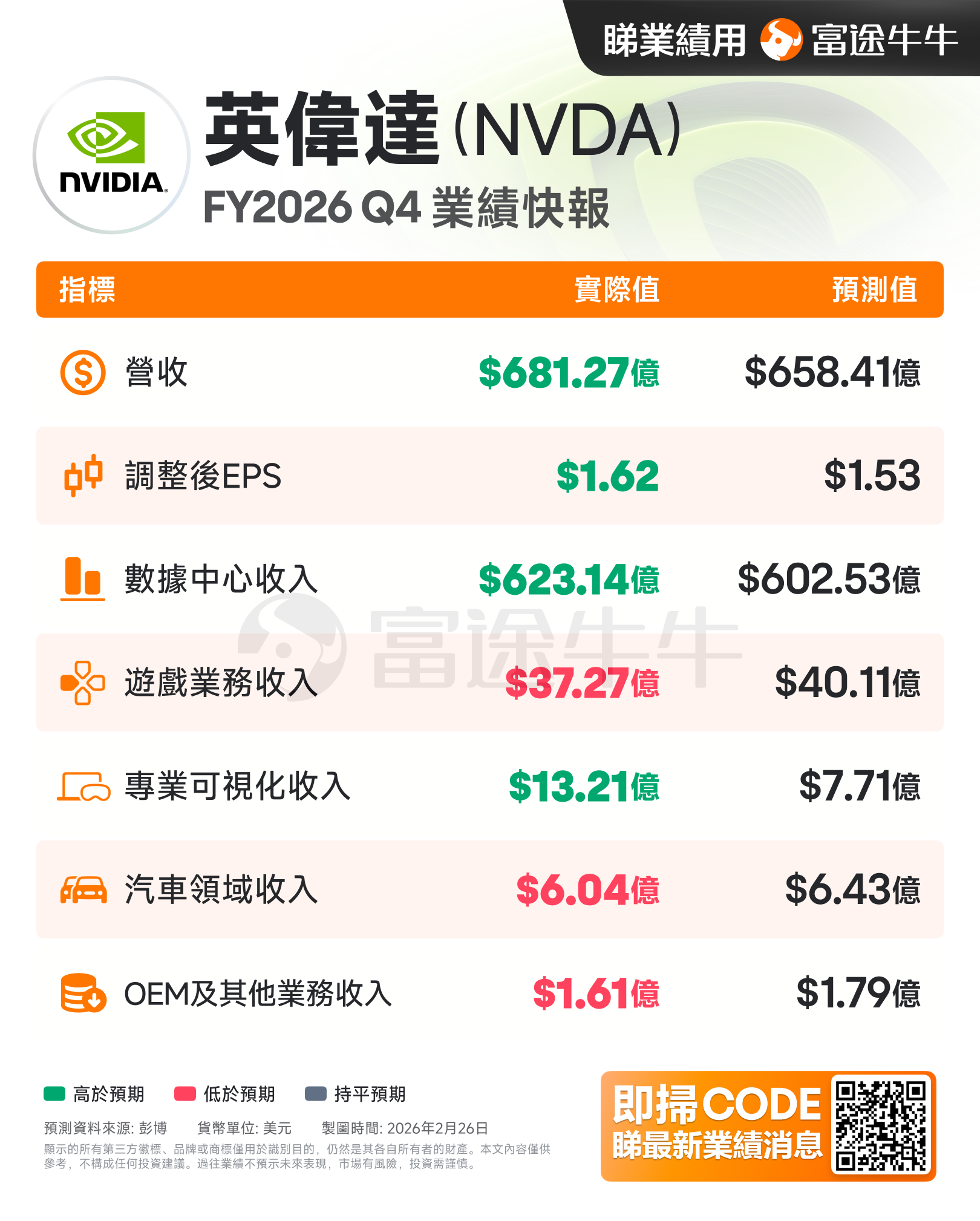
 NVIDIA’s profitability in the fourth quarter was equally strong. On a non-GAAP basis, adjusted earnings per share (EPS) surged over 80% year-over-year, exceeding analyst estimates by approximately 5.9%. Gross margin also rose above expectations to 75.2%, marking the highest level in a year and a half.
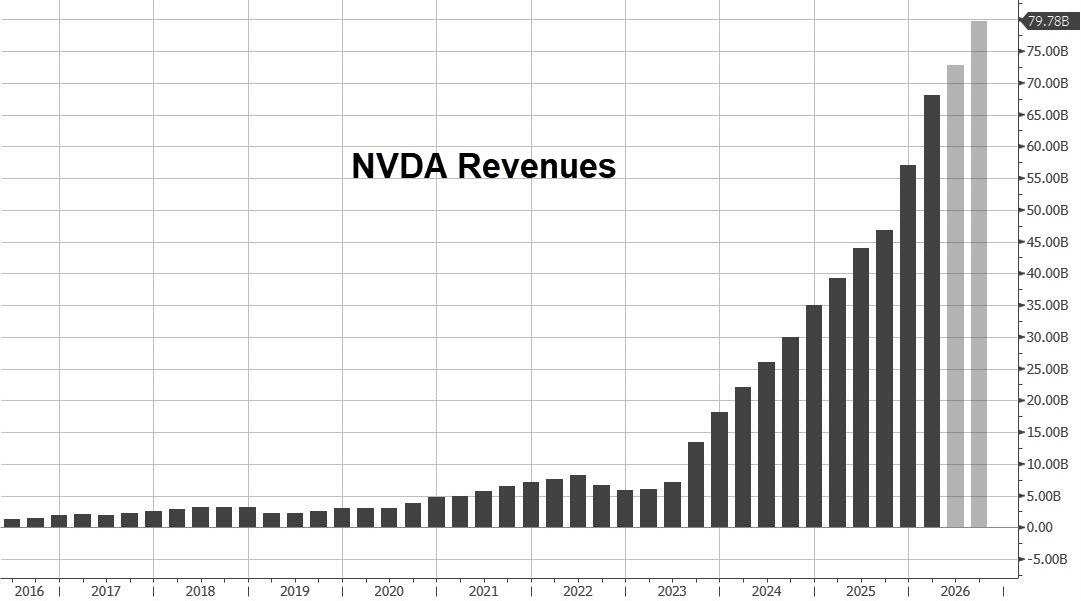
Even more encouraging for investors, NVIDIA's guidance for the first quarter of fiscal year 2027 (Q1) also beat expectations. Revenue is projected to set another record, with the midpoint of the guidance range surpassing the analyst consensus by 7.1%, and even exceeding buy-side optimistic forecasts by 4%. Year-over-year growth is expected to accelerate to nearly 77% compared to Q4. NVIDIA noted that this guidance excludes data center computing revenue from the Chinese market.
During the earnings call on Wednesday, NVIDIA CEO Jensen Huang raised his previous forecast for chip revenue, stating, “We will exceed the $500 billion target.” Supply will meet demand through next year. At the GTC conference in October last year, Huang revealed that NVIDIA had secured $500 billion worth of chip orders for the calendar years 2025 and 2026, including the next-generation Rubin chips, which are set to begin mass production this year.
Jensen Huang noted that customers are aggressively investing in AI computing, with computational demand surging rapidly. Corporate adoption of agent applications has soared. Referring to the concept of “space data centers,” he remarked that the current economics of space data centers remain “barren,” but the situation will evolve over time.
Following the earnings report release, NVIDIA's stock price, which had already closed more than 1% higher on Wednesday, surged further in after-hours trading. The after-hours gains quickly expanded, rising over 4% at one point. Analysts believe the key reason for the market's positive response lies in two aspects: data center revenue and total revenue both exceeded expectations; gross margin continued to improve with the ramp-up of production for the new architecture Blackwell chips. Moreover, despite not accounting for some income from the Chinese market, guidance for the current fiscal quarter was stronger, reinforcing the narrative of resilient demand for AI computing power.
However, during the earnings call, NVIDIA's stock price continued to pare gains and eventually turned negative in after-hours trading. Some commentators noted that the reversal into negative territory indicates investors were not impressed by the latest guidance, suggesting concerns about an overheated AI economy will continue to weigh on NVIDIA. Other analyses pointed out that sustained high growth in operating expenses, along with the inclusion of share-based compensation (SBC) in non-GAAP metrics starting from Q1, may alter investor perceptions of 'profit growth' in the short term.
Q4 Revenue Hits Quarterly Record High, Gross Margin Reaches Highest Level in 18 Months
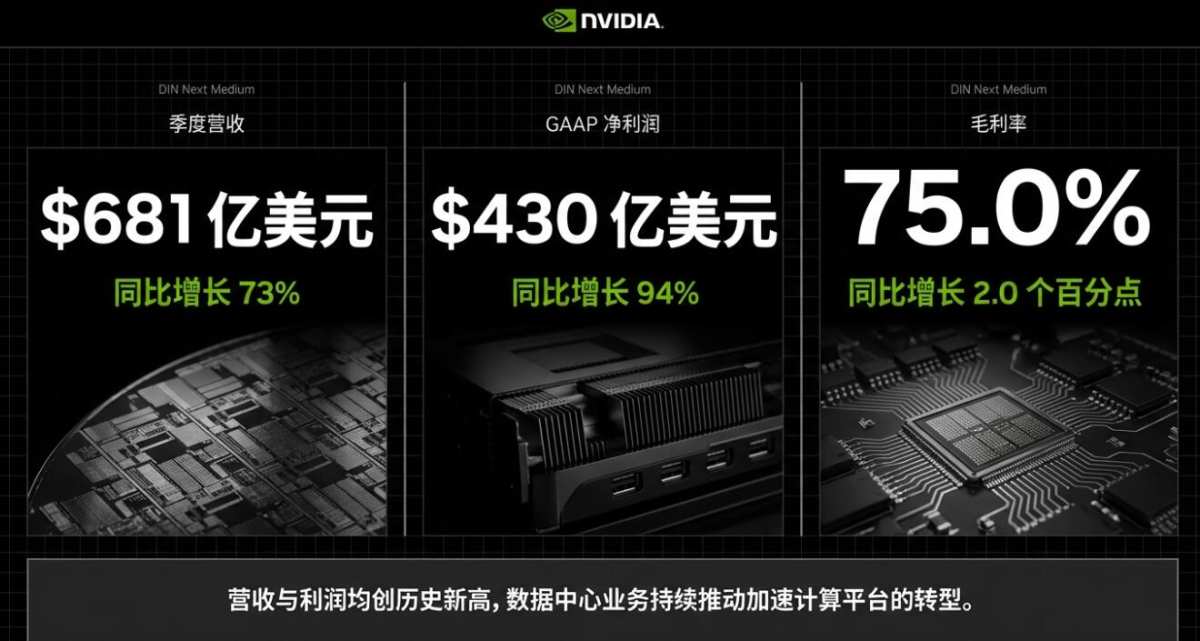
NVIDIA’s revenue in the fourth quarter grew by 73% year-over-year to USD 68.127 billion, significantly higher than the previous quarter's growth rate of 62%, surpassing the mid-point of NVIDIA’s own guidance at USD 65 billion. Analysts had expected revenue of USD 65.84 billion, representing a year-over-year increase of approximately 68%. For the full fiscal year, NVIDIA also set an annual record high, with revenue reaching USD 215.938 billion, up 65% compared to the prior year.
Gross margin emerged as another highlight of the fourth quarter: on a non-GAAP basis, gross margin reached 75.2%, up 1.7 percentage points year-over-year and 1.6 percentage points quarter-over-quarter, marking the highest level since the second quarter of fiscal year 2025 and surpassing analysts’ expectations of 75.0%.
NVIDIA's Chief Financial Officer (CFO) Colette Kress explained that the year-over-year improvement in gross margin was due to 'reduced inventory provisions,' while the quarter-over-quarter improvement was related to a 'better product mix and cost structure' driven by the continued ramp-up of Blackwell chips.
However, for the entire fiscal year 2026, the non-GAAP gross margin declined, dropping from 75.5% in the previous fiscal year to 71.3%, a year-over-year decrease of 4.2 percentage points, indicating that structural disruptions will continue to affect full-year profitability during the platform transition and supply ramp-up phase.
Data Center: Stabilizing Compute Growth, Networking Acceleration Takes Over
In the fourth quarter, NVIDIA's data center business recorded revenue of $62.314 billion, a year-over-year increase of 75%, which was higher than the 66% year-over-year growth in the previous quarter. Analysts had expected a nearly 70% year-over-year increase to $60.36 billion.
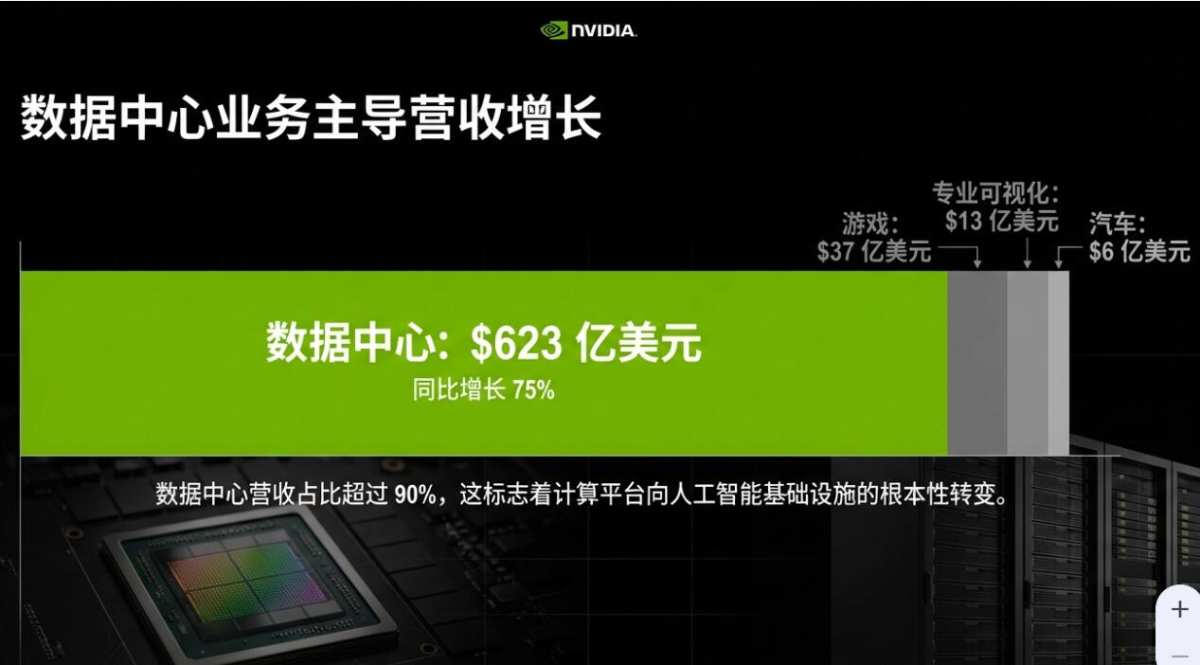
Within the data center segment, NVIDIA provided two particularly noteworthy sets of figures this quarter:
Data Center Compute revenue reached $51.334 billion, a year-over-year increase of 58%, slightly higher than the 56% growth rate in the third quarter.
Data Center Networking revenue amounted to $10.980 billion, surging 263% year-over-year, significantly outpacing the 162% growth in the third quarter.
NVIDIA attributed the explosive growth in networking revenue to the 'launch and ongoing ramp-up' of NVLink compute fabric for GB200 and GB300 systems, alongside continued growth in Ethernet and InfiniBand platforms.
In other words, the market should not only focus on the shipment pace of GPUs themselves but also recognize that NVIDIA is packaging 'compute power, interconnects, and systems' into an integrated solution that is harder to replace. The high growth rate in networking revenue is the financial reflection of this strategy.
In terms of customer composition, the company disclosed that in the fourth quarter, revenue from hyperscale cloud providers accounted for just over 50% of the total data center business revenue, remaining the largest customer category. However, revenue growth during the quarter came more from other data center customers, indicating a diversification of revenue sources and a marginal easing of concentration risk.

Blackwell Drives Gaming Demand, Short-Term Impacted by Supply and Channel Disruptions
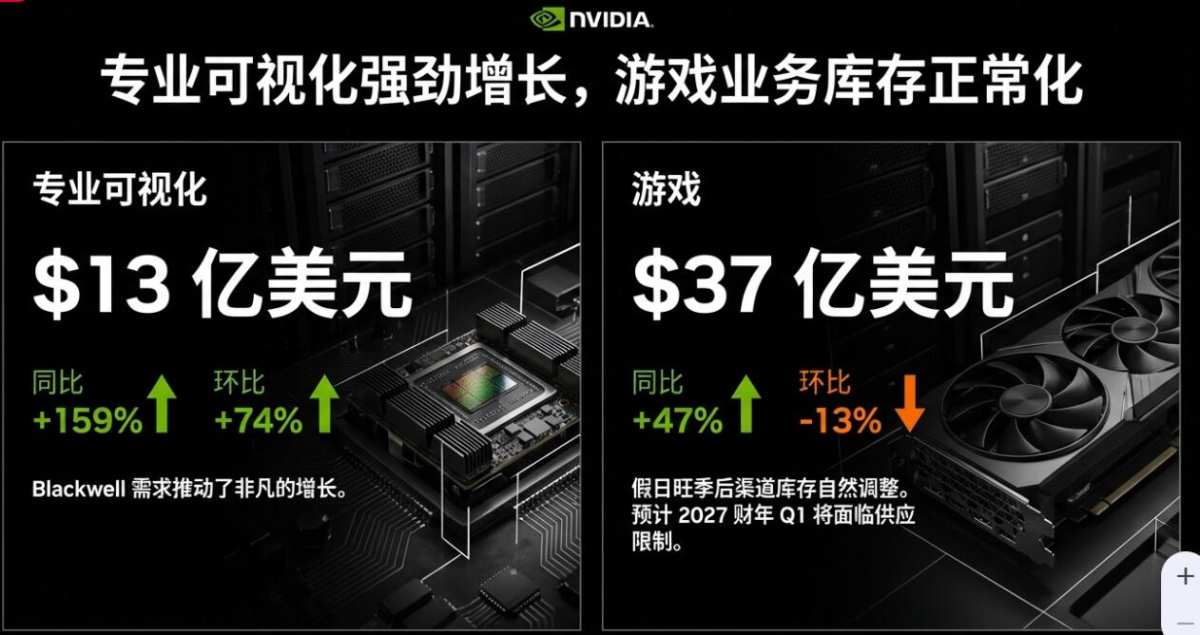
In the fourth quarter, NVIDIA's gaming business revenue reached $3.727 billion, a year-over-year increase of 47%. Analysts had expected $4.01 billion, compared to a 30% year-over-year growth in the previous quarter.
The gaming business accelerated its year-over-year growth in the fourth quarter, which NVIDIA attributed primarily to strong demand for Blackwell. However, revenue for this segment declined 13% sequentially due to 'a natural pullback in channel inventory following the holiday peak season.' Notably, NVIDIA explicitly warned that supply constraints are expected to become a headwind for the gaming business starting in the first quarter and beyond.
Revenue from professional visualization in the fourth quarter amounted to USD 1.321 billion, marking a 159% year-over-year increase. Analysts had forecasted USD 771 million, while the previous quarter saw a 56% year-over-year growth.
Driven by Blackwell, professional visualization achieved more than a doubling of revenue year-over-year and a 74% sequential increase, making it one of the standout growth segments outside of data centers. However, the scale of this business remains far smaller than that of data centers.
Midpoint of Q1 Revenue Guidance Reflects Nearly 77% Year-over-Year Growth, Excluding Data Center Compute Revenue from China
In terms of performance guidance, NVIDIA announced an expected revenue of $78 billion for the first quarter, with a margin of plus or minus 2%, equating to a range of $76.44 billion to $79.56 billion. This range indicates that NVIDIA’s revenue for the current fiscal quarter will set a new record, surpassing the all-time high achieved in the fourth quarter.
Based on the midpoint of the revenue guidance, NVIDIA anticipates a year-over-year revenue growth of 76.9% for the first quarter, further accelerating from the 73% growth rate seen in the fourth quarter.
NVIDIA’s midpoint of revenue guidance not only exceeds the analysts’ consensus estimate of $72.78 billion but also surpasses the buy-side’s optimistic expectations of $74 billion to $75 billion.
NVIDIA’s gross margin forecast for the first quarter aligns with the buy-side’s optimistic projections on Wall Street and is anticipated to reach a new high since the second fiscal quarter of 2025.
The adjusted gross margin for Q1 under the non-GAAP measure is expected to be 75%, with a fluctuation of 50 basis points, i.e., between 74.5% and 75.5%. The buyers' optimistic expectation stands at 75%, while the consensus expectation from sellers is 74.7%.
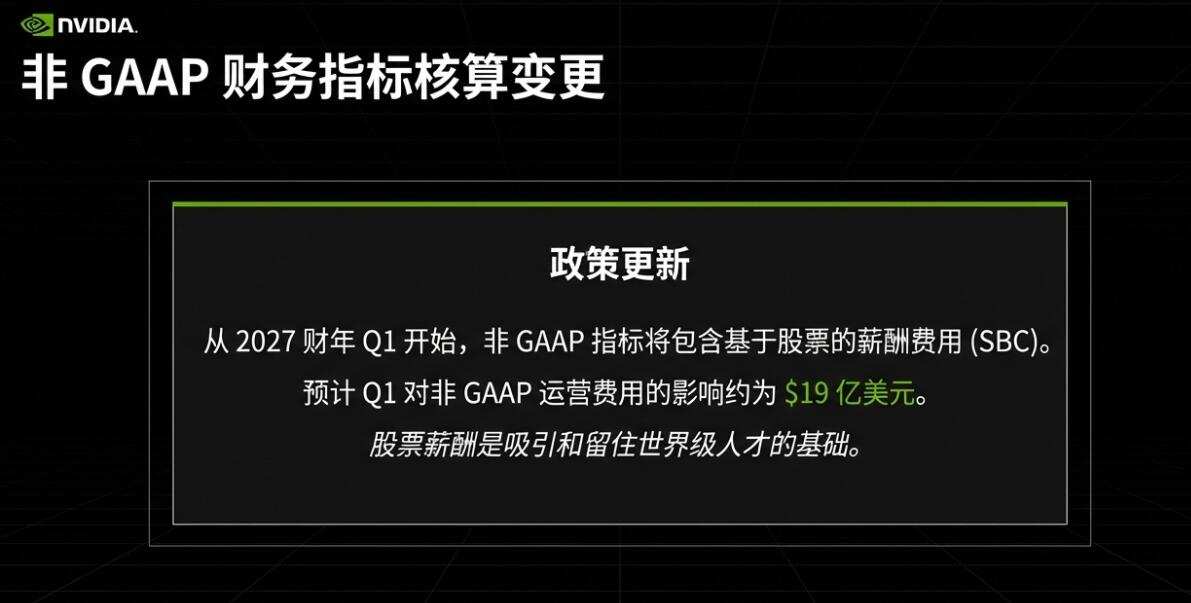
Starting from Q1, share-based compensation will be included in the non-GAAP measures.
While announcing its financial results, NVIDIA stated that starting from Q1, share-based compensation (SBC) will no longer be excluded from financial metrics under the non-GAAP framework. Due to this adjustment, NVIDIA anticipates that operating expenses under the non-GAAP framework for Q1 will increase by approximately $1.9 billion.
This change will directly alter the “standard measure” that the market has long relied on for cross-comparisons of profit margins and expense ratios. In the short term, it may lead to recalibration of consensus expectation models, while also allowing investors to more clearly see the true costs NVIDIA incurs to maintain its leadership in talent and R&D.
Open Futubull > Stock Page > Click on the 【Company】 Tab >Earnings Express: AI Insights Highlight Key Points, Three Steps to Build an Options Strategy!

Editor/Jayden