
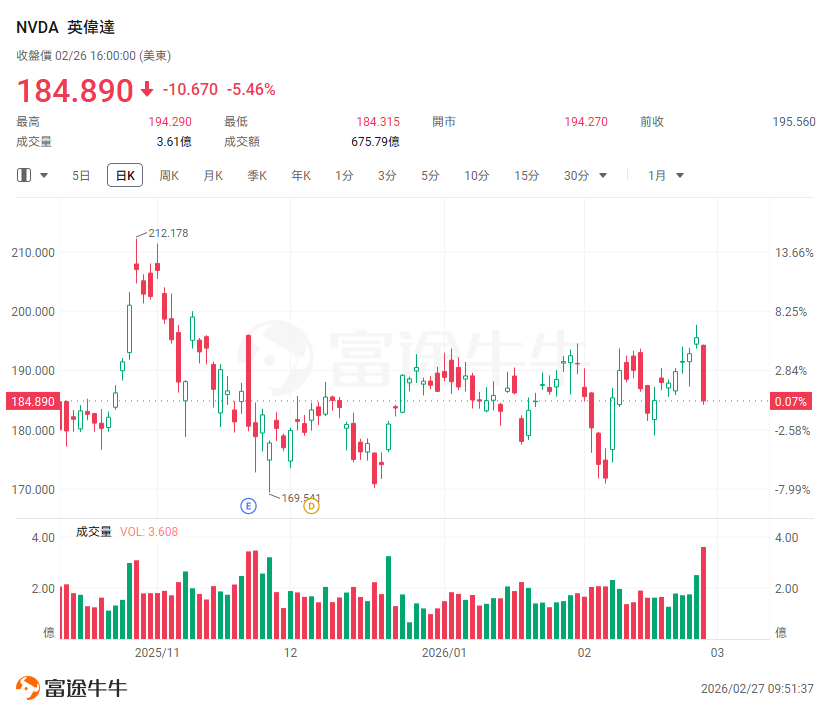
①NVIDIA reported strong results for the fourth fiscal quarter, but its stock price plunged by 5.5% overnight, wiping out nearly $260 billion in market value; ②On one hand, investors’ focus is shifting from earnings data to the sustainability of artificial intelligence capital expenditures; on the other hand, renowned “Big Short” investor Michael Burry pointed out that NVIDIA's 'purchase obligations' have surged to $95 billion, potentially posing risks to its financial performance.
After the market close on Wednesday Eastern Time, NVIDIA's earnings report revealed a highly successful performance: the company’s profit nearly doubled in the fourth fiscal quarter, and its revenue reached an all-time high.
However, $NVIDIA (NVDA.US)$ the stock price showed a completely opposite, pessimistic trend.
 The stock price of this ‘AI darling,’ which sits at the center of the global artificial intelligence trading hub, fell after hours on Wednesday and plummeted by 5.5% at Thursday’s close. This marked the largest single-day decline since April last year, with nearly $260 billion (approximately 1.7 trillion yuan) in market value evaporating overnight.
The shares of other major chip manufacturers also plummeted significantly; for instance, $Broadcom (AVGO.US)$ the stock price fell by more than 3%, $Advanced Micro Devices (AMD.US)$ dropped by 3.41%, and $Taiwan Semiconductor (TSM.US)$ declined by 2.8%.
NVIDIA’s Curse
Part of the reason behind NVIDIA’s stock plunge lies in what has been termed ‘NVIDIA’s curse’: starting from August 2024, regardless of the quality of the earnings report, NVIDIA’s stock has consistently opened lower the following day.
In fact, the deeper reason behind this ‘curse’ may be that the market no longer finds NVIDIA’s outstanding performance surprising: over the past three years, the company has consistently exceeded profit expectations every quarter, leading investors to have very high expectations for its performance.
This means that even delivering a robust earnings report has become routine for this globally highest-valued listed company, no longer eliciting awe.
A Shift in Wall Street Sentiment
On the other hand, sentiment on Wall Street has indeed shifted – particularly in the field of artificial intelligence and with regard to market attention on NVIDIA.
Mike O'Rourke, Chief Market Strategist at JonesTrading, wrote after NVIDIA's earnings call: 'Investors know that trouble is brewing in paradise.'
The investment value of any company goes far beyond what its earnings data can reflect, and this is precisely the focus of O'Rourke and other AI skeptics.
NVIDIA’s Chief Financial Officer, Colette Kress, acknowledged during the earnings call that the top five global cloud service providers and hyperscale cloud companies contributed more than 50% of NVIDIA's data center revenue in 2026, which once again heightened Wall Street's concerns about NVIDIA's overly concentrated data center demand.
During the conference call, an analyst asked Jensen Huang, CEO of NVIDIA, about his confidence in customers' ability to continue investing hundreds of billions of dollars in purchasing NVIDIA chips.
Huang responded that he was 'highly confident' in the cash flow growth of his clients' companies.
However, O'Rourke pointed out that the problem lies in the fact that Huang’s statements do not align with reality. In fact, financial reports released a month ago by top 'hyperscale data centers,' including Amazon, Meta, Microsoft, and Google, showed either a significant decline or stabilization in their free cash flow.
O'Rourke wrote:
If management is not forthright about widely known information, investors will fear the unknown.
Richard Clode, Portfolio Manager at Janus Henderson, stated bluntly: 'The debate has shifted from recent performance results to the sustainability of AI capital expenditures, with concerns about NVIDIA's scale, monetization, and potential cash flow deterioration.'
The 'Big Short' highlights another critical issue.
Adding to the mounting pressure on NVIDIA is a blog post by the renowned 'Big Short' Michael Burry, the real-life figure portrayed in the movie. Burry has long been a vocal critic of the artificial intelligence boom.
In the blog post, Burry emphasized a particular figure from NVIDIA’s earnings report — one that he believes could lead to 'catastrophic' consequences if enthusiasm for artificial intelligence begins to wane.
This critical figure is NVIDIA's 'purchase obligations' (contracts to buy goods within a specified timeframe). In its latest earnings report, this number surged from $16 billion a year ago to $95 billion. He pointed out that the reason lies in Taiwan Semiconductor, NVIDIA's main supplier, demanding more cash from NVIDIA for the production of complex custom chips.
Burry wrote that this means NVIDIA has been 'forced to place non-cancelable purchase orders before demand becomes clear,' and this shift appears to be 'structural' rather than temporary. Should downstream demand falter in the future, this ballooning figure could pose a significant risk to NVIDIA's financial health.
NVIDIA lacks clear guidance on its future prospects.
Investors noted that NVIDIA’s stalled $100 billion deal with OpenAI is another pain point contributing to the stock’s decline.
In NVIDIA’s 10-K regulatory filing released on Wednesday, the company stated that while it is 'finalizing an investment and cooperation agreement' with ChatGPT developer OpenAI, 'we cannot guarantee that we will reach an investment and cooperation agreement with OpenAI or that the transaction will be completed.'
Tom Graff, Chief Investment Officer at Facet, frankly stated that after clients like Microsoft and Amazon were expected to increase their data center spending, the market had already anticipated NVIDIA’s strong performance this quarter. However, investors hoped for more clarity from NVIDIA but were met with disappointing results.
Graff stated:
We did not receive specific details regarding future performance guidance. If a company like OpenAI may be slowing down its expenditures, this should reflect in the actual revenue over the next one to two quarters. Therefore, the lack of clear revenue prospects is concerning.
 AI Portfolio Strategist goes live!Gain comprehensive insights into your holdings, fully grasp opportunities and risks with a single click.

Editor/Rice