
①Market concerns about the potential impact of artificial intelligence on corporate profits have resurfaced, hitting U.S. technology stocks. ②The uncertainty surrounding U.S. tariff policies has intensified again, coupled with growing market fears over escalating geopolitical risks in the Middle East involving the U.S. and Iran, which may trigger intermittent inflows of safe-haven funds into the bond market.
Cailian Press, February 27 (Editor Yang Bin) After experiencing significant volatility in January, U.S. Treasury bonds quietly rebounded in February, supported by multiple factors.
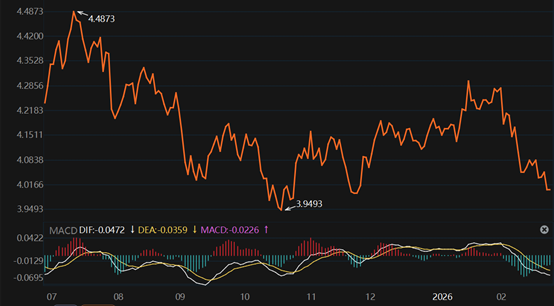
This month, the yield on the 10-year U.S. Treasury bond fell nearly 30 basis points, recently touching 4.0%, a three-month low. Despite strong U.S. inflation and employment data, which cooled rate cut expectations, risk aversion and fluctuations in the U.S. stock market supported Treasuries. Institutional analysts noted that if the resistance level of 4.0%-4.01% for the 10-year U.S. Treasury yield proves difficult to break, the yield may seek a short-term bottom before rebounding somewhat.
 Early this morning, U.S. Treasury yields fell significantly. The yield on the 10-year Treasury bond dropped by about 4.5 basis points, touching the 4.0% mark, hitting its lowest level since November last year.
In terms of short-term news, the indirect negotiations between Iran and the U.S. ended, with Iran's foreign minister stating that differences remain, and technical negotiations are set for March 2. Additionally, initial jobless claims in the U.S. for the week ending February 21 were 212,000, lower than the expected 215,000.
Chart: Trend of the 10-year U.S. Treasury yield
(Data source: Wind data, compiled by Cailian Press)
The strengthening of U.S. Treasury yields began at the start of February, with the yield on the 10-year Treasury falling by 30 basis points from near 4.30%. However, during the Lunar New Year holiday, Treasury yields rebounded temporarily.
During this period, the minutes of the Federal Reserve’s January interest rate meeting revealed a 'two-way risk' statement, with some officials mentioning the possibility of rate hikes. Rising geopolitical tensions between the U.S. and Iran fueled market expectations of increased risk aversion and rising inflation. Furthermore, the U.S. Supreme Court ruled on the legality of tariffs on February 20, but the Trump administration quickly introduced new tariff measures, increasing policy uncertainty.
Xu Liang, Chief Fixed Income Analyst at Guolian Minsheng Securities, believes that driven by hawkish divisions within the Fed minutes and the Supreme Court’s tariff ruling, U.S. Treasury yields rose significantly at key levels, further reversing market expectations of early rate cuts. Meanwhile, concerns over lost tariff revenue and potential refund pressures intensified fears of an expanding U.S. fiscal deficit and increased debt supply, putting overall pressure on the bond market.
However, following the tariff ruling turmoil, the yield on U.S. Treasuries surged and then retreated. The yield on the 10-year U.S. Treasury note has fallen by about 9 basis points this week.
Research from Oriental Gold Credit indicates that uncertainties surrounding the tariff ruling, alternative tariff measures by the Trump administration, and the Section 301 investigation have intensified again. Coupled with market concerns over escalating geopolitical risks in the Middle East involving the U.S. and Iran, intermittent inflows of safe-haven funds into the bond market may be triggered, thereby lowering U.S. Treasury yields to some extent.
Although recently released U.S. employment and inflation data were strong, the GDP data for the fourth quarter of last year came in below expectations. The initial reading of the annualized quarterly growth rate for real GDP in Q4 was 1.4%, marking the lowest level since Q1 of 2025.
Moreover, an article by the FICC team at Zheshang Bank pointed out that the decline in U.S. equities provided support for U.S. Treasuries. At the start of this week, renewed market concerns emerged over the potential impact of artificial intelligence on corporate profits. Following the release of Citrini Research’s report titled 'The 2028 Global Intelligence Crisis,' which outlined the potential risks AI poses to various industries, technology, logistics, and payment stocks were affected.
U.S. stocks fell again overnight, with the S&P 500 dropping by 0.54%. Technology stocks saw significant declines, with the Nasdaq index falling by 1.18%.
The FICC team at Zheshang Bank noted that risk aversion pushed U.S. Treasury yields back to lower levels, but the effect was mainly seen in the intermediate segment. Amid a pullback in GDP and a moderation in optimistic expectations regarding AI's impact on economic growth, the pessimistic outlook for long-term U.S. Treasuries has yet to be corrected. The institution believes it is necessary to monitor the intensity of this round of corrections in U.S. equities. If the correction is limited, the resistance level of 4.0%-4.01% for the 10-year U.S. Treasury yield will be difficult to break, and the yield may seek a temporary bottom before rebounding somewhat.
Editor/Jayden