
NVIDIA has made a bold investment of $4 billion, simultaneously acquiring stakes in Coherent and Lumentum, two leading companies in the optical communications sector, to secure core production capacity for co-packaged optics (CPO) crucial to next-generation 'AI interconnectivity.' The procurement commitment extends until 2030, with funds primarily allocated to support the expansion of both companies' manufacturing capabilities within the United States and ensure the supply of key lasers for CPO. Barclays explicitly noted that NVIDIA's primary objective is to achieve 'supply protection' for CPO. This move is akin to securing an entire orchard before the fruit has ripened.
NVIDIA has invested $4 billion in two major optical communication giants, securing critical capacity in advance for the upcoming 'optical interconnect' era of next-generation AI computing architectures.
On March 2 local time, NVIDIA announced multi-year partnerships with optical communications component manufacturers $Coherent (COHR.US)$ and $Lumentum (LITE.US)$ . The collaboration includes joint R&D in optical technologies, arrangements for future production capacity and supply priority, as well as NVIDIA's 'multi-billion-dollar' multi-year procurement commitment. Additionally, NVIDIA invested $2 billion each in the two companies to support their R&D, future capacity expansion, and operational growth within the United States.
 According to TradingView, JPMorgan's North American equity research team analyzed that the structures and intents of the two deals are 'essentially similar':
Both are non-exclusive, multi-year advanced optical collaborations;
Both include 'multi-billion-dollar procurement commitments';
NVIDIA invested $2 billion in both Coherent and Lumentum to expand U.S.-based manufacturing capacity and support R&D; both companies also mentioned that NVIDIA will receive common stock in exchange for this investment.
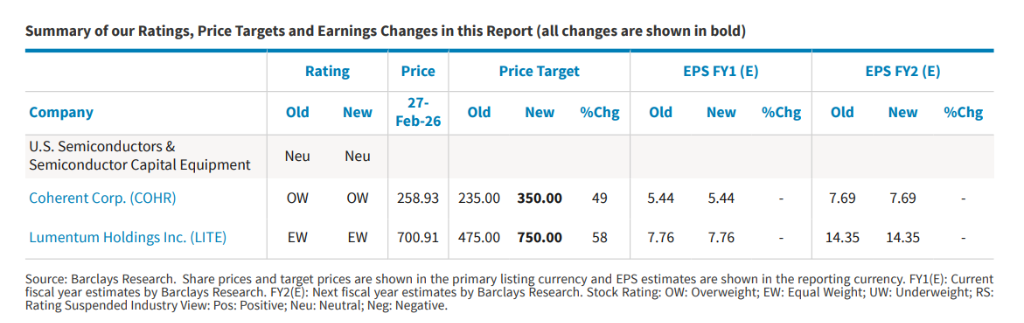
In its latest research report, Barclays pointed out that the core objective of NVIDIA's investment is to secure the supply of co-packaged optics (CPO).
The bank wrote: 'The primary reason for these deals is to protect NVIDIA’s supply in both scale-out and scale-up CPO solutions.' In their view, this is more akin to preparing materials in advance for a larger-scale 'optical interconnect' era rather than addressing a short-term supply-demand disruption.
It is like pre-booking an entire orchard before the fruit ripens. As AI cluster sizes expand, traditional pluggable optical modules will face physical limits in power consumption and density. Co-packaged optics (CPO), which integrates optical components directly with GPUs, becomes an inevitable trend. CPO embeds pluggable transceivers inside switches, reducing hardware procurement costs for data center operators and significantly lowering network energy consumption.
Where the money is going: lasers, InP production lines, and U.S.-based factories.
From the disclosed details, NVIDIA's bet is not on general 'optical interconnect modules,' but rather on the key light sources and core component capacity required for co-packaged optics (CPO).
Barclays noted, 'We believe the bulk of this deal targets 400mW continuous wave (CW) lasers.' JPMorgan also emphasized that the collaboration with Coherent covers multiple product categories, 'including ultra-high-power CW lasers for CPO.'
JPMorgan revealed specific details about the funding. NVIDIA's investment is primarily aimed at expanding the U.S. manufacturing capabilities of the two companies and supporting R&D.
For Coherent, the unrestricted funding of up to $2 billion will be prioritized for capital expenditures, particularly to expand its indium phosphide (InP) production capacity at the Sherman, Texas plant. Multi-billion-dollar procurement commitments will begin in early 2027 and continue until 2030.
For Lumentum, the majority of the funds will be used to build a 'brand-new' wafer fab in the United States. Previously, Lumentum had disclosed a 'multi-hundred-million-dollar' procurement order expected to be fulfilled in the first half of 2027, while NVIDIA’s current order is entirely incremental, with the incremental revenue expected to materialize from the second half of 2027 onward.
Timeline: Order fulfillment pushed further back, pointing to supply-demand dynamics after 2027.
For the market, the more critical issue is whether the revenue recognition will 'immediately appear on financial statements.' The research report leans towards 'later realization.'
JPMorgan stated that Coherent’s 'multi-year, multi-billion-dollar procurement commitment' is expected to begin in early 2027, with the partnership 'extending through 2030.' Regarding Lumentum, the bank highlighted that the new collaboration represents an incremental addition to existing orders: a previously disclosed 'hundreds-of-millions-of-dollars' procurement order is expected to be realized in the first half of 2027, while the incremental revenue from this collaboration is more likely to start showing from the second half of 2027 onward.
This partly explains why NVIDIA’s move has been interpreted as 'pre-emptive capacity building': CPO addresses the interconnect bottleneck for AI clusters at higher bandwidths and lower power consumption, and its scaling resembles industrial migration rather than a single-quarter surge in demand.
Significance for the industry chain: Electrical interconnects will not disappear immediately, but the signal of 'phased replacement' is stronger.
Barclays expects the market may initially exhibit two types of rapid reactions:
First, 'this is negative for electrical connectivity-related companies (such as CRDO),' as locking in supply implies that short-distance CPO connections may progress sooner. However, the bank also offers a semi-joking reminder with a 'phased' assessment – 'Does this mean all electrical connections will be immediately phased out? (Of course, we’re joking).' It reiterated that electrical interconnects will remain significant in the short term, with impacts more evident in long-term structural changes.
Second, the transaction further reinforces the theme of expanding U.S.-based supply chains. Barclays believes this deal 'does not directly point to optical modules,' but it may make the market more cautious about certain 'non-U.S.' module manufacturers.
Additionally, Barclays noted that the timing of the transaction announcement 'is not surprising,' as NVIDIA 'will likely disclose some discussions on new CPO solutions at the GTC conference.' If the upcoming GTC conference provides clearer product development pathways, the implication of the aforementioned 'capacity lock-in' may lead the market to reassess the pace of CPO advancement.
Editor/Lambor