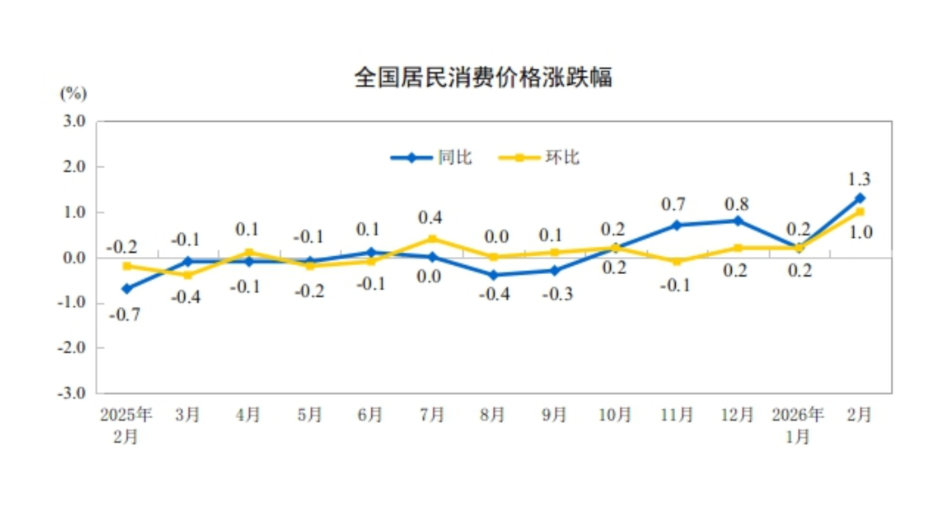
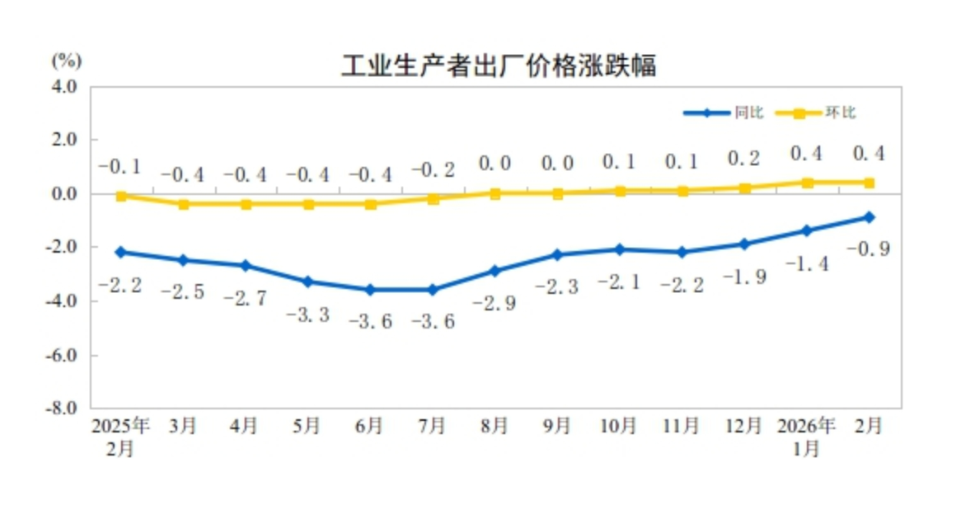
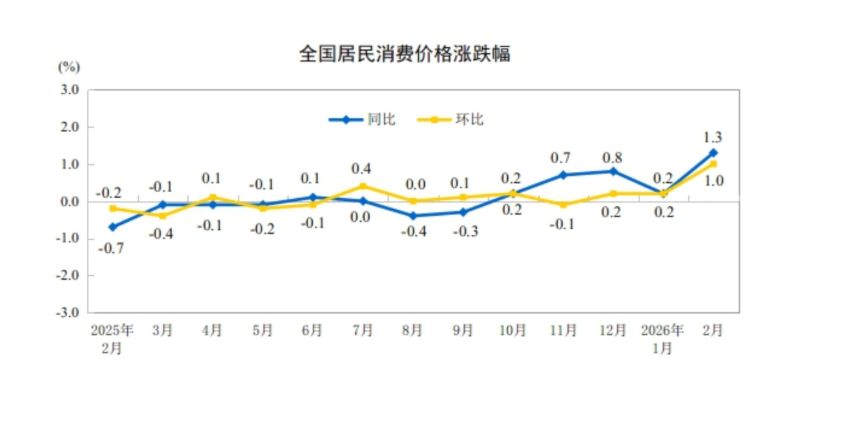
The year-on-year increase in the CPI for February rose from 0.2% to 1.3%, the highest in nearly three years, while the month-on-month increase expanded from 0.2% to 1%, the highest in nearly two years. This was mainly due to the concentrated release of consumer demand during the extended Spring Festival holiday, which led to a significant rise in service prices. The PPI for February increased month-on-month, while the year-on-year decline continued to narrow. Key features included: first, rising international non-ferrous metal and crude oil prices driving up prices in related domestic industries; second, growth in computing power boosting demand and pushing prices higher in certain sectors.
In February, affected by the Spring Festival factor, the Consumer Price Index (CPI) increased by 1.0% month-on-month and 1.3% year-on-year, while the core CPI excluding food and energy prices rose by 1.8% year-on-year. Influenced by factors such as rising international commodity prices, rapid growth in demand in some domestic industries, and the continued effectiveness of macroeconomic policies, the Producer Price Index (PPI) increased by 0.4% month-on-month but fell by 0.9% year-on-year, with the decline narrowing consecutively.
On March 9, data released by the National Bureau of Statistics showed that:
- China's CPI in February rose to 1.3% year-on-year, the highest in nearly three years, compared to the previous value of only 0.2%;
- China's CPI in February expanded from 0.2% month-on-month in the previous month to 1.0%, the highest in nearly two years;
- The core CPI excluding food and energy prices increased by 1.8% year-on-year.
- The PPI decreased by 0.9% year-on-year, compared to a previous decrease of 1.4%. This marks the third consecutive month of narrowing declines.
- The PPI increased by 0.4% month-on-month, the same increase as the previous month, marking five consecutive months of growth.
 Dong Lijuan, Chief Statistician of the Urban Department of the National Bureau of Statistics, interpreted the CPI and PPI data for February 2026:
Expansion of CPI Growth
On a month-on-month basis, the national CPI growth expanded from 0.2% in the previous month to 1.0%, the highest in nearly two years, mainly due to the concentrated release of consumer demand during the extended Spring Festival holiday, leading to significant increases in service prices above seasonal levels. Service prices increased by 1.1%, an expansion of 0.9 percentage points compared to the previous month, contributing approximately 0.54 percentage points to the month-on-month CPI increase. Among services, prices for air tickets, vehicle rentals, travel agency fees, and hotel accommodations increased by 31.1%, 24.7%, 15.8%, and 7.3%, respectively, collectively contributing about 0.32 percentage points to the month-on-month CPI increase, accounting for over 30% of the total CPI increase; prices for pet services, vehicle repairs and maintenance, and housekeeping services increased by 12.0%, 11.6%, and 3.1%, respectively, while movie and performance ticket prices and dining-out costs increased by 9.9% and 1.1%, respectively, collectively contributing about 0.18 percentage points to the month-on-month CPI increase. Prices for industrial consumer goods increased by 0.4%, an expansion of 0.1 percentage points from the previous month. Among these, influenced by rising international gold prices, domestic gold jewelry prices increased by 6.2%, and the impact of geopolitical conflicts on energy prices became evident, with domestic gasoline prices increasing by 3.1%, collectively contributing about 0.12 percentage points to the month-on-month CPI increase. Although food prices, which were flat in the previous month, rose by 1.9%, the increase remained below seasonal levels, contributing approximately 0.33 percentage points to the month-on-month CPI increase. Within food, festival-related demand increases led to price rises of 6.9%, 4.0%, and 4.0% for aquatic products, fresh fruits, and pork, respectively, with price increases for mutton, beef, eggs, and poultry meat ranging between 1.6% and 2.2%, collectively contributing about 0.34 percentage points to the month-on-month CPI increase; abundant market supply of fresh vegetables resulted in a price decrease of 0.1%.
Year-on-year, the impact of the Lunar New Year shift combined with recovering consumer demand led to a rise in the national CPI from 0.2% in the previous month to 1.3%, reaching the highest level in nearly three years. Among these, service prices rose by 1.6%, expanding by 1.5 percentage points compared to the previous month, contributing approximately 0.75 percentage points to the year-on-year increase in CPI. Within services, prices for air tickets, vehicle rentals, travel agency fees, and hotel accommodations reversed from declines in the previous month to increase by 29.1%, 19.8%, 12.5%, and 5.4%, respectively; pet services, vehicle repairs and maintenance, domestic services, and food delivery prices increased by 13.0%, 12.0%, 6.3%, and 5.6%, respectively; movie and performance ticket prices dropped by 1.1%; as housing rental entered its off-season, rental prices declined by 0.6%. Prices of industrial consumer goods rose by 1.1%, with the increase expanding by 0.2 percentage points over the previous month. Among them, gold jewelry prices surged by 76.6%, with a slight deceleration in growth; home appliances, household sundries, and clothing prices increased by 5.3%, 2.6%, and 2.0%, respectively; gasoline prices fell by 9.8%; and car prices decreased by 1.2%. Food prices turned from a 0.7% decline in the previous month to a 1.7% increase, contributing about 0.30 percentage points to the year-on-year CPI increase. Within food, prices for fresh vegetables, beef, mutton, and fresh fruits increased between 5.9% and 10.9%, with their increases all widening compared to the previous month, collectively contributing approximately 0.41 percentage points to the year-on-year CPI increase; pork and egg prices fell by 8.6% and 3.0%, respectively, but their declines narrowed compared to the previous month, collectively pulling the year-on-year CPI down by about 0.18 percentage points.
PPI rises month-on-month, while year-on-year declines continue to narrow
From a month-on-month perspective, the national PPI increased by 0.4%, the same as the previous month, marking the fifth consecutive month of increase. The main characteristics of this month’s PPI month-on-month movement are as follows: First, rising international non-ferrous metal and crude oil prices drove price increases in related domestic industries. Non-ferrous metal mining and selection, non-ferrous metal smelting, and pressing industry prices increased by 7.1% and 4.6% month-on-month, respectively. Among these, silver smelting, gold smelting, aluminum smelting, and copper smelting prices increased by 16.9%, 8.4%, 4.2%, and 3.7%, respectively. Petroleum and natural gas extraction, refined petroleum product manufacturing, and organic chemical raw material manufacturing prices increased by 5.1%, 0.7%, and 1.3%, respectively. Influenced by cost-push factors, electrical machinery and equipment manufacturing prices increased by 1.2%, with wire and cable manufacturing prices rising by 2.3%. Second, computing power growth drove demand increases and price rises in certain industries. Computer communication and other electronic equipment manufacturing prices increased by 0.6% month-on-month. Among these, electronic semiconductor materials, external storage devices and components, and integrated circuit packaging and testing series prices increased by 2.8%, 1.2%, and 1.1%, respectively.
Year-on-year, the national PPI decreased by 0.9%, with the decline narrowing by 0.5 percentage points compared to the previous month, marking the third consecutive month of narrowing declines. The integrated effects of domestic macro policies continued to show, with some industries experiencing positive changes in prices. First, the accelerated construction of a modern industrial system has driven price increases in related sectors. The vigorous development of 'AI+' saw price rises of 4.9% in electronic component and specialized electronic material manufacturing, 1.6% in control micro-motor prices, and 0.7% in service consumption robot manufacturing; green transition efforts advanced steadily, leading to a 3.2% increase in biofuel processing and a 0.6% increase in environmental protection equipment manufacturing; high-end equipment showed strong momentum, with aircraft manufacturing prices rising by 7.7%, ship and related equipment manufacturing prices increasing by 0.5%, and additive manufacturing equipment prices rising by 0.3%. Second, the continuous optimization of market competition order resulted in prices stabilizing and rebounding in some industries. The effective treatment of key industry capacity issues and 'internal' competition综合整治 yielded continuous results: photovoltaic equipment and component manufacturing prices increased by 3.2%, expanding by 2.7 percentage points from the previous month; lithium-ion battery manufacturing prices shifted from a 1.1% decline last month to a 0.2% increase, marking the first monthly year-on-year increase after 33 consecutive months of decline; the declines in coal mining and washing, cement manufacturing, new energy vehicle manufacturing, and ferrous metal smelting and rolling industries narrowed by 2.8, 1.5, 0.5, and 0.3 percentage points, respectively, compared to the previous month.
In February, consumer prices rose by 1.3% year-on-year and 1% month-on-month.
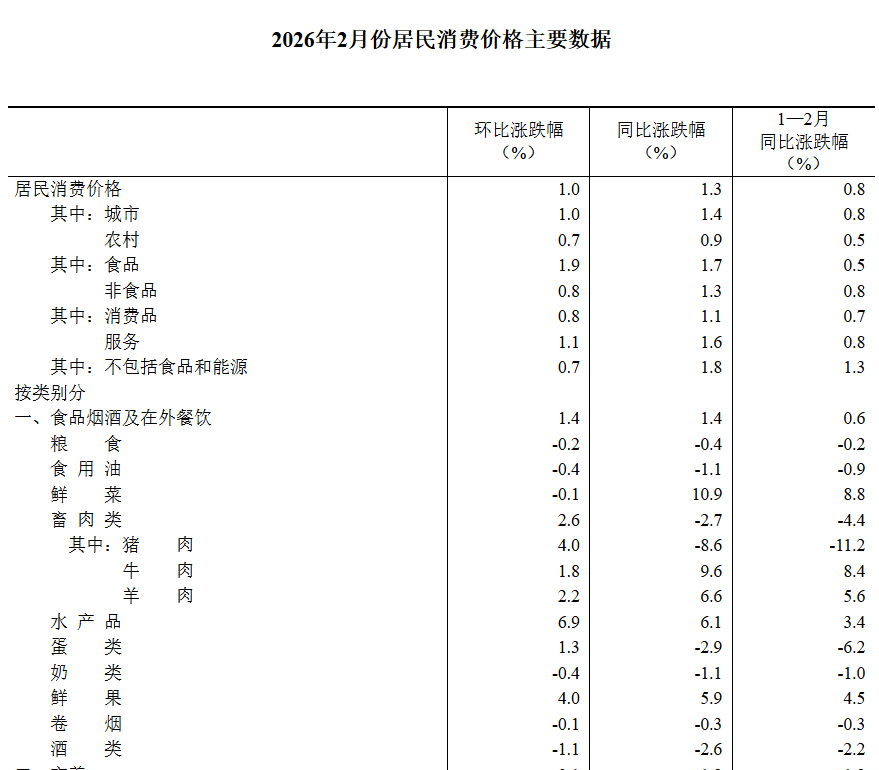
In February 2026, the national consumer price index (CPI) increased by 1.3% year-on-year. Specifically, prices in urban areas rose by 1.4%, while rural areas experienced a 0.9% increase; food prices rose by 1.7%, non-food prices increased by 1.3%; consumer goods prices increased by 1.1%, and service prices rose by 1.6%. On average for January-February, the national consumer price index increased by 0.8% compared to the same period last year.
In February, the national consumer price index (CPI) increased by 1.0% month-on-month. Specifically, urban areas saw a 1.0% increase, while rural areas increased by 0.7%; food prices rose by 1.9%, non-food prices increased by 0.8%; consumer goods prices increased by 0.8%, and service prices rose by 1.1%.
1. Year-on-year changes in prices of various goods and services
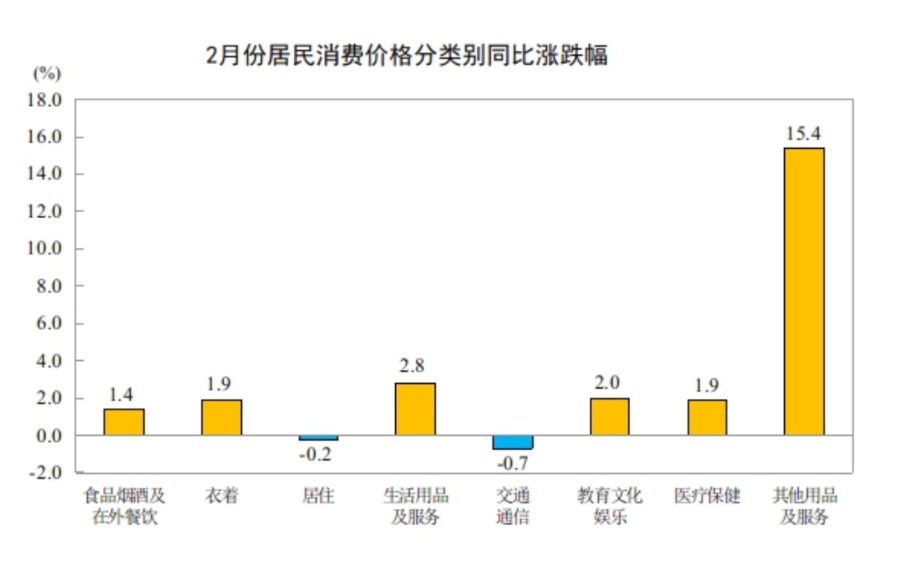
In February, prices for food, alcohol, tobacco, and dining out rose by 1.4% year-on-year, contributing approximately 0.41 percentage points to the CPI increase. Within food, fresh vegetable prices rose by 10.9%, contributing approximately 0.19 percentage points to the CPI increase; aquatic product prices increased by 6.1%, contributing approximately 0.11 percentage points; fresh fruit prices rose by 5.9%, contributing approximately 0.12 percentage points; egg prices fell by 2.9%, reducing the CPI by about 0.02 percentage points; livestock meat prices decreased by 2.7%, reducing the CPI by about 0.11 percentage points, with pork prices falling by 8.6%, contributing to a reduction in CPI by about 0.17 percentage points.
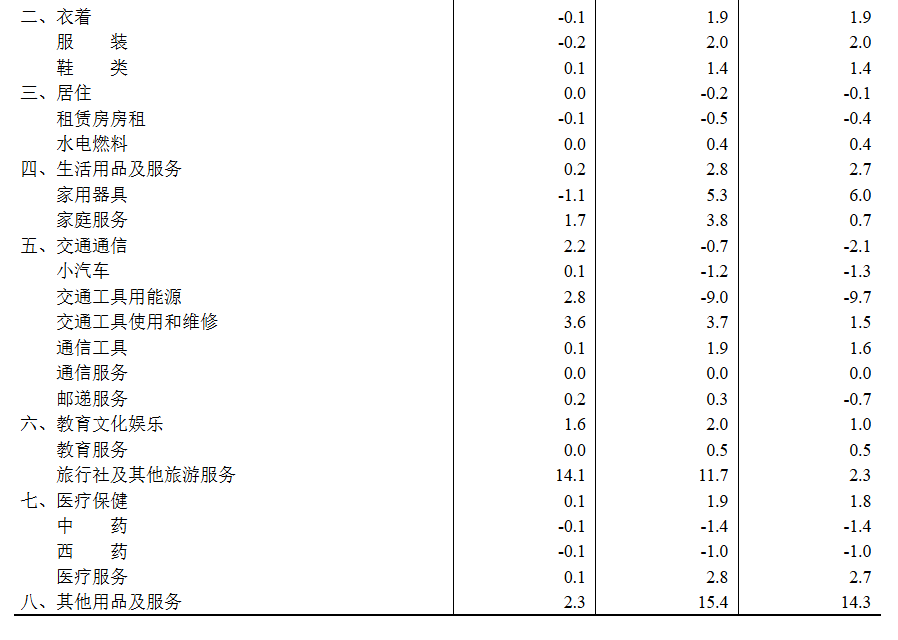
Among the other seven major categories, five categories showed increases and two categories showed decreases year-on-year. Specifically, prices for miscellaneous goods and services, household goods and services, and education, culture, and entertainment increased by 15.4%, 2.8%, and 2.0%, respectively; apparel and medical care prices both rose by 1.9%; transportation and communication prices fell by 0.7%, and housing prices decreased by 0.2%.
2. Month-on-month changes in prices of various goods and services
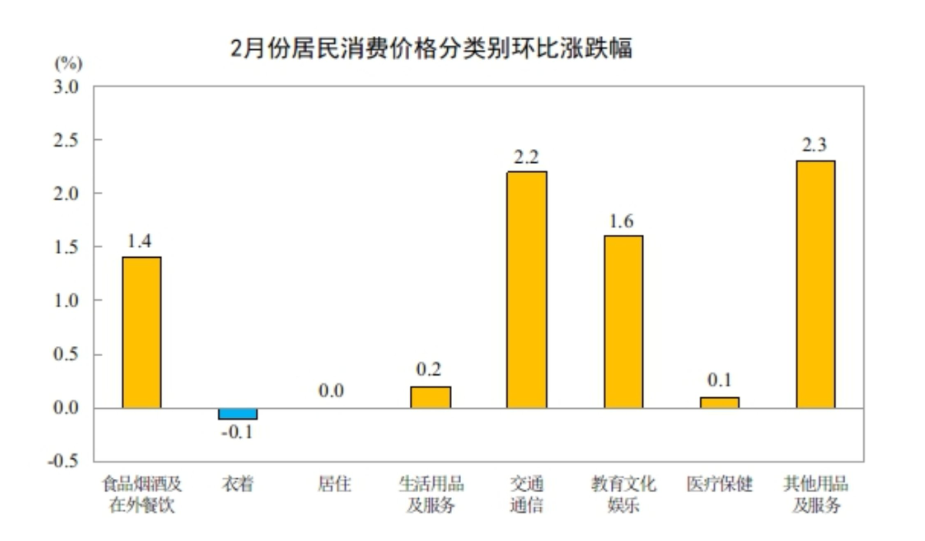
In February, prices for food, alcohol, tobacco, and dining out rose by 1.4% month-on-month, contributing approximately 0.40 percentage points to the CPI increase. Within food, aquatic product prices increased by 6.9%, contributing approximately 0.13 percentage points; fresh fruit prices rose by 4.0%, contributing approximately 0.08 percentage points; livestock meat prices increased by 2.6%, contributing approximately 0.11 percentage points, with pork prices rising by 4.0%, contributing approximately 0.07 percentage points; egg prices increased by 1.3%, contributing approximately 0.01 percentage points.
Among the other seven major categories, five categories showed increases, one remained flat, and one category showed a decrease month-on-month. Specifically, prices for miscellaneous goods and services, transportation and communication, and education, culture, and entertainment increased by 2.3%, 2.2%, and 1.6%, respectively; household goods and services and medical care prices rose by 0.2% and 0.1%, respectively; housing prices remained unchanged; and apparel prices decreased by 0.1%.
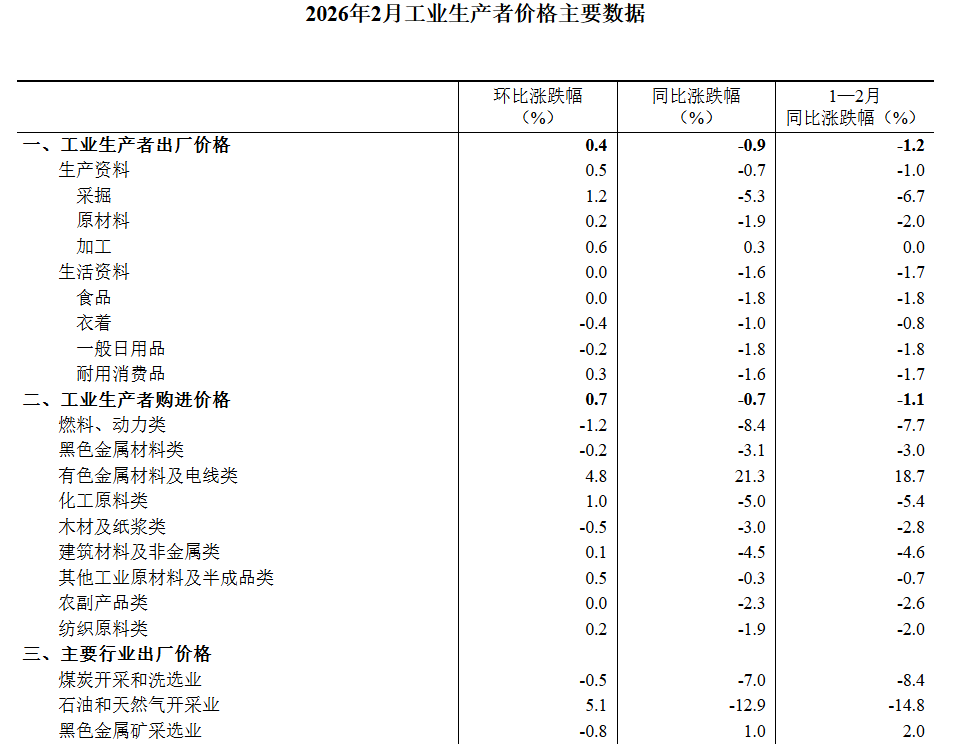
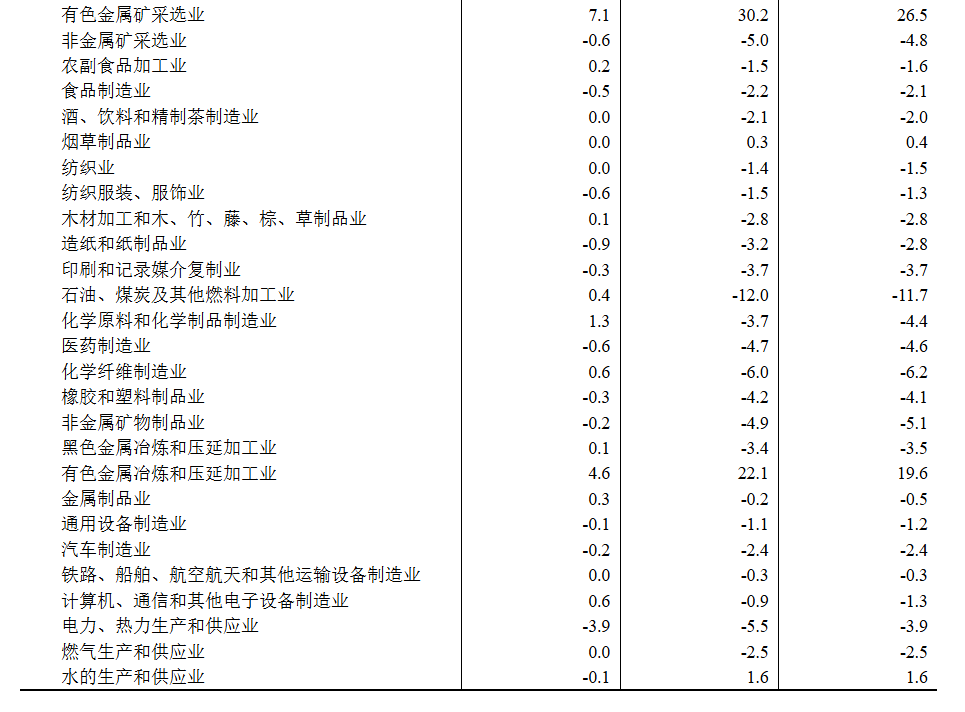
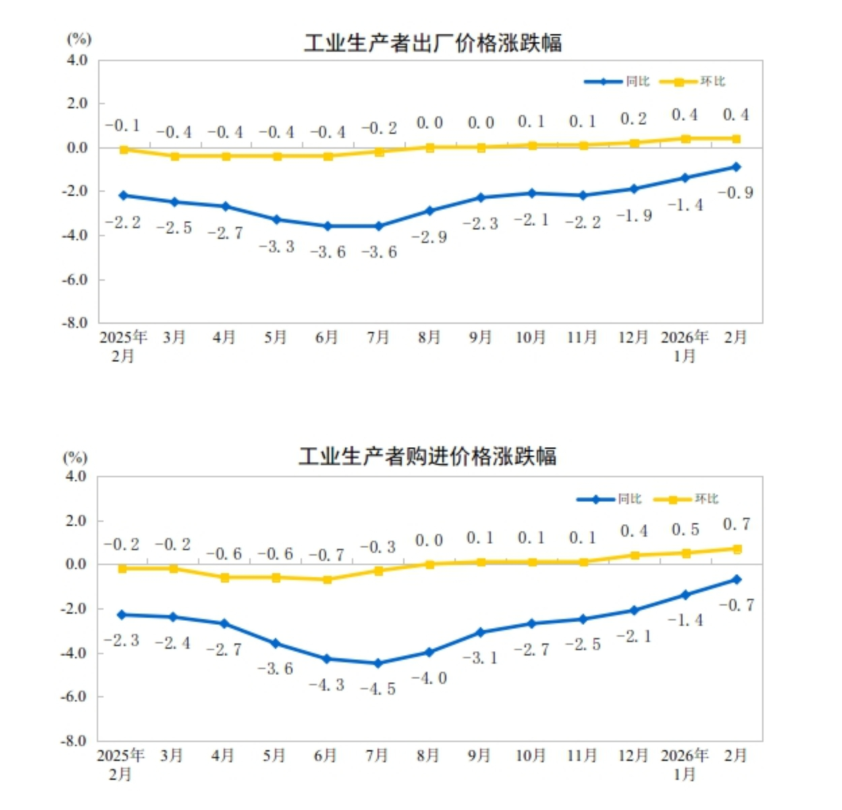
The year-on-year decline in the Producer Price Index (PPI) for industrial producers narrowed in February, with a continued month-on-month increase.
In February 2026, the national Producer Price Index (PPI) for industrial producers decreased by 0.9% year-on-year, with the decline narrowing by 0.5 percentage points compared to the previous month. The month-on-month increase was 0.4%, unchanged from the previous month. The prices of materials purchased by industrial producers decreased by 0.7% year-on-year, with the decline narrowing by 0.7 percentage points compared to the previous month; the month-on-month increase was 0.7%, expanding by 0.2 percentage points compared to the previous month. On average for January-February, the PPI for industrial producers fell by 1.2% compared to the same period last year, while the prices of materials purchased by industrial producers decreased by 1.1%.
I. Year-on-year changes in the prices of industrial producers
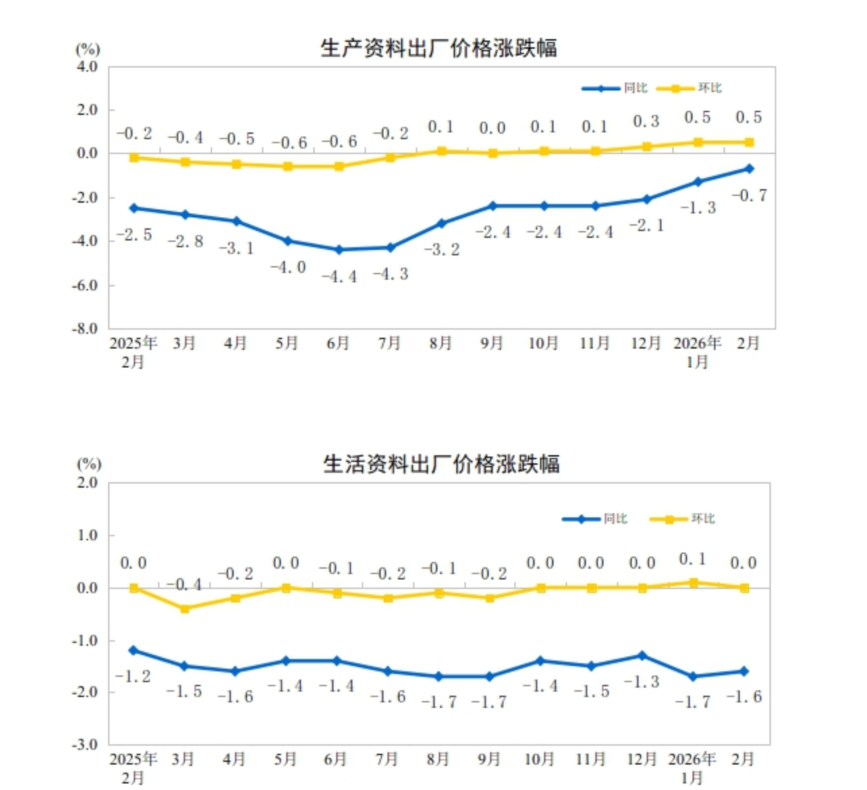
In February, the prices of production materials among the PPI for industrial producers fell by 0.7%, contributing to a decline of approximately 0.55 percentage points in the overall price level for industrial producers. Specifically, the prices in mining industries dropped by 5.3%, raw material industries fell by 1.9%, and processing industries increased by 0.3%. The prices of consumer goods declined by 1.6%, leading to a decrease of about 0.35 percentage points in the overall price level for industrial producers. Among these, food prices fell by 1.8%, clothing prices decreased by 1.0%, general daily necessities prices dropped by 1.8%, and durable consumer goods prices fell by 1.6%.
Among the prices of materials purchased by industrial producers, fuel and power categories fell by 8.4%, chemical raw materials fell by 5.0%, construction materials and non-metal categories dropped by 4.5%, ferrous metal materials fell by 3.1%, agricultural and sideline products fell by 2.3%, textile raw materials decreased by 1.9%; however, prices for non-ferrous metals and wire categories rose by 21.3%.
II. Month-on-month changes in the prices of industrial producers
In February, the prices of production materials within the PPI for industrial producers increased by 0.5%, contributing to a rise of approximately 0.38 percentage points in the overall price level for industrial producers. Specifically, mining industry prices increased by 1.2%, raw material industry prices rose by 0.2%, and processing industry prices grew by 0.6%. Prices of consumer goods remained flat. Specifically, food prices were stable, clothing prices fell by 0.4%, general daily necessities prices decreased by 0.2%, and durable consumer goods prices increased by 0.3%.
Among the prices of materials purchased by industrial producers, prices for non-ferrous metals and wire categories increased by 4.8%, chemical raw materials rose by 1.0%, textile raw materials grew by 0.2%, and construction materials and non-metal categories increased by 0.1%. However, fuel and power prices fell by 1.2%, ferrous metal materials decreased by 0.2%, and agricultural and sideline products prices remained unchanged.