
This article is sourced from: Sixiang Gangyin
01 Is the strategy of 'adding to winning positions' correct?
Many people have heard of the method of 'adding to winning positions.' You identify an investment opportunity, start with a small position, and if it begins to generate profits, you increase your position. If the movement goes against your expectations, you close the position.
Is this method correct? In fact, there are many opposing views on this topic.
 Jesse Livermore was the first to propose this method. In 'Reminiscences of a Stock Operator,' most of his successful cases followed the approach of 'adding to winning positions.'
However, I once heard a futures tycoon express disdain for 'adding to winning positions.' He adheres to a fundamental supply-and-demand investment approach, believing that when commodity prices deviate from their fundamentals due to imbalances, one should decisively add to the position as long as there is no risk of liquidation. His several successful investments were mostly achieved by enduring losses in the early stages, adding positions during declines, and eventually making a turnaround.
In fact, there is no definitive answer to this question; it depends on your investment system. Some people should add to winning positions and reduce losing ones, while others should reduce winning positions and add to losing ones.
Similar to 'adding to winning positions,' many masters' investment experiences follow this pattern. Which ones are the 'sweet nectar' suitable for you, and which are the 'poisoned chalice'? Clearly, trying every single one is not feasible. The correct approach is to analyze from the perspective of your own investment framework.
This article will further elaborate on these three dimensions and analyze the following content:
1. Representative methods and distinctions between probability-based investing and odds-based investing
2. Two typical probability-based investment styles: the social security fund investment style and speculative stock trading
3. Two Typical Odds-based Investment Approaches: The Buffett Method and Out-of-the-Money Options
I will also analyze in the final section of this article what kind of investment approach 'adding positions on floating profits' is suitable for.
Section 02: How Did Duan Yongping Bottom-fish PDD Holdings?
Any trading method must first align with your personality, methodology, and values. Are you more suited for odds-based investing or probability-based investing?
Odds refer to the ratio of upside potential to downside risk in a stock's price over a given period. The greater the upside compared to the downside, the higher the odds of the investment opportunity.
Probability refers to the ratio of the likelihood of a stock’s price increasing versus decreasing over a given period. A higher likelihood of an increase represents a high-probability investment opportunity.
Of course, any investment opportunity must balance both probability and odds, but it is preferable to emphasize one over the other. Comparing investment opportunities is inherently subjective; a slight deviation can lead to significant errors. If you seek both high odds and high probability, the result is often mediocre trades that offer neither, with an expected value of zero.
This explanation may seem somewhat abstract, so I will provide examples of typical odds-based and probability-based trades below.
After researching a certain company, you discover that it has spent several years building a unique product development, operations, and sales system within the industry. Through grassroots surveys, you find that customer acceptance of this system is rising and is about to reach an inflection point. Given the high barriers of this system, there will be virtually no competitors within two years. Based on the business model you have constructed, the company’s performance is expected to double in two years. Coupled with valuation expansion, the stock has an upside potential of 3 to 5 times within two years.
A sell-side analyst in the industry also agrees with your view. He informs you that the reason for the company’s depressed stock price is that earnings will continue to decline over the next two quarters, which may negatively impact the stock. Additionally, since the industry is not a popular one, many investors are adopting a wait-and-see attitude.
This is a typical odds-based investment opportunity, where the potential upside is several times greater than the downside. Even with moderate probability of success, the overall expected return remains high.
In this opportunity, the probability of success is also important. For such new products, almost every company in the A-share market can name one or two. If you judge that the system or new product is still too early, or the demand is uncertain, or after the market is established, the demand quickly peaks, the probability of success will be too low, resulting in an overall low expected return, or even negative, thus not qualifying as a good opportunity. Therefore, a certain probability of success is a prerequisite for odds-based investing.
The reason why the probability of success in this case meets the basic requirements is that the greatest uncertainty lies in slowing down the progress of the new system under financial pressure, which represents a delay in time rather than outright failure.
After meeting the basic probability of success requirement, the focus of judgment should still be on the upside potential.
There are many medium- to long-term odds-based opportunities in US and Hong Kong stocks. Therefore, for individuals with strong research capabilities but average trading skills, focusing on odds-based investments in US and Hong Kong stocks will provide sufficient returns.

Let’s take another typical example of probability-based trading.
During your market visits, you discover that a consumer goods company had good sales momentum in the third quarter, which has not yet been reflected in investor expectations. In this scenario, there will likely be some price appreciation around the time the earnings report is released.
However, the problem is that the current index is too high, and even positive earnings results may not offset this external systemic risk.
Nevertheless, you find that the company also has convertible bonds, with premiums at normal levels. Since convertible bonds have a price floor, they mitigate systemic risk. Coupled with the positive news, and based on calculations of the elasticity between share price and convertible bonds, the upside potential at the current level slightly exceeds the downside risk. While the odds are average, they are not poor. The probability of an increase far outweighs the probability of a decrease, indicating a high success rate. Given the short time horizon, this opportunity can achieve an ideal expected return.
Therefore, many conservatively styled funds, after a period of market gains, will look for probability-based investment opportunities in convertible bonds.
From the two examples above, we can see that if your investment system is heavily focused on odds, your account will often remain dormant for long periods before skyrocketing, followed by another long silence; if your investment style is based on probability, the value of your account will steadily increase - a characteristic common to many accounts specializing in convertible bonds.
Once you understand odds trading and probability trading, you will find the investment opportunities best suited for yourself, even transforming odds trading into probability trading using certain financial instruments.
By the end of 2021, after rounds of sharp declines in U.S.-listed Chinese stocks, many investors stepped in to buy at the bottom. Duan Yongping also took action, investing in his long-favored $PDD Holdings (PDD.US)$, but instead of simply buying stocks, he sold put options. Later, he used the same method to sell put options on New Oriental Education & Technology Group.
The characteristic of selling put options is that it caps upside potential, reducing the odds but increasing the probability, as the worst-case scenario would be purchasing the stock at the strike price.
In hindsight, PDD Holdings' stock price was at $60 at the time, $New Oriental (EDU.US)$and New Oriental’s was at $22. By 2022, the lowest prices for the two companies fell to $23 and $8.4 respectively, with both dropping more than 60%. However, their current share prices are $109 and $67, representing increases of 81% and 200% from then.
Therefore, this was a typical odds-based investment opportunity, but Duan Yongping transformed it into a probability-based trade that he was more comfortable with. For such seasoned investors, probability indeed matters more than odds.
After understanding the differences in opportunities between probability-based and odds-based investments, we can introduce the concept of duration, categorizing investment methods into four types: long-term probability, short-term probability, long-term odds, and short-term odds.
03 Investing in Moutai and Speculative Trading
The duration of an investment opportunity refers to the length of time it takes for the rationale behind your investment to materialize in the stock price.
To simplify the discussion, I divide investment durations into two categories: long-term and short-term. Long-term refers to durations exceeding two years, while short-term refers to less than one month (in practice, medium-term investments are more common). Let us first examine the combination of long-term and short-term strategies with probability of success in two methods:
A typical example of a long-term probability-of-success trade is investing in Maotai.
Characteristics of investing in Maotai: Its fundamentals are relatively clear, its earnings growth rates are predetermined, analysts' forecasts align closely with actual performance, its business model has certain barriers or a relatively stable dividend payout capability, its growth rate may not be rapid but is relatively predictable, it boasts a high ROE, and its valuation tends to remain elevated over the long term... Its medium- to short-term odds are quite ordinary, but its long-term probability of success is relatively high. Many retail investors participate in popular thematic stocks believing in grand narratives such as national strategic funding, vast market potential, or explosive growth in major client orders, mistakenly treating these thematic stocks as odds-based trades, only to be repeatedly exploited.
These grand narratives arise because the stock price has already experienced an upward movement; without sufficient upside potential, it becomes difficult to justify participation. Therefore, these 'grand narratives' are reasons for attention, not investment logic.
Why are thematic stocks considered a typical probability-of-success trade?
High visibility and high turnover represent short-term probability of success. The supply of sellers lacks elasticity, and high visibility inevitably leads to supply-demand imbalances. High visibility drives prices up, which in turn attracts even more attention, giving highly visible stocks a very high short-term probability of success.
However, visibility is a resource that is quickly generated in large quantities in the short term and rapidly consumed. Coupled with fierce competition among themes, this makes thematic stocks a typical form of short-term trading. Thus, thematic stocks exhibit the characteristic of 'act aggressively on rumors, exit upon confirmation.'
04 Buffett and Black Swan Lottery
Let’s now examine the combination of investment duration and odds.
Buffett is a typical long-term odds investor, and his most profitable transactions share the following characteristics:
1. The industry has significant long-term growth potential, and the company possesses strong competitive advantages to maintain its market share.
2. The holding period is extremely long; unless the stock becomes significantly overvalued, he may reduce his position slightly, but will buy back when it becomes particularly undervalued.
3. After purchasing, there is a high tolerance for temporary losses—although he consistently emphasizes avoiding losses.
The following graph illustrates the winning strategy of long-term odds investing.
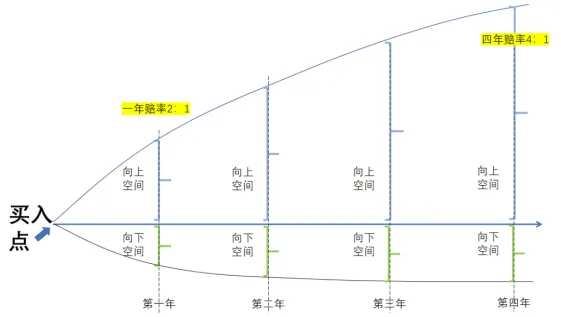
The longer the investment duration, the higher the odds, as the upward slope is relatively steep while the downward slope is relatively gentle.
Domestic investors who follow Buffett's methodology often experience exaggerated scenarios such as a 50% drop in stock price one year after purchase. However, since the stock price may multiply afterward, they still achieve substantial profits, reflecting the characteristics of long-term odds trading.
Therefore, many of Buffett’s principles are based on long-term odds investing. If you do not belong to this system—for instance, if you cannot tolerate losses exceeding 30%, cannot hold your core positions for an extended period, or lack the ability to evaluate companies over the long term—his approach could be detrimental to your investment strategy.
Finally, let us examine short-term odds trading:
A typical example of medium- to short-term odds trading is the “black swan lottery,” such as out-of-the-money options with low exercise prices and short durations. These instruments have extremely low probabilities of success but offer very high odds, akin to purchasing insurance against future financial crises.
The A-share market has many unique short-term odds trading methods, such as:
By understanding the characteristics of these four investment methods, it is not difficult to understand the applicable targets for 'adding positions on floating profits.'
05 Adding Positions on Floating Profits: Buying Odds Targets at the Inflection Point of Winning Probability
Firstly, the method of adding positions on floating profits is a typical odds-based investment approach.
The reason is simple: the upward potential of odds-based investments is significant, and even if there is a slight increase, it does not diminish. On the other hand, probability-based investments inherently have limited upward potential, and after a small rise, both the odds and probabilities may disappear.
Secondly, from the perspective of space, long-term odds investments and short-term odds investments define floating profits differently. In long-term odds trading, floating profits essentially involve waiting for certain information to confirm fundamental inflection points — that is, the inflection point of winning probability.
Let’s take a look at the investment methods for odds targets:
On one hand, odds targets require purchasing at high odds positions, buying more as prices fall. On the other hand, to build up substantial positions, it is necessary to wait for a clear inflection point in fundamentals, commonly referred to as the 'right-side signal.' Although the stock price may have risen somewhat at this point, it does not alter the long-term odds.
The points for adding positions in short-term odds trading often occur when resistance levels are broken, causing a sudden increase in winning probability — what Livermore referred to as the path of least resistance.
Conversely, for standard probability-based investments, positions should be added on floating losses. When the investment logic remains unchanged (winning probability stays the same), a decline increases the odds, providing even more reason to double down on the bet.
Win probability, odds, and investment duration are the underlying logic of all investment methods; only by fully understanding them can you learn the investment approach that truly suits you from the experiences of investment masters.
 Looking to pick stocks or analyze them? Want to know the opportunities and risks in your portfolio? For all your investment-related questions,just ask Futubull AI!

Editor/KOKO