
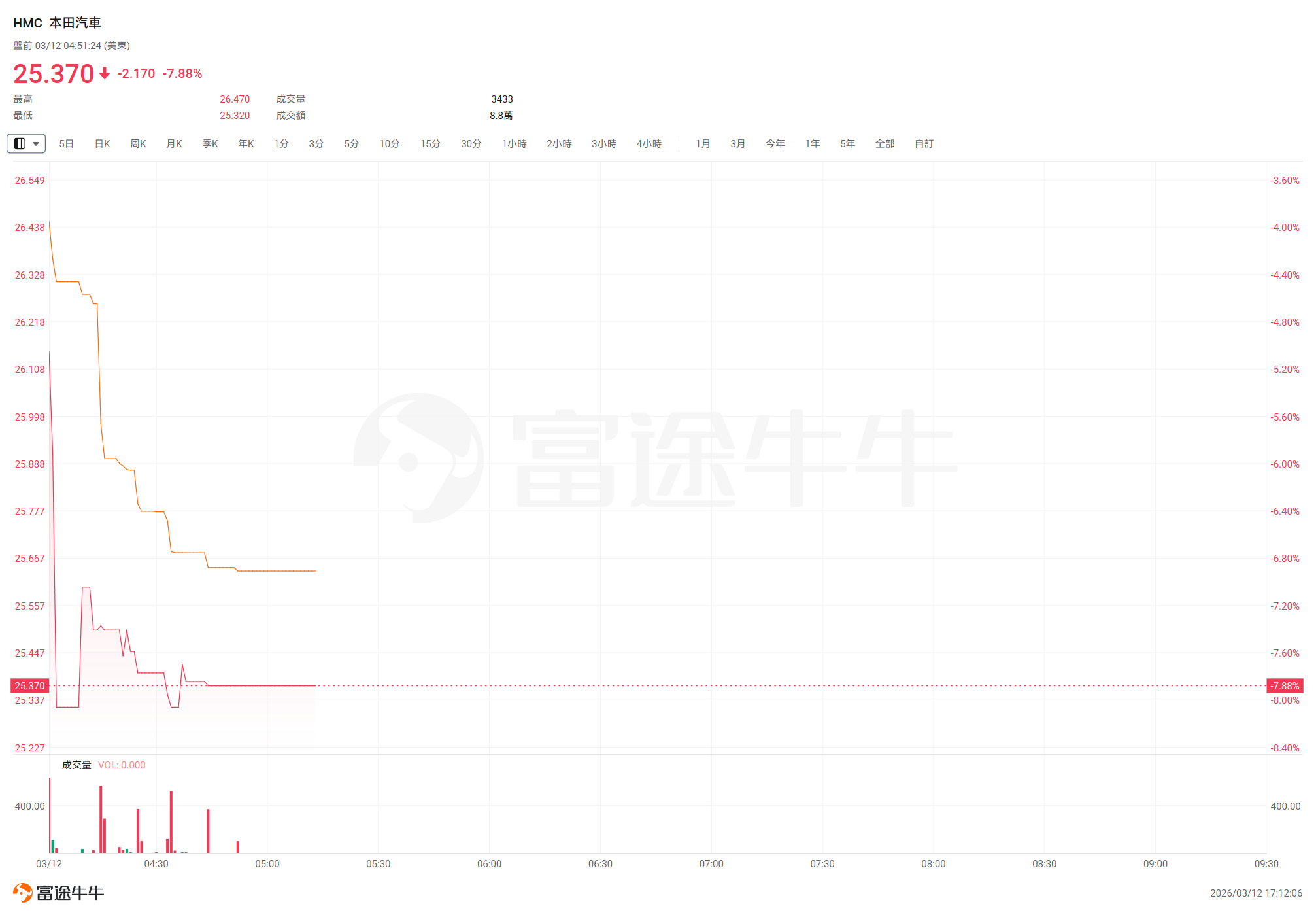
In pre-market trading of U.S. stocks today, $Honda Motor (HMC.US)$the share price fell by nearly 8%, with the latest quote at $25.37 per share.
Honda Motor recently announced that due to the restructuring of its electric vehicle development strategy, the company expects to incur costs of up to 2.5 trillion yen (approximately $15.7 billion). This has made it another major automaker impacted by setbacks in the global electrification transition.
The Japanese automaker disclosed on Thursday that it would cancel the research and launch plans for three electric models originally intended for the North American market. For the current fiscal year ending March next year, the company anticipates losses ranging from 270 billion to 570 billion yen.
 Just last month, Honda had already warned of a sharp increase in expenditures related to its electric vehicle business, and this announcement highlights the heavy price it is paying due to slowing demand for new energy vehicles. This estimated scale places Honda alongside two other automakers — $Stellantis NV (STLA.US)$ Ford Motor, which incurred costs exceeding €22 billion (approximately $25 billion) due to a strategic shift, and $Ford Motor (F.US)$ another that booked a $19.5 billion loss due to business restructuring.
Taku Sugawara, an analyst at Iwai Cosmo Securities, pointed out that this impact could spill over into the new fiscal year starting in April. “It remains uncertain whether Honda can absorb these losses within the current fiscal year; the effects may extend into the next fiscal year.”
Honda admitted that its automobile business is under significant pressure due to the impact of U.S. tariff policies and declining competitiveness in the Asian market. Particularly in the Chinese market, the company expects to incur impairment losses on investments.
Currently, global automakers are generally in困境due to Europe’s deceleration of its aggressive timeline for phasing out internal combustion engine vehicles and the United States’ relaxation of fuel economy and emissions standards — key pillars that were meant to support demand for new energy vehicles.
Meanwhile, as consumers shift toward domestic brands that better meet their needs, foreign automakers have seen a sharp decline in market share in China. $BYD COMPANY (01211.HK)$ BYD has led this transformation and became the world’s largest electric vehicle manufacturer last year.
In response to the slowing demand in the North American market, Honda stated that it is reallocating resources and streamlining its model lineup to strengthen its hybrid product offerings. At the same time, the company plans to deepen its business presence in India, a dual-growth market for both automobiles and motorcycles.
Honda will announce its revised medium- and long-term business strategy plan in the next fiscal year.
Editor/KOKO