
Li Auto's 2025 financial report shows a weakening in profitability, with annual revenue of 112.3 billion yuan, a year-on-year decline of 22.3%; net profit was only 1.14 billion yuan, plummeting by 85.8%. Q4 revenue reached 28.78 billion yuan, with an operating loss of 443 million yuan, and vehicle gross margin fell to 16.8%. Affected by the contraction in delivery volumes, the company expects its Q1 2026 revenue guidance to be only between 20.4 billion and 21.6 billion yuan, significantly below expectations. Li Auto’s stock price fell nearly 3% in pre-market trading on the US market.
$Li Auto (LI.US)$ The revenue guidance for the first quarter was significantly lower than market expectations, while the concurrently released fourth-quarter financial report also showed a comprehensive weakening in profitability, with substantial declines across multiple core metrics.
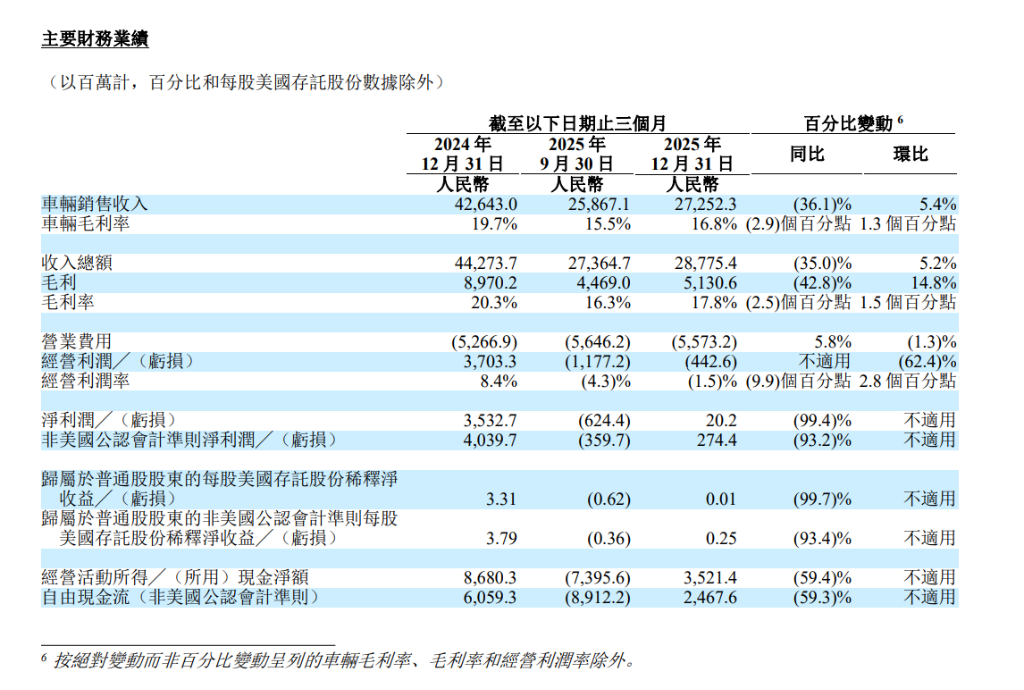
Li Auto's Q4 revenue plummeted 35% year-over-year to RMB 28.775 billion, in line with estimates; in terms of net profit, the company achieved a net profit of RMB 20.2 million in Q4, representing a significant year-over-year decline of 99.4%, compared to RMB 3.5 billion in the same period last year; on a non-GAAP basis, net profit was RMB 274 million, compared to RMB 4 billion for the same period in 2024. Adjusted earnings per ADS fell sharply from RMB 3.79 in the same period last year to RMB 0.25.
 The company expects its first-quarter revenue to range between RMB 20.4 billion and RMB 21.6 billion, lower than the Bloomberg consensus estimate of RMB 24.01 billion. The delivery guidance for the same period is 85,000 to 90,000 vehicles, broadly in line with the estimated 87,609 units.
On March 12, Li Auto released its unaudited financial results:
Full-year deliveries for 2025 contracted sharply to 406,300 vehicles from 500,500 in 2024, marking a year-over-year decline of over 18%;
Annual revenue also decreased by 22.3% year-over-year to RMB 112.3 billion (approximately USD 16.1 billion) from 2024;
Net profit for the full year amounted to RMB 1.14 billion, down 85.8% from RMB 8.05 billion in 2024; under the Non-GAAP measure, net profit was RMB 2.4 billion, reflecting a year-over-year decline of 77.5%.
Q4 vehicle sales revenue reached RMB 27.3 billion, a 36.1% decrease year-over-year but a 5.4% increase compared to Q3.
Affected by declining revenue and rising expenses, the company recorded an operating loss of RMB 443 million in Q4, compared to an operating profit of RMB 3.7 billion in the same period last year. However, this marked a significant narrowing from the operating loss of RMB 1.2 billion in Q3, with an operating margin of -1.5%.
In terms of net profit, the company reported a net profit of RMB 20.2 million for Q4, a significant year-over-year decline from RMB 3.5 billion in the same period last year; under non-GAAP measures, net profit was RMB 274 million, compared to RMB 4 billion for the same period in 2024.
In terms of profitability, the vehicle gross margin for the fourth quarter was 16.8%, down from 19.7% in the same period last year but rebounding from 15.5% in the previous quarter; the overall gross margin stood at 17.8%, lower than 20.3% in the same period in 2024 but higher than 16.3% in the third quarter.
Q4 free cash flow turned positive again, recording RMB 2.47 billion.
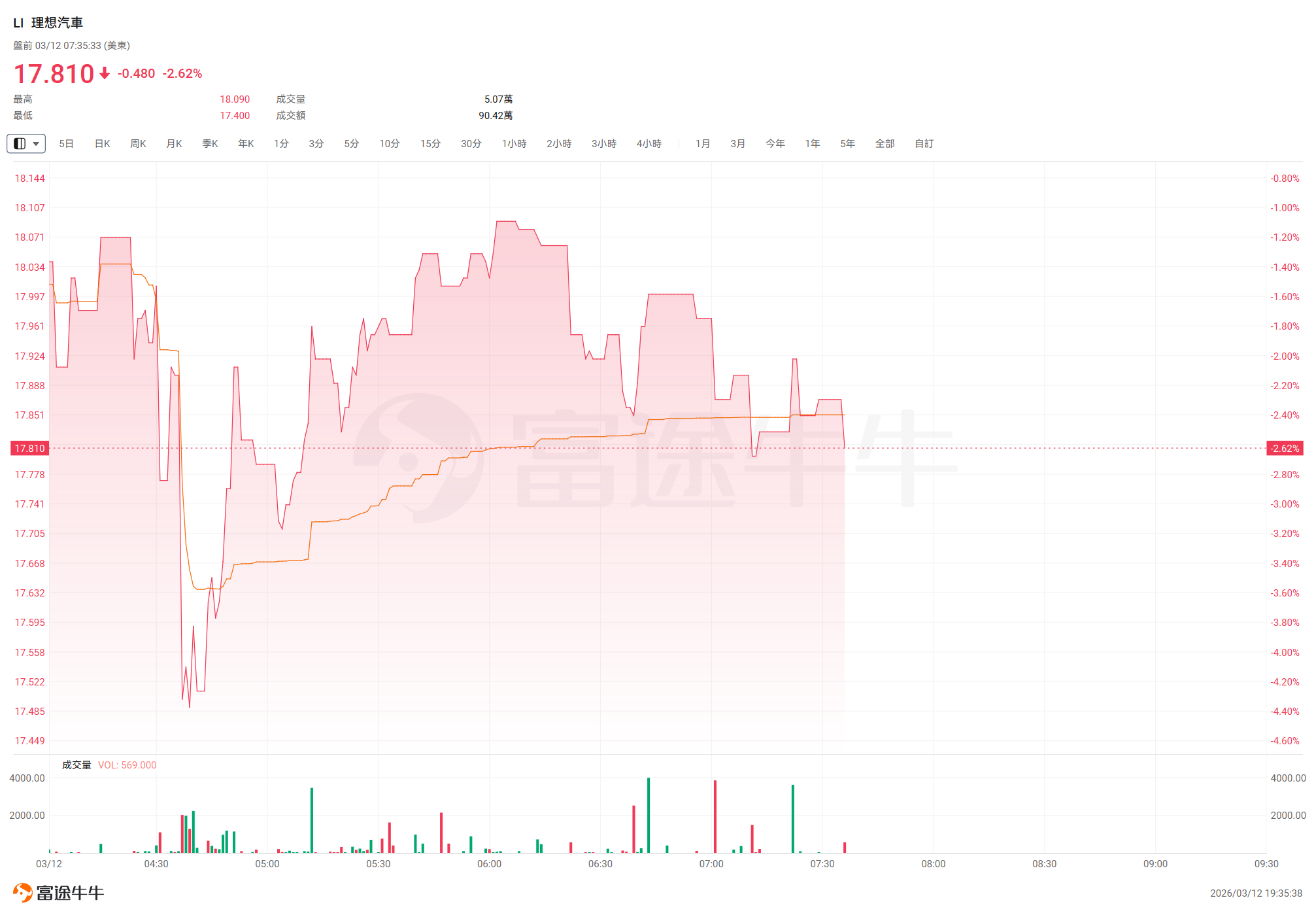
Li Auto's US stock price fell more than 4% in pre-market trading and is currently down over 2%.
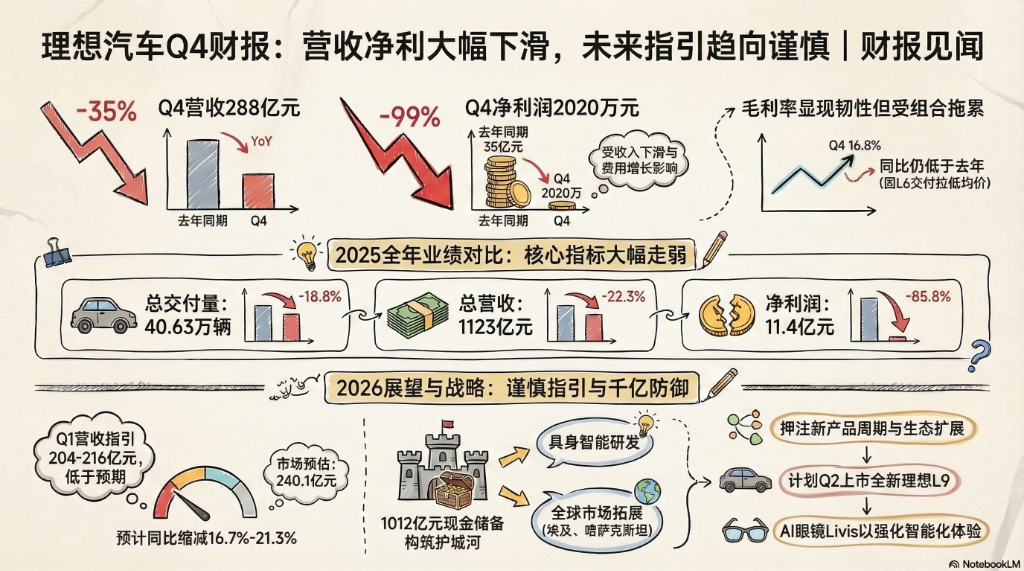
Shrinking deliveries weighed on revenue, but fourth-quarter gross margin demonstrated resilience.
In the fourth quarter of 2025, Li Auto delivered a total of 109,000 vehicles, a year-over-year decrease of 31.2%. This directly impacted the quarter’s total revenue, which dropped to RMB 28.775 billion, marking a year-over-year decline of 35.0%. Of this, vehicle sales revenue amounted to RMB 27.3 billion, a year-over-year decrease of 36.1%.
Despite pressure on the revenue side, cost-cutting measures, including a 14.0% year-on-year reduction in selling, general, and administrative expenses, enabled the company to achieve a slim profit in the fourth quarter, with a Non-GAAP net profit of RMB 274 million.
On the closely watched profitability metric, Li Auto's vehicle gross margin for the fourth quarter was 16.8%, lower than 19.7% in the same period in 2024 but up from 15.5% in the third quarter of 2025. The financial report noted that the year-on-year decline in gross margin was primarily due to changes in product mix, particularly the impact of the delivery of the Li L6 model, which lowered the overall average selling price. However, operating cash flow for the quarter reached RMB 3.5 billion, with free cash flow at RMB 2.5 billion, demonstrating that the company's core cash flow remained positive in the single quarter.

Annual profitability structure shifts, with a reserve of RMB 100 billion in cash forming a defensive stronghold.
Looking at the full-year performance of 2025, Li Auto's total revenue reached RMB 112.3 billion, a year-on-year decrease of 22.3%. Annual gross profit fell to RMB 21 billion, with the overall gross margin narrowing from 20.5% in 2024 to 18.7%. Due to a combination of shrinking revenue scale and a slight increase in R&D expenses to RMB 11.3 billion, the company recorded an operating loss of RMB 521 million for the year, compared to an operating profit of RMB 7 billion in the previous year.
Although the company's full-year Non-GAAP net profit dropped significantly by 77.5% year-on-year to RMB 2.4 billion from RMB 10.7 billion in the previous year, and annual free cash flow turned negative at RMB 12.8 billion, Li Auto's balance sheet remains robust. As of December 31, 2025, the company's cash position (including cash, cash equivalents, and restricted cash) reached RMB 101.2 billion. CFO Li Tie pointed out that this strong cash reserve provides ample momentum for the company to seize opportunities in embodied intelligence and accelerate global expansion.
Sales guidance leans towards conservatism, betting on a new product cycle and ecosystem expansion.
Facing the start of 2026, Li Auto has issued relatively cautious earnings guidance.
The company expects vehicle deliveries in the first quarter to be between 85,000 and 90,000 units, representing a year-over-year decrease of 3.1% to 8.5%; total revenue is projected to range from RMB 20.4 billion to RMB 21.6 billion, reflecting a year-over-year decline of 16.7% to 21.3%. Recent operational data shows that the company delivered 27,600 and 26,400 vehicles in January and February 2026, respectively.
To break through short-term growth bottlenecks, Li Auto is shifting its focus to the upcoming new product cycle and ecosystem expansion. CEO Li Xiang revealed that the all-new Li Auto L9 will be launched in the second quarter of 2026, with anticipated comprehensive upgrades in the powertrain system, autonomous driving, and chassis technology.
Beyond its core automotive business, the company released Livis, an AI glasses product priced at RMB 1,999, at the end of 2025, aiming to deepen the seamless integration of intelligent experiences within car systems. Meanwhile, its globalization efforts are paying off, as it officially entered the markets of Egypt, Kazakhstan, and Azerbaijan in December 2025, further expanding its global footprint.
 Looking to pick stocks or analyze them? Want to know the opportunities and risks in your portfolio? For all your investment-related questions,just ask Futubull AI!

Editor/KOKO