Surging oil prices have fueled inflation expectations, casting a shadow of stagflation over the markets, with traders' bets on interest rate cuts by 2026 nearly evaporating. The bond market's 'fear index' is screaming.
Volatility in U.S. Treasuries surged to a nine-month high as the war with Iran heightened inflation concerns and upended traders' expectations for the Federal Reserve's policy path.
The ICE BofA MOVE Index, often referred to as the bond market's 'fear gauge,' climbed to its highest level since last June as rising oil prices exacerbated inflation concerns, eroded real returns on U.S. Treasuries, and diminished their safe-haven appeal.
 Provocative stances from both U.S. President Trump and Iran have cast uncertainty over the duration of the conflict. The yield on 30-year U.S. Treasuries, which are sensitive to inflation and government spending dynamics, has risen to its highest level in a month, while traders have scaled back bets on any interest rate cuts by the Federal Reserve in 2026.
Jack McIntyre, portfolio manager at Brandywine Global Investment Management, stated: 'As bond investors, we must start thinking from a stagflation perspective, which always brings significant uncertainty. Therefore, from a volatility standpoint, I need to be compensated.'
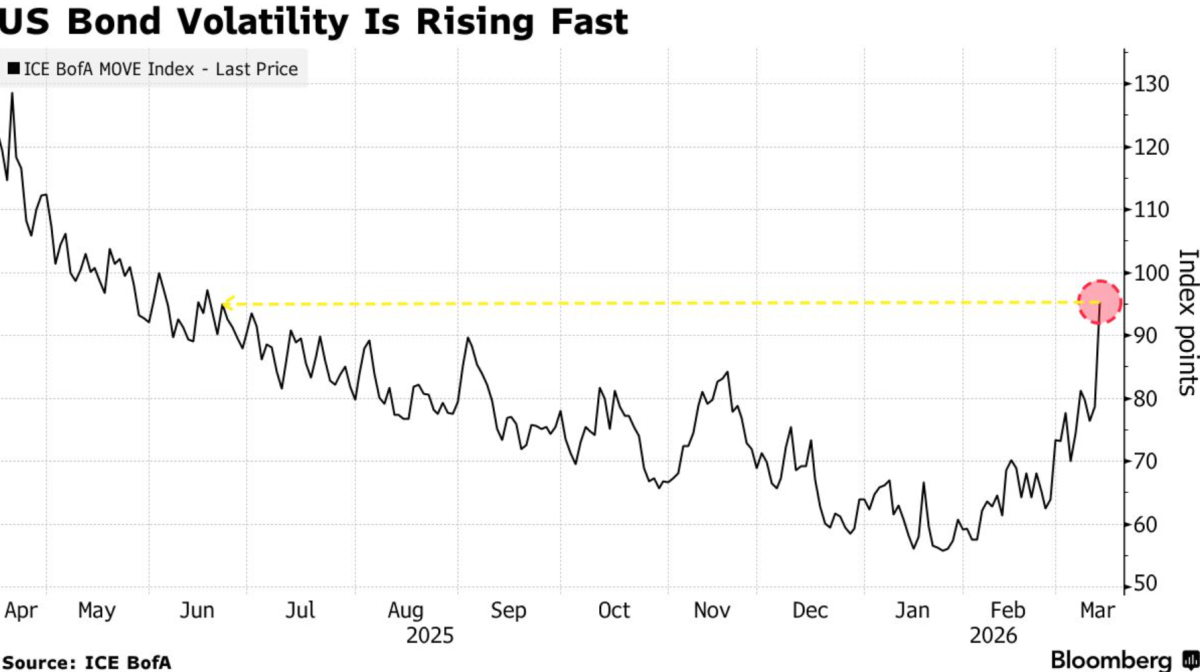
Rapid rise in U.S. Treasury volatility
Since the outbreak of the Iran war two weeks ago, bonds from the U.S. to Japan and Australia have fallen as investors focus on what rising oil prices mean for the global economy. U.S. Treasuries set the tone for global government debt, and yields have continued to climb as investors bet that global central banks may have to raise interest rates sooner to combat inflation.
Trump also renewed his call for Fed Chair Powell to cut interest rates, adding to the risks surrounding U.S. monetary policy outlook and volatility. The yield on two-year U.S. Treasuries has risen to its highest level since last August, while one-year U.S. inflation swaps are nearing 3%—indicating that investors expect greater price pressures ahead.
Chris Weston, head of research at Pepperstone Group, stated: 'Given the inflation dynamics, bonds are not serving as a safe haven. Markets are increasingly signaling that this situation could persist longer, with more pronounced implications for inflation and central bank policies.'
Bloomberg strategist Alyce Andres noted, 'If the situation continues to deteriorate, inflation concerns will further reinforce market expectations that the Fed will maintain higher interest rates for an extended period.'
Volatility and inflation concerns are being reflected in returns. The gains in the Bloomberg U.S. Treasury index so far this year have been almost entirely erased.
As the war persists, Blackrock Investment Institute perceives the risk of stagflationary shocks, while Loomis Sayles warns of U.S. deficit risks, further pressuring bonds. These factors could drive the MOVE index higher.
Marcella Chow, Global Market Strategist at JPMorgan Asset Management, stated, "Any protracted geopolitical tensions and limited visibility of prospects may place additional pressure on the U.S. fiscal situation, triggering further concerns."
Editor/Doris