
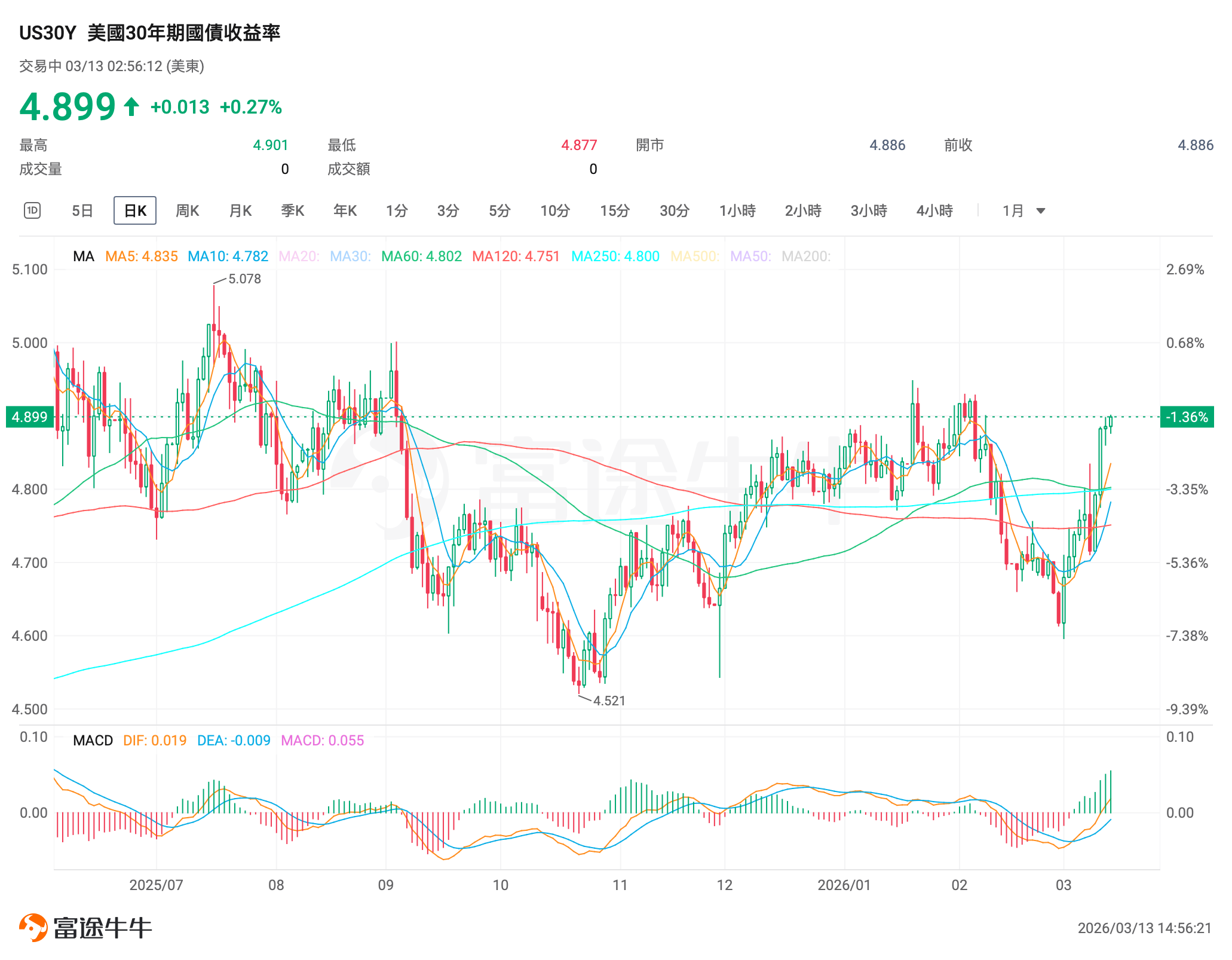
Fiscal deterioration and inflationary pressures are exerting a two-way squeeze on global bond markets. The yield on 30-year U.S. Treasury bonds surged to nearly 4.90%, erasing all gains for the year. From Europe to the Asia-Pacific region, long-term interest rates across countries are under widespread pressure. A combination of multi-billion-dollar war appropriations in the U.S., trillion-dollar deficits, and a sharp decline in tariff revenues has led the market to begin pricing in long-term fiscal sustainability. "A 5% yield may become the new norm."
Fears over fiscal spending triggered by the U.S.-Iran war are sweeping through global bond markets, with long-term government bonds hit by a fresh wave of sell-offs.
On Friday, yields on 30-year U.S. Treasuries climbed to nearly 4.90%, hitting a one-month high. Since the outbreak of the war on February 28, yields have surged by more than 20 basis points, wiping out all year-to-date gains in U.S. Treasury bonds. Bloomberg's index tracking U.S. bond returns has seen its year-to-date performance nearly fall to zero.
 This sell-off is not unique to the United States. From the United Kingdom to Germany, from Australia to Japan, bond yields across the globe have soared, with long-term government bonds under widespread pressure.
Investors are concerned that as the costs of the war continue to rise, governments around the world will be forced to issue substantial debt to fund defense expenditures and provide subsidies to households affected by energy price shocks. This prospect, combined with inflationary pressures driven by rising oil prices, poses a dual threat to fixed-income markets.
Dual Pressures of Fiscal and Inflation Squeeze Long-Term Rates
The recent rise in long-term yields has been driven by both inflation expectations and concerns over fiscal deterioration.
Notably, yields on 30-year Treasury Inflation-Protected Securities (TIPS) rose by 7 basis points this week—while short-term real rates declined due to expectations of slowing growth. This divergence indicates that market concerns over long-term fiscal sustainability now extend beyond cyclical economic considerations.
"The long-end rate is a fiscal story, but it's also a story about government credibility," said Gang Hu, managing partner at Winshore Capital Partners. "It reflects market expectations that Trump will need to spend heavily to finance the war and subsidize consumers facing high oil prices."
The U.S. Congress is currently debating additional war appropriations of up to $50 billion, though the administration has yet to release specific estimates for military operations. Meanwhile, the U.S. budget deficit remains at approximately $1 trillion for the five months ending in February. The Supreme Court's decision to overturn trade tariffs has further eliminated a potential source of revenue that could have brought in hundreds of billions of dollars for the fiscal budget.
"This comes at a time when tariff revenues are reversing, and tariffs themselves are inflationary, just as war is inflationary," said Matt Eagan, portfolio manager at Loomis, Sayles & Co., which oversees more than $430 billion in assets. "It only adds to the deficit problem."
The $22 billion auction of 30-year U.S. Treasury bonds held on Thursday attracted moderate demand after a significant rise in yields, but market participants remain pessimistic about the outlook. 'I don’t see much appeal in the 30-year Treasury bonds until yields break through 5%,' Eagan added.
Global borrowing surges as bond market pressures spread outward
Fiscal pressure is not confined to the United States. In Europe, governments are facing dual pressures from higher defense spending and potential energy subsidies. European Commission President Ursula von der Leyen proposed several measures this week, including a cap on natural gas prices. According to Andrzej Szczepaniak, Senior European Economist at Nomura Securities, European governments may replicate their response during the 2022 energy crisis by issuing joint EU bonds to finance emergency expenditures, which will exert structural pressure on the eurozone bond market.
Asia is no exception. Countries such as Australia and Singapore have successively increased their defense budgets, and Japan’s defense spending this year is expected to reach a record high. Carol Kong, a strategist at Commonwealth Bank of Australia, pointed out that the conflict in Iran could further increase long-term spending pressures for governments across Asia, complicating fiscal consolidation efforts. 'Rising inflation expectations will also push up bond yields, and this applies to all of Asia, including Japan.'
Chris Arcari, Head of Capital Markets at Hymans Robertson, noted that compared with the energy crisis triggered by the Russia-Ukraine conflict in 2022, governments currently have less fiscal space, with higher debt burdens and interest costs. This time, the bond market may be less willing to absorb such large-scale fiscal expansion, or at least will demand higher real yields as compensation.
Investors generally believe that if the conflict persists and governments around the world continue to increase spending, the ongoing expansion of global sovereign debt supply will keep long-term interest rates under pressure. Demanding higher risk premiums for long-term bonds will become the new norm in the market.

Editor/Doris