
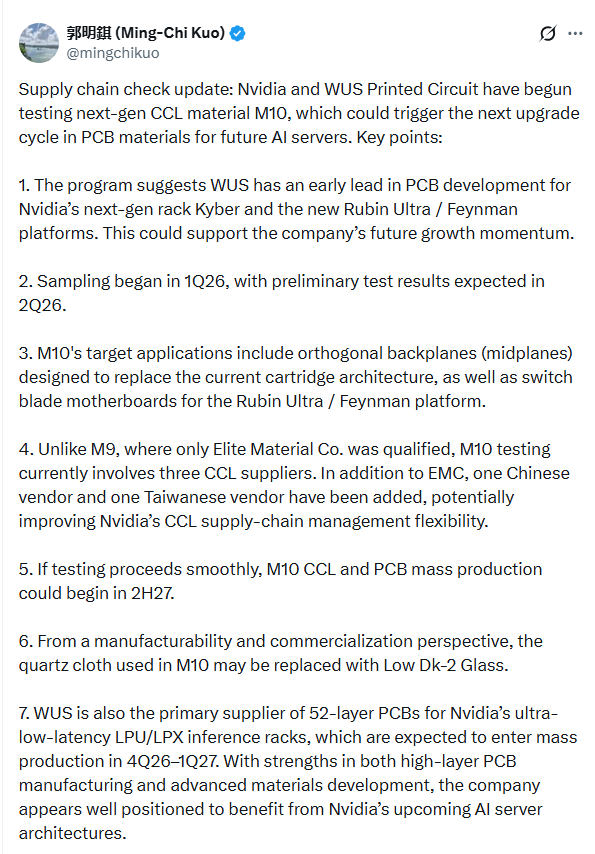
According to Tianfeng International's Ming-Chi Kuo, NVIDIA has initiated testing for the next-generation M10 copper-clad laminate. The targeted applications include orthogonal backplanes and switch blade motherboards for the Rubin Ultra and Feynman platforms, with mass production expected in the second half of 2027. The scope of the M10 testing has expanded to three suppliers, including two additional Chinese manufacturers, which is expected to enhance supply chain resilience.
$NVIDIA (NVDA.US)$The supply chain layout for the next-generation AI server platform is accelerating, and the outline of a new cycle of PCB material upgrades is becoming increasingly clear.
According to the latest supply chain survey by TF International Securities analyst Ming-Chi Kuo, NVIDIA has initiated testing with PCB manufacturers on the next-generation copper-clad laminate (CCL) material M10. Target applications include orthogonal backplanes and switch blade motherboards for the Rubin Ultra and Feynman platforms.
 If testing proceeds smoothly, M10 CCL and PCB products are expected to enter mass production in the second half of 2027.
This round of M10 testing also introduces two CCL suppliers, breaking the previous pattern where the preceding M9 material was exclusively supplied by Elite Material. This development could enhance the flexibility of NVIDIA’s CCL supply chain management.
Initiation of M10 Testing
According to Ming-Chi Kuo's supply chain survey,$NVIDIA (NVDA.US)$Wujiang District-based Compeq Manufacturing Co., Ltd. has officially initiated testing of the M10 CCL material. Sampling commenced in the first quarter of 2026, with preliminary test results expected to be released in the second quarter of 2026.
The primary target application scenarios for M10 include two categories: orthogonal backplanes (mid-planes) specifically designed to replace existing slot-based architectures, and switch blade motherboards for the Rubin Ultra and Feynman platforms.
Both types of applications occupy a core position in NVIDIA's next-generation AI server architecture and impose significantly higher performance requirements on PCB materials compared to current solutions.
Kuo believes that the progress in these tests indicates that Wus Printed Circuit has gained a leading position in the development of PCBs for Kyber racks as well as for the Rubin Ultra and Feynman platforms, which will help support the company’s future growth momentum.
Changes in Supplier Dynamics
The M10 test has witnessed a notable shift in the supplier landscape. In the previous generation of M9 material testing, only one CCL supplier, TUC, passed the qualification.
During the M10 phase,$NVIDIA (NVDA.US)$the testing scope has been expanded to include three suppliers. In addition to Taiwan-based Glotech, two additional Chinese manufacturers have been incorporated.
The introduction of supplier diversification implies that NVIDIA’s bargaining power in high-end CCL procurement and its supply chain resilience are both expected to improve, while also creating a more direct competitive dynamic among relevant suppliers.
Regarding the technical evolution of the materials themselves, Kuo Ming-Chi pointed out that, considering manufacturability and commercialization perspectives, there is a possibility that quartz cloth used in M10 could be replaced by Low Dk-2 glass fiber. This change might further impact material cost structures and supplier qualifications.
If the M10 testing proceeds as scheduled, the mass production timeline will be set for the second half of 2027, marking the beginning of a new cycle of scaled procurement of AI server PCB materials. Relevant supply chain vendors are expected to benefit from this development.
Editor/Melody