
①Tesla announced on Saturday that its Terafab project, aimed at manufacturing AI chips, will commence in seven days; ②This marks another expansion for Tesla beyond its core electric vehicle business, as well as the beginning of a costly and massive undertaking.
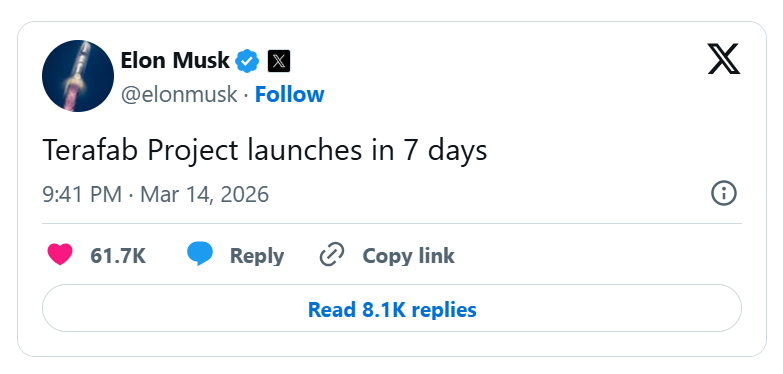
Local time on Saturday, $Tesla (TSLA.US)$ CEO Elon Musk posted on X that the company's Terafab project, aimed at manufacturing artificial intelligence (AI) chips, will commence in seven days.
Musk did not disclose specific details, but he and his team may soon explain to the public how this chip factory will be established.
 This marks another expansion for Tesla beyond its core electric vehicle business, as well as the beginning of a costly and massive undertaking.
Currently, the majority of advanced chip manufacturing worldwide is undertaken by$Taiwan Semiconductor (TSM.US)$, Samsung, $Intel (INTC.US)$ and a few other chip foundries. Tesla procures chips from companies such as$NVIDIA (NVDA.US)$while also designing chips in-house. The company has signed manufacturing agreements with chip foundries such as Samsung and Taiwan Semiconductor.
At present, Tesla is designing its fifth-generation AI chip (AI5) to drive its autonomous driving vision. According to Tesla's official introduction, this chip, which is targeted for mass production by 2027, is expected to achieve performance 50 times greater than the current AI4. AI5 will have nine times the memory capacity and ten times the raw computing power of AI4, and will be applied across a wide range of scenarios from Tesla's electric vehicles to robots, AI training, and data centers.
Tesla's AI6 chip is currently in the early stages of development. Musk has stated that subsequent versions of chips, including AI7, AI8, and AI9, will also be launched. The target cycle for chip design is nine months. It is understood that AI6 will mainly be used for Optimus robots and data center computing, while AI7 will shift toward space-grade AI computing.
Driven by the AI boom, the semiconductor industry is experiencing "unprecedented prosperity," with demand for chips so high that companies like Tesla are facing supply constraints.
Repeated mentions of building an independent chip factory
Over the past few months, Musk has repeatedly stated that Tesla will build a "giant chip factory" to produce AI chips in order to address supply bottleneck issues.
At Tesla's annual shareholder meeting held in November last year, Elon Musk first proposed the concept of building a 'Terafab'—a facility akin to a Gigafactory but specifically for producing artificial intelligence chips. The goal is to achieve complete vertical integration.
Musk stated at the time that he anticipated Tesla would need to establish a 'gigantic' chip factory to fulfill its ambitions of manufacturing autonomous vehicles and humanoid robots. He remarked, 'I see no other way to achieve the level of chip production we desire.'
He also mentioned at the time that Tesla might collaborate with Intel. 'Did you know? Perhaps we will engage in some collaboration with Intel,' Musk told Tesla shareholders. 'We haven't signed any agreements yet, but it might be worth discussing with Intel.'
Earlier this year, Musk announced plans to build a 2nm chip factory and challenged the semiconductor manufacturing industry’s 'cleanroom' standards. In an interview, he made a surprising statement, claiming he would build a 2nm chip factory where one could 'smoke cigars and eat burgers.'
During Tesla's earnings call in January, Musk again mentioned the idea of constructing its own chip factory. He also noted that existing chip suppliers could not meet demand.
Musk's 'chip-making' dream was met with skepticism.
According to Musk's previous statements, he aspires to achieve an annual chip production volume of 100 billion to 200 billion units. Technically, this would make his factory one of the largest chip plants globally.
Clearly, Musk has firmly set his sights on entering the chip manufacturing sector, but some experts have expressed doubts, calling Musk's ideas 'far-fetched.'
Some have pointed out that the entry barrier for the semiconductor manufacturing industry is extremely high, and building a chip factory from scratch is arguably one of the most challenging technical feats in the world. Others believe Musk's idea of foregoing cleanrooms is unfeasible.
There is speculation that one possible way to realize Tesla's TeraFab would be through licensing agreements with chip manufacturers like Intel and Taiwan Semiconductor, along with providing the necessary funding to help them establish production lines.
Editor/Rice