
①How do institutions view the subsequent performance of the Hong Kong stock market? ②Why did Tencent Music lead the market decline this week?
Cailian Press, March 20 (Editor Hu Jiarong) The Hong Kong stock market continued its volatile adjustment pattern this week, with all three major indices weakening collectively. By the close, the Hang Seng Index had fallen 0.74% cumulatively to 25,277.32 points; the Hang Seng Tech Index fell 2.12% cumulatively to 4,872.38 points; and the Hang Seng China Enterprises Index dropped 1.12% cumulatively to 8,574.07 points.
This week's market exhibited characteristics of 'index pullback and structural divergence,' with the focus of capital competition shifting from sentiment-driven factors to fundamental validation.
 Specifically, the Hang Seng Tech Index rebounded from a low of 4,935.85 points at the beginning of the week to a high of 5,232.33 points, followed by consecutive pullbacks that breached the 4,900-point level; the Hang Seng Index and the Hang Seng China Enterprises Index showed similar movements.
Institutions indicate that four key supports are forming a bottom, with the main focus shifting to valuation recovery.
A Galaxy Securities research report pointed out that the resilience of Hong Kong stocks stems from four core logics:
Valuation trough: The price-to-earnings ratio of major indices is in a historically low range.
High dividend attractiveness: Dividend yields of some sectors are significantly higher than comparable global assets.
Support from southbound capital: Continuous net inflows provide liquidity support.
Dual nature of assets: A strategic allocation target for Chinese capital and a tactical hedge function for global capital.
Outlook for Investment Themes in the Next Six Months:
Discretionary consumption: Strong domestic demand-driven characteristics, with notable earnings growth and profitability stability, demonstrating strong resilience against external shocks.
Financial sector: Valuation at historical lows, with ample safety margins; significant upside potential following improvements in the policy environment.
Technology sector: Communication services (high dividends, essential consumption attributes) form a defensive base, while software services (AI, digital economy) provide growth elasticity.
Individual stock performance: A tale of two extremes, with significant divergence driven by underlying logic.
Underperforming stocks: Pressured by fundamentals, liquidity, and expectations.
Tencent Music-SW (01698.HK) fell 25.14% cumulatively during the week. The primary reason was a loss of 23 million monthly active users (MAU) in online music in Q4 last year, declining to 528 million, raising concerns about peaking user growth.
DeepTech (01384.HK) fell 24.17% cumulatively during the week. Previously hyped to a high of 120 HKD due to inclusion in Stock Connect and AI concept speculation, funds exited en masse after profit-taking. Additionally, a forecasted net loss exceeding 900 million yuan in 2025, coupled with high valuation lacking profit support, led to selling pressure amid sector divergence.
Shandong Gold (01787.HK) fell 14.35% cumulatively during the week. International gold prices plummeted over 600 USD/ounce in a week, as the Federal Reserve signaled an ultra-hawkish stance of only one rate cut for the year, boosting the US dollar and Treasury yields, sharply increasing the holding costs of gold as a non-interest-bearing asset.
Outperforming stocks: Resonance of event-driven and fundamental realization.
Maoji Kuiyong (01716.HK) surged 86.75% cumulatively within the week. The actual controller has changed to a key figure of Xilian Technology, a leader in the indium industry. Market expectations suggest that hard technology assets such as photovoltaic/semiconductor targets will be injected, shifting the valuation logic from traditional media stocks to the new materials sector. Coupled with a small market capitalization and light free float, speculative trading effects have amplified gains.
Bright Smart Securities (01428.HK) rose 27.40% cumulatively during the week. Ant Group's acquisition received final regulatory approval from mainland authorities, empowering the company with traffic, technology, and licensing resources, breaking through the growth ceiling for regional brokers. Additionally, the surge in average daily turnover in Hong Kong stocks directly benefited the brokerage sector.
Zhipu (02513.HK) gained nearly 19% within the week. The company recently launched the GLM-5-Turbo large model to reinforce its technological barriers, while raising API prices by 20%, demonstrating commercialization capabilities and pricing power. Continuous inflows from southbound funds and institutional investors have established it as a benchmark for 'earnings realization' in the AI sector.
Today's Market
The Hong Kong stock market continued its volatile adjustment pattern. The three major indices opened lower collectively and weakened further during trading. By the close, the Hang Seng Index fell 0.88%, the Technology Index dropped 2.48%, and the China Enterprises Index declined 1.40%. The market exhibited significant structural divergence, with storage-related concepts, OPENCLAW, and SaaS stocks leading the declines.
Industry High Growth Diverges from Stock Price Correction: Montage Technology Falls Over 3%
By the close, Montage Technology (06809.HK) fell 3.43%, and GigaDevice Semiconductor (03986.HK) dropped 3.18%.

Despite pressure on storage concept stocks, the industry’s fundamentals remain robust. Samsung Electronics announced plans to invest over 110 trillion Korean won by 2026 to strengthen AI R&D and storage capacity. Driven by AI infrastructure development, demand for high-bandwidth memory (HBM) is surging, while supply tightness for general-purpose DRAM persists.
Earnings Divergence Among Leading Companies Triggers Volatility in Tech Stocks; Alibaba Drops Over 6%
By the close, Xiaomi Group-SW (01810.HK) fell 8.59%, Alibaba-SW (09988.HK) dropped 6.29%, and Kuaishou-W (01024.HK) declined 2.80%.
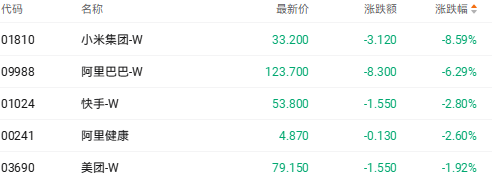
Recent developments indicate critical signals from tech giants: Alibaba reported a mere 2% revenue increase for Q3 of fiscal year 2026, while adjusted net profit plummeted 67% year-over-year. Notably, Alibaba Cloud revenue grew by 36%, with AI product revenue achieving triple-digit growth for ten consecutive quarters.
Xiaomi Group launched the SU7 model and announced an AI investment of no less than 60 billion yuan over three years. The market's cautious evaluation of profitability quality, AI investment return cycles, and valuation alignment has become a core driver of the tech stock adjustments.
Meanwhile, SaaS concept stocks also experienced adjustments. By the close of trading, Fubo Group (03738.HK) fell 6.45%, Shiteng Group (02562.HK) dropped 6.08%, and Lexiang Group (06988.HK) declined 4.26%.
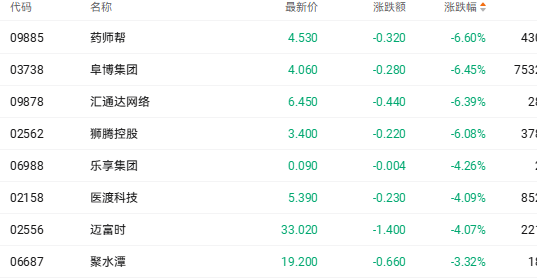
Amid weakening overall market sentiment, investor tolerance for high-valuation, long-cycle growth sectors has significantly decreased. Although SaaS companies possess a long-term digital transformation narrative, short-term earnings realization timelines and cash flow performance have become key considerations for investors, prompting a phase of valuation logic reassessment.
Unusual stock price movements.
Sinotruk rose more than 8%. Analysts believe that robust heavy truck exports will continue into 2026.
Sinotruk (03808.HK) surged 8.40%, closing at HKD 37.94. In terms of news, Sinotruk exported over 16,000 heavy trucks in January, setting another record high. According to China Customs, heavy truck exports in 2025 increased by 12.5% year-over-year to 371,000 units. CICC noted that strong infrastructure demands, such as real estate and highways, in regions like Vietnam, coupled with robust mining investment needs in Indonesia, Congo, and Tanzania, suggest sustainable growth potential for heavy truck demand across Asia, Africa, and Latin America.
Li Ning shares once surged nearly 13% following its earnings release, reporting a 3.2% revenue increase last year to RMB 29.598 billion.
Li Ning (02331.HK) gained 8.56%, surging nearly 13% intraday. Following yesterday’s announcement of the group's audited consolidated results for the fiscal year ending December 31, 2025, the company reported revenues of RMB 29.598 billion, up 3.2% from the same period in 2024. Gross profit reached RMB 14.489 billion, representing a 2.4% increase from 2024, with an overall gross margin of 49.0%.