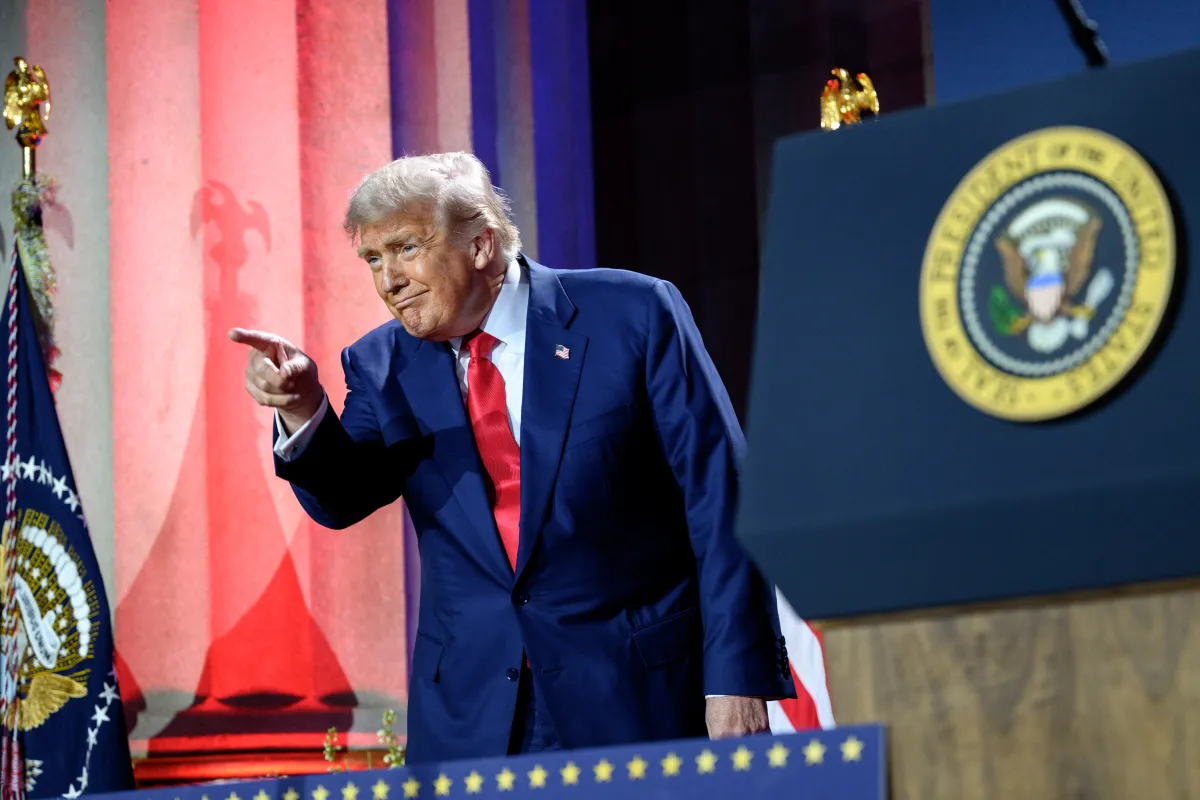
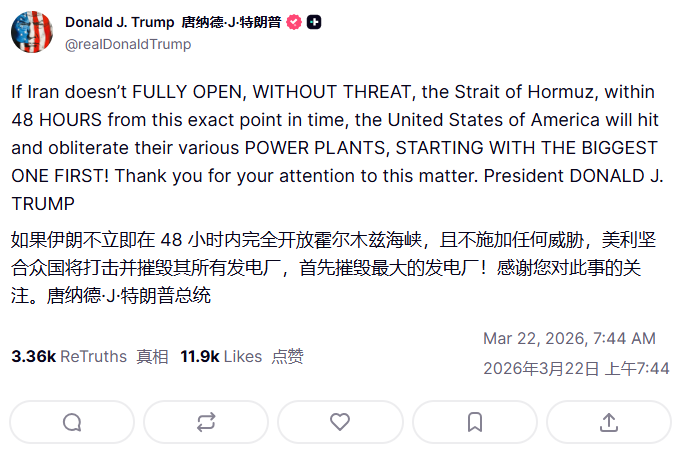
Trump posted on the social platform "Truth Social," demanding that Iran fully open the Strait of Hormuz within 48 hours, or the United States would strike and destroy various power plants within Iran. "The largest one will be the first target." Just a day earlier, Trump had indicated he was considering "gradually reducing" military operations in the Persian Gulf.
According to CCTV News, on March 21 local time, U.S. President Trump posted on the social platform "Truth Social," demanding that Iran fully open the Strait of Hormuz within 48 hours, otherwise the United States would strike and destroy various power plants within Iran, with "the largest one being the primary target."
Notably, just one day earlier, Trump had expressed that he was considering "gradually scaling down" military operations in the Persian Gulf.
A shift in tone: From 'withdrawal' to escalating threats
 In after-hours trading on Friday, Trump had just sent a de-escalation signal, stating that the U.S. was "very close to achieving its set objectives" and was considering gradually downgrading military actions against the Iranian regime in the Middle East. He also stated that the patrol duties in the Strait of Hormuz should be undertaken by countries dependent on the strait, and the U.S. would no longer assume responsibility.
However, within less than 24 hours, Trump’s wording took a 180-degree turn, directly issuing a 48-hour ultimatum to Iran, threatening to strike its power facilities.
This back-and-forth has left governments and markets struggling to cope. Previously, Trump pressured NATO allies to deploy troops to help secure the safety of the strait but faced widespread rejection, prompting Trump to label the allies as "cowards." The U.S. had also promised naval escorts and government-backed reinsurance programs to reduce risks for vessels passing through the strait, but there are currently no signs of any tankers successfully passing under U.S. naval escort.
Meanwhile, despite Trump urging Israel to halt strikes against regional energy assets—strikes that could trigger retaliatory attacks by Iran on oil and gas infrastructure, further restricting global supply—the regional conflict continues to escalate.
Last Wednesday, Israel attacked Iran's South Pars gas field, prompting Iran to retaliate by striking the world’s largest LNG facility located in Qatar. On Saturday, Israel and Iran exchanged missile fire again, with Iran launching missiles at Dimona, a city in Israel, resulting in over 100 people injured across several locations in southern Israel.
Additionally, Iran fired ballistic missiles at the U.S.-UK joint military base on Diego Garcia on Friday. Although the base, located approximately 4,000 kilometers from Iran, sustained no damage, the attack demonstrated long-range strike capabilities beyond previously known limits. Israeli Defense Minister Katz stated on Saturday that joint military actions would be "significantly strengthened."
Week Four of the Conflict: Energy Shocks and Market Turmoil
The Middle East conflict has entered its fourth week, with the Strait of Hormuz nearly closed. The strait carries approximately 20% of the world's oil and natural gas transportation, and its paralysis has triggered a severe energy supply shock.
Brent crude settled at $112.19 per barrel on Friday, the highest level since mid-2022, with a weekly increase of about 9% and a monthly surge of nearly 50%. According to data from the International Energy Agency, this conflict has caused the largest supply disruption in the history of the global oil market, with oil-producing countries around the Persian Gulf collectively cutting production by approximately 10 million barrels per day.
The spike in energy prices is spreading into the broader economy. European TTF natural gas prices have risen to their highest level since January 2023, while the average price of diesel in the U.S. surged above $5 per gallon again this week. Bloomberg analyst Nathan Risser pointed out that diesel powers essential machinery ranging from tractors in fields to long-haul trucks across states, meaning rising fuel costs will ultimately be passed on to everyday consumer goods like food.
The surge in oil prices is also reshaping market expectations for the Federal Reserve’s policy path. Markets are now pricing in a 50% probability of a Fed rate hike by the end of 2026, forcing bond traders who previously bet on rate cuts to revise their strategies. Gennadiy Goldberg of TD Securities remains cautious about rate hikes, arguing that the oil price surge should delay rate cuts due to stagflation pressures, but if the increase is substantial enough, it may cause financial conditions to tighten, potentially prompting the Fed to respond with rate cuts.
The U.S. Treasury Department has implemented extraordinary measures, allowing Iranian oil and petrochemical products already loaded onto ships to be sold under the existing sanctions framework. The surge in oil prices poses domestic political risks for Trump, with only eight months remaining until the midterm elections, as voter concerns over the economy and cost of living become key variables.
Analysts including Helima Croft of RBC Capital Markets noted in a research report, "There is currently no indication that this is a limited engagement," and Tehran still "effectively controls the Strait of Hormuz," leaving market uncertainties far from resolved.
Editor/Ray