
Source: Yiliu Investment Research Notes
01. Contrarian Thinking
1. The first type of contrarian thinking involves not focusing on how to achieve a goal, but rather on how to move further away from it.
For example, business owners can consider: What actions could lead to rapid losses for the company?
 Investors might think about: What approaches could result in being trapped or losing everything?
Success often requires too many conditions. First, one must avoid failure, and only then is success possible. Luck sometimes plays a significant role in determining success. Often, avoiding failure allows one to benefit from the dividends that luck brings.
2. The wise learn more from fools because the wise always avoid the mistakes made by fools, while fools do not emulate the successes of the wise. — Marcus Porcius Cato
Learning from failures is the second type of contrarian thinking.
Learning from mistakes yields far greater rewards than learning from success, as successful practices involve multiple factors that are not easily discernible, whereas the lessons of failure often have very clear characteristics.
Studying errors is more likely to inspire deep reflection.
Humans are more adept at finding faults than identifying strengths. Particularly, humans often worship the powerful without reservation, while showing disdain for failures. Under such disdain, there tends to be little restraint in fault-finding.
Certainly, when observing human behavior, it is easy to notice that the more foolish individuals tend to be more arrogant and consider others as fools, whereas the wise never see themselves as wise. This is a rather peculiar phenomenon.
3. 'We can begin our thinking from the ultimate goal, assuming we have already found a way to achieve it.' — Pappus
This represents another form of reverse thinking, which involves contemplating from the endpoint and assuming the goal has been achieved.
Through such contemplation, we can adjust our objectives to avoid heading in the wrong direction.
If the direction is incorrect, time and effort may ultimately be wasted. Even if the earlier-set goal is reached, one might realize that it was not the desired outcome after all.
Although the scope of choice for ordinary people is relatively narrow and effort remains essential, we can still decide in which direction to invest our efforts and where to allocate our time.
02 Risk Awareness
1. A perspective can only be deemed valid after considering all potential negative factors. — Charlie Munger
In fact, a viewpoint that ignores negative factors cannot be regarded as a true perspective but merely an enumeration of positive information. Thus, the 'viewpoints' of brokerage firms largely cannot be considered genuine perspectives.
Perhaps this is also one of our distinctive traits: we tend to extensively highlight the flaws of foreign countries, while for our own shortcomings, we emphasize a kind of 'tacit understanding.' For issues around us, those in the know turn a blind eye to maintain superficial harmony. Meanwhile, those who are unaware end up being misled and suffer the consequences.
When it comes to investment, such negligence is absolutely unacceptable. Fooling around like this will eventually lead to not only actual financial losses but alsoOpportunity costlosses in terms of opportunity cost.
2. "At the beginning, he tests the waters with small steps; if the difficulty is too great, he chooses to give up. He lived a happy and prosperous life." — Charlie Munger
Giving up is not a shameful act. In many cases, it is an embodiment of wisdom, albeit perhaps appearing less exciting.
But when it comes to investing, why does it have to look so thrilling? Or put another way, why try to find excitement through taking risks? Isn't earning stable returns more satisfying?
3. "If you cannot tolerate the bitter consequences in the future, then do not sow the seeds of such actions." — Warren Buffett
For young people, although their ability to bear risks may be relatively high, the mistakes they often make lie in either not knowing what the adverse outcomes might be or naively assuming that negative results won’t occur.
The greater issue is that even though these are adverse outcomes, we still cannot comprehend the extent of their severity.
4. "We proceed cautiously to ensure there’s always a way out in case of unforeseen circumstances." — Charlie Munger
The future is unpredictable, and unforeseen events can sometimes lead to severe consequences. Therefore, we particularly need a margin of safety. This margin ensures that even in the worst-case scenario, there remains a chance for survival.
What is the most serious outcome in stock investment? It is the total loss of capital, where nearly all money is lost. Naturally, this leads to certain principles, such as not using leverage, not investing all funds in the market, always maintaining a stable cash flow, and not buying at high prices while expecting even higher returns.
03, Attitude Towards Life
1. "Life is not short; it's just that we waste too much time." — Seneca
This means the length of life depends on how we use our time. Besides work, time can be spent playing games, watching videos, reading, or writing. There are also differences in working hours: ordinary people perform specific tasks, whereas leaders direct the work of others.
Seneca also said, 'We never think about the day we will die, nor do we realize how fragile life is, and we often overlook the swiftly passing time.'
The most important way to value time is often this: determine your circle of competence, then adhere to and expand it.
2. Honesty represents true freedom
Honesty means perceiving and treating things as they truly are, akin to 'observing with a mirror, neither bringing nor sending away.' Do not view the world or oneself through tinted lenses.
Of course, society often contains various forms of pretense and all kinds of deception. Among legitimate professions, politicians are often the least honest, saying one thing but doing another, frequently dedicated to misleading and duping the public, and exploiting the trust of the people.
In investing, honesty is an essential quality. One must be honest about information and stock prices, rather than constantly adopting a personal stance or subjective expectations.
3. "Life is too serious to be taken seriously." — Oscar Wilde
One should not be overly serious in life or excessively suppress oneself; instead, adopt a humorous and positive attitude towards life.
Buffett said, "Don't focus on money. Do what you love, and if you do it well, the money will come to you naturally." Constantly focusing on money can make one nervous and bring unnecessary pressure.
4. "He who has no extravagant hopes is always happy because he will never be disappointed." — Benjamin Franklin
Excessive expectations often lead to psychological imbalance, overcommitment, or excessive risk-taking. Falling short of these expectations may result in disappointment, which triggers feelings of discouragement and further leads to poor judgment.
Another meaning of this statement is that one should not always live with a victim mentality, as such thinking is easy and diverts one’s attention. When unpleasant events occur, consider how to avoid them next time.
Without excessive desires, one can better live in the present and focus on the tasks at hand.
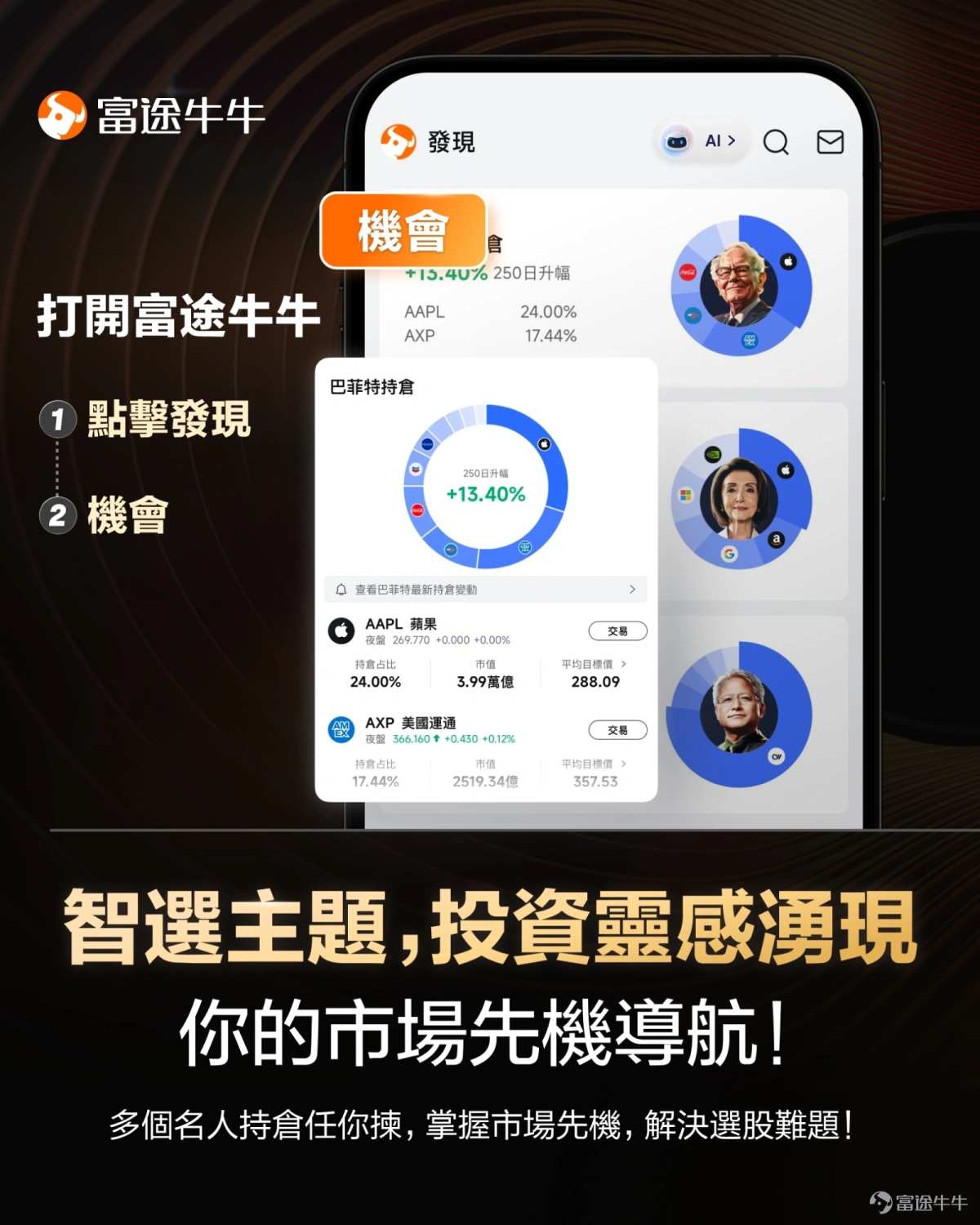
 Futubull【机会页】Celebrity portfolio tracking opportunities have been launched! Multiple celebrity portfolios are available for selection, allowing you to follow the strategies of major players with one click, accurately locking in high-quality investment targets, and investing with greater confidence!
Editor/Rice