
Source: Qile Club
The longer one engages in investment, the more one realizes that the most reliable approach is a simple yet profound methodology that strikes at the essence, and the most critical aspect is success in terms of overarching strategy and strategic vision.
01
The two ends of investment are analysis and trading, with waiting being the bridge that connects them. The core of investment analysis lies in business acumen and probabilistic thinking, while the essence of investment trading revolves around odds and contrarian reasoning. The key to waiting is adhering to one’s circle of competence and respecting common sense.
 In the long run, superior trading cannot salvage poor analysis, but excellent analysis may be undermined by subpar trading. However, the hardest skill to master remains learning how to wait (whether in stocks or futures).
Investment performance is always validated retrospectively, yet the medium- to long-term probabilities and odds of each investment can be determined in advance. Outstanding results are merely the outcome; the underlying causes are what truly matter.
Effort, talent, and luck may be the three most critical factors: striving in the right direction sets a baseline for success, talent determines the efficiency and time cost of growth, while luck often bestows unexpected rewards upon those who persistently adhere to correctness.
Successful investors are less defined by their ability to calculate and choose than by their understanding of when to relinquish and persevere. Rather than excelling at multitasking or having a broad perspective, they maintain unwavering focus. It is not extraordinary talent or exceptional insight that defines them, but rather a profound awareness of their limitations, coupled with a clear understanding of what is feasible and what is not in the market. So-called investment gurus do not possess mysterious revelations; they simply remain loyal to the principle of compounding and consistently put it into practice.
Those who understand compounding know that its sustainability conflicts with profitability (similar to ROE). High compounding rates and long durations are mutually exclusive, with Buffett’s nearly 25% over 50 years representing the current human limit (those who claim to surpass Buffett by only looking at high compounding rates without considering time have barely scratched the surface of investing).
After achieving high compounding rates, reverting to the mean is inevitable, driven by both objective and subjective factors. The best scenario in an investment career is an initial phase of high compounding followed by robust and enduring consistency thereafter.
02
At certain stages, investing can easily become fixated on constructing a “perfect system,” which is not much different from dedicating one’s life to building a perpetual motion machine. The more complex the system and the deeper the immersion in minutiae, the further one drifts from the essence of investing.
The longer one engages in investment, the more one realizes that the most reliable approach is a simple yet profound methodology that strikes at the essence, and the most critical aspect is success in terms of overarching strategy and strategic vision.
A perilous situation for an investor is prematurely feeling as though they hold all the answers. If this is compounded by boredom or a competitive streak, resulting in verbal attacks on those with slightly differing views, it generally signals little room for further improvement.
Of course, investing has principles that are immovable, but the weighting of different elements in investment does not follow a 'sacred model.' This is not to advocate fickleness but to maintain an open mindset, which is itself a form of capability.
03
Concentration or diversification? If considered from a specific phase perspective, it depends on whether flexibility (the fish) or security (the bear's paw) is more important to you.
If considering the long-term norm, concentration seems to represent high confidence in the depth of company research and analysis. However, on second thought, if one were truly that confident, they should be able to identify more excellent targets and achieve moderate diversification.
Of course, this essentially boils down to a matter of degree, ultimately requiring a balance between research depth and position efficiency, as well as a moderate trade-off between investment flexibility and risk diversification.
The investment decision-making process involves many elements, but if we refine and summarize, three key points stand out:
1. Big-picture thinking: understanding where you stand in the overall market cycle—whether it’s time to be fearful, greedy, or indifferent.
2. Value judgment: placing bets on objects that will belong to future advantageous categories and being friends with time.
3. Expectation gap: clarifying the assumptions behind value judgments and the expectations embedded in valuations, and staying sensitive when significant expectation gaps arise.
04
Investment myths are filled with stories of invincibility, but reality is much harsher—even Buffett admits to continuously making mistakes.
However, why do some people suffer fatal consequences from their mistakes while others do not incur severe losses? The difference lies in:
1. Whether one subjectively acknowledges being an ordinary person who is prone to making mistakes?
2. Are you objectively good at protecting yourself with a margin of safety?
3. Have risks been diversified and compensated with favorable odds? Therefore, losses depend on the pre-processing of errors.
Based on the formula PB = PE * ROE, when ROE equals 8%, even if PE is 35 times, PB would only be 2.8 times. If the company can sustain growth and ROE increases to 25%, then when PE reaches 25, PB will rise to 6.25 times instead.
It can thus be seen that PE reflects expected premium, while PB reflects asset premium. Expectations usually manifest far earlier than actual changes in ROE, whereas PB tends to move in sync with or lag behind changes in ROE.
From this perspective, the core element of valuation is the trend of ROE itself. The greatest mystery of valuation lies not in simple arithmetic operations of indicators but in forward-looking judgments about a company’s future profitability and accurate qualitative assessments of its operational stage.
The so-called 'vaguely correct' means that specific PE and PB figures can be relatively vague (or analyzed specifically), but the judgment on the trend of ROE must be accurate.
A high ROE reflects a company's profitability, while a consistently high and sustainable ROE demonstrates the company's strong competitive advantage. For such excellent companies, the market will inevitably assign a capital premium in most cases, which means a higher PB.
If a high-ROE company exhibits an unusually low PB, you should consider why. Possible reasons include: 1. The market is irrational; 2. The company’s nature is highly cyclical and it is currently at the peak of profitability. Such contradictions may occasionally occur, but fundamentally, high ROE and low PB are contradictory under normal circumstances.
05
In the field of investment, 'dancing with shackles' might not be a limitation but rather a protective mechanism. A typical example is Buffett’s saying, 'Punch only 20 holes in your lifetime,' or the most common practice of regular fixed investments.index fund。
These behaviors seem highly restricted, but over time, it often turns out that the 'shackles' have become golden bracelets. This also explains why the 'freedom of action' of most people cannot outperform their virtual portfolios.
Companies that can continuously generate new expectations are often favored by the market. However, there are two scenarios: one where new expectations revolve around strengthening core businesses or upgrading the industrial chain, and major forecasts are consistently fulfilled, which indicates a promising company with great potential; the other involves frequent shifts in expectations, chasing trends while constantly using new promises to cover unmet old ones, signaling an unreliable or even fraudulent enterprise.
In terms of the relative relationship between companies and prices, purchasing at a statically high price is not ideal but also not the worst-case scenario.
Particularly if the company becomes progressively cheaper in the future, it could turn into an excellent investment opportunity. The most concerning situation is when it appears cheap at purchase but grows increasingly expensive over time, indicating a fundamental flaw in the initial investment logic.
In this case, the ability to quickly correct mistakes is paramount, as the cost of waiting for errors to materialize can be overwhelmingly burdensome.
Operationally efficient companies may seem to lack obvious barriers initially, yet such efficiency might transform quantitatively into qualitative advantages, eventually forming significant entry barriers based on scale, technology, or customer loyalty. However, by the time these factors are confirmed, the company is often nearing maturity.
For such companies, the key focus during early- to mid-stages should include three aspects: 1) Long-term demand expansion; 2) A dedicated team with strong industry ambitions; and 3) Consistent execution in delivering on commitments.
Qualitatively speaking, the deterioration of a balance sheet is undesirable, but the reasons behind it need to be analyzed from different perspectives.
One possibility is accompanied by a significant decline in revenue growth along with abnormal accounts receivable and inventory levels during the same period; another scenario involves rapid revenue growth but requires upfront capital investment or suffers from insufficient economies of scale, leading to a sharp increase in leverage and deteriorating cash flow.
The former often signals that further relaxation of credit conditions will lead to even worse results on the revenue side, whereas the latter arises because surging demand outpaces the current capital’s capacity to absorb it.
06
Today I came across a quote: 'What is limitation? Limitation is when woodcutters imagine emperors carrying golden axes.' It was incredibly apt.
Continuing from the topic above, if you want to learn successful value investing, never spend your days memorizing Buffett's mantras; if you plan to start a business, don't obsess over various success theories. What you need most is to gather information on how others have failed! A person who hasn't thoroughly studied various cases of failure cannot succeed. Those who keep telling you 'so-and-so is great, and doing so-and-so will completely transform you into an overnight success' are either pedantic or frauds.
In a bull market, everyone talks about high volatility, but after several rounds of stock market crashes, attention shifts to 'how to avoid fluctuations in net asset value.' In reality, drawdowns in net asset value are a byproduct of market volatility, and completely rejecting them would be tantamount to opposing investment itself.
However, the same level of volatility carries entirely different meanings depending on the context: in a bubble environment, the focus should be on avoiding volatility, while in an undervalued environment, embracing volatility becomes necessary. In the vast majority of uncertain environments, one needs to calmly endure volatility.
A book mentions, 'A mediocre general, when faced with complex situations, piles up lists of problems and questions, overwhelmed and disoriented. A true leader, however, cuts through the chaos, discerning the essence and key points from seemingly ordinary situations, and acts decisively.'
This principle also resonates with investment decision-making. Outstanding investors excel at identifying the main contradictions in both markets and companies, drawing insights from details to form the 'logical fulcrum' for their decisions.
From a valuation perspective, my primary concern isn’t about something being expensive; rather, it’s about its value being difficult to assess. The core difficulty in assessment lies either in too many variables or in the subject being too far beyond one’s capabilities. My second fear isn’t about something being expensive but falling into the trap of apparent bargains. Seemingly cheap investments can tempt one to act aggressively, but once proven to be traps, they lead to significant losses.
If all other factors are relatively certain, then 'expensiveness' is actually a fairly straightforward issue, at least easier to measure. However, it becomes highly problematic when critical valuation assumptions are unclear or overturned.
In many fields, as long as you work hard, even if you achieve no remarkable results, your efforts still guarantee some basic rewards. However, the cruel and simple nature of investing lies in the fact that it doesn’t care how much effort you put in, but only whether you’re right or wrong.
In this type of work, effort takes a backseat to having the correct values and methodology. Otherwise, heading in the wrong direction means the harder you work, the more obstacles you encounter, and the deeper you fall into obsession, the more irrational you become.
Though both relate to luck, novice investors often appear correct due to good fortune, whereas seasoned investors tend to create their own luck through making correct decisions. The former is random and passive, while the latter is high-probability and proactive.
It is normal for an individual to be lucky once or twice in their investment performance. However, if someone consistently appears to be fortunate, there must be a factor attracting such luck, which we call 'competence.' A sign of enlightenment in investing is the ability to distinguish between the boundary line of competence and luck.
07
A few days ago, a friend on Fenda asked how to pursue a career in professional investing. In fact, professional investing is a high-risk choice, especially with a very high elimination rate during the initial stages. Whether one becomes a professional investor or not is irrelevant; what truly matters is whether they are proficient or not.
Moreover, it is advisable to begin professional investing during a bear market, as the harsh environment allows individuals to more rationally assess themselves and understand the challenges of investing. If one cannot endure, it indicates unsuitability; if they survive, then they can decide whether to continue.
To thrive and succeed in the world of investing, one must rely on a keen sense of risk and a strong intuition for opportunity. Having a nose for risk is fundamental to longevity, as preserving one's capital ensures future opportunities.
If, by chance, one also possesses an intuitive grasp of major opportunities, it becomes difficult to fail. In essence, both risk and opportunity fundamentally involve dealing with uncertainty, and understanding the complexity of the world and recognizing personal limitations form the basis for establishing this mechanism of handling uncertainty.
Life and investing share many similarities: both are inherently uncertain but possess methods to improve long-term success rates. More important than knowing what to do is understanding what absolutely should not be done. The fate of a lifetime often hinges on just a few decisions. Various short-term contingencies will be smoothed out over time, and the final outcome tends to be fair. What one chooses to do determines their height, while the people they associate with determine the difficulty. The greatest pain is not missing out, but realizing the truth too late.
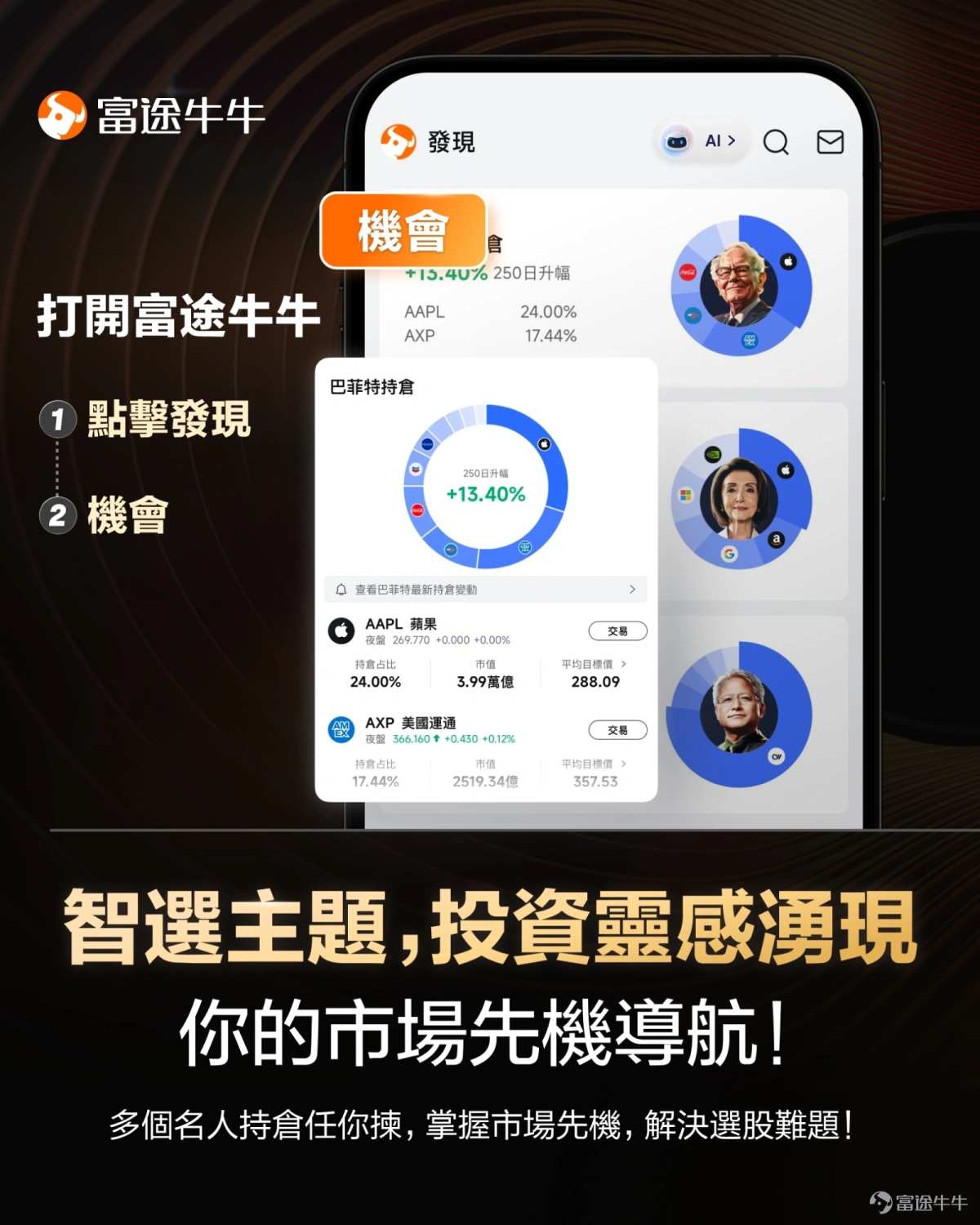
 Futubull【机会页】Celebrity portfolio tracking opportunities have been launched! Multiple celebrity portfolios are available for selection, allowing you to follow the strategies of major players with one click, accurately locking in high-quality investment targets, and investing with greater confidence!
Editor/Rice