
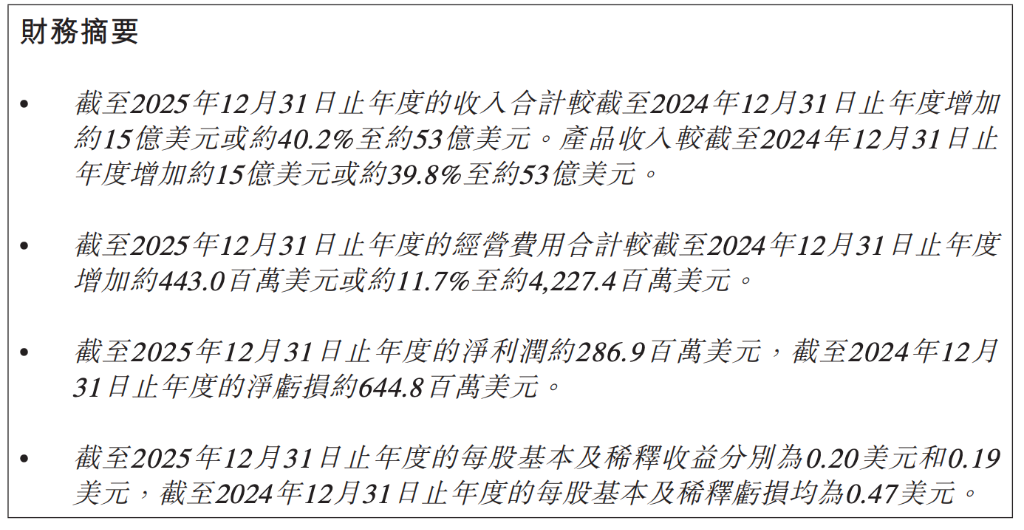
BeiGene reported a 40.2% year-over-year increase in total revenue for the full year of 2025, with net product revenue reaching $5.282 billion, representing a 39.8% year-over-year growth.
Global sales of its core product, Brukinsa, reached $3.928 billion, a 48.6% year-over-year increase, firmly maintaining its leading position in global revenue among BTK inhibitors. Sales of Tislelizumab amounted to $737 million, reflecting an 18.8% year-over-year increase.
$BEONE MEDICINES (06160.HK)$/$BeiGene (ONC.US)$The year 2025 marked a significant milestone in financial performance, as the company achieved a net profit of $287 million for the full year, successfully reversing a net loss of $645 million from the previous year. This is the first time the company has recorded an annual profit since its establishment, signaling that its business model has entered a phase of sustainable growth.
 The company’s total revenue for the year reached $53.43 billion, representing a 40.2% increase year-over-year. Net product revenue amounted to $52.82 billion, growing by 39.8% year-over-year. Global sales of its core product, Brukinsa, reached $39.28 billion, an increase of 48.6% year-over-year, solidifying its leading position globally among BTK inhibitors; Tislelizumab generated sales of $7.37 billion, up 18.8% year-over-year.
Alongside improved profitability, the company’s cash flow situation significantly strengthened. As of the end of 2025, cash and cash equivalents totaled $45.48 billion, a 73.1% increase year-over-year. Net cash flow from operating activities for the full year was $11.28 billion, compared to a net outflow of $1.41 billion in the same period last year. The company stated that it had maintained positive operating cash flow since the third quarter of 2024.
Brukinsa drives global revenue growth with notable contributions from European and American markets
In 2025, the company’s net product revenue reached $52.8 billion, reflecting a 39.8% year-over-year increase. By product:
Brukinsa generated revenue of $39.3 billion, an increase of 48.6% year-over-year, accounting for approximately 74% of total product revenue;
Tislelizumab generated revenue of $7.37 billion, an increase of 18.8% year-over-year;
Revenue from Amgen’s collaboration product, Xgeva (denosumab), reached $3.06 billion, marking a 36.4% year-over-year increase;
Revenue from Blincyto (blinatumomab) reached $1.04 billion, reflecting a 40.2% year-over-year increase;
Revenue from Prolibus (bevacizumab biosimilar, licensed from Bio-Thera) amounted to $47.4 million, representing an 11.4% year-over-year decline.
It is evident that the robust performance of Brukinsa has been the core driver behind the company's turnaround. In 2025, the product achieved sales revenue of $28 billion in the U.S. market, representing a year-over-year increase of 45.1%, primarily driven by steady demand growth across all indications and moderate net price increases. Sales in the European market amounted to $596 million, marking a 66.2% year-over-year increase, with continued market share expansion in key regions such as Germany, Italy, Spain, France, and the United Kingdom. In the Chinese market, sales reached $344 million, reflecting a 33.3% year-over-year growth.
Other income reached $60.97 million, surging by 98.6% year-over-year, primarily due to royalty revenue from IMDELLTRA (talazoparib) under the Amgen collaboration agreement ($40.73 million) and broader market revenue from Novartis. The substantial rise in Amgen royalty income underscores the commercial value of the pipeline and provides strong support for the royalty sale transaction completed with Royalty Pharma in August 2025.
Gross Margin Improvement: Dual Drivers of Structural Optimization and Manufacturing Efficiency
$BeiGene (ONC.US)$For the full year 2025, gross profit reached $4.67 billion, with a gross margin of 87.3%, an improvement of 3 percentage points compared to 84.3% in 2024. The increase in cost of goods sold was only 12.5%, significantly lower than the revenue growth rate of 40.2%, demonstrating a pronounced operating leverage effect.
Management attributed the improvement in gross margin to three factors: first, the increasing revenue contribution from high-margin Brukinsa; second, continuous optimization of manufacturing costs for both Brukinsa and Tislelizumab; and third, the gradual commissioning of the Hopewell production facility in New Jersey, USA, where assets worth $469 million were brought into use during 2025, alleviating depreciation pressure. Notably, one-time costs related to capacity adjustments amounted to $33.9 million, exerting a minor drag on gross margin.
Optimization of Expense Structure and Emergence of Scale Effects
In 2025,$BeiGene (ONC.US)$The company’s R&D expenses amounted to $2.146 billion, a 9.9% year-over-year increase, while sales and administrative expenses reached $2.081 billion, a 13.7% year-over-year increase. Combined, these two expense categories accounted for 78.6% of product revenue, significantly down from 90.2% in the same period last year, indicating a gradual emergence of operating leverage.
The increase in R&D expenses was mainly driven by higher external costs associated with clinical development programs and increased co-development expenses under the Amgen collaboration. The company noted that its global R&D team continues to expand, with an increasing number of clinical and preclinical drug candidates, alongside ongoing efforts to internalize R&D activities.
The growth in selling and administrative expenses was primarily due to continued investment in commercial expansion in the U.S. and European markets. By the end of 2025, the company's global workforce had grown to nearly 12,000 employees, an increase of approximately 1,000 from the previous year.
Robust Financial Position and Ongoing Optimization of Capital Structure
On the balance sheet front,$BeiGene (ONC.US)$As of the end of 2025, total assets stood at $8.189 billion, with shareholders' equity at $4.361 billion. On the liabilities side, total liabilities were $3.827 billion, including a substantial decrease in short-term borrowings to $57.29 million, compared to $852 million at the end of the previous year.
In November 2025, the company signed credit agreements with financial institutions such as HSBC, securing a total of approximately USD 768 million in term loans to refinance its short-term working capital borrowings. Additionally, in August, the company entered into a royalty sale agreement with Royalty Pharma, receiving a non-refundable advance payment of USD 885 million, further bolstering its cash reserves.
Pipeline Progress: Advancing on Both Hematologic and Solid Tumor Fronts
While commercialized products continue to gain traction, the progress of the company’s pipeline is equally noteworthy.
Sotoclax (a next-generation BCL2 inhibitor) was first approved in January 2026 for the treatment of relapsed or refractory mantle cell lymphoma (R/R MCL) and chronic lymphocytic leukemia/small lymphocytic lymphoma (R/R CLL/SLL). The US FDA has accepted its new drug application and granted it priority review status, positioning it to become another blockbuster product in the hematologic oncology field following Brukinsa.
The Phase 3 HERIZON-GEA-01 study of Zanidatamab (Zelunart, a HER2-targeted bispecific antibody) achieved positive endpoints. The company will submit a marketing application for first-line treatment of HER2-positive gastric esophageal adenocarcinoma based on these results, marking the entry into the harvest phase of its solid tumor strategy.
Regarding BTK-CDAC,$BeiGene (ONC.US)$The company is the only one globally to possess potential best-in-class drug candidates across all three key targets for chronic lymphocytic leukemia (BTK inhibitors, BCL2 inhibitors, and BTK degraders). The company’s CDAC platform currently has over 20 projects in various stages ranging from discovery to clinical development.
Editor/Melody