
Shandong Gold achieved a total operating revenue of 104.287 billion yuan for the full year, representing a year-on-year increase of 26.38%; net profit attributable to shareholders was 4.739 billion yuan, up by 60.57% year-on-year; non-recurring net profit attributable to shareholders amounted to 4.993 billion yuan, reflecting a year-on-year growth of 66.91%. The company's gold production in 2025 reached 48.89 tons, increasing by 5.89% year-on-year. Notably, overseas mine production was 12.58 tons, surging by 60.20% year-on-year.
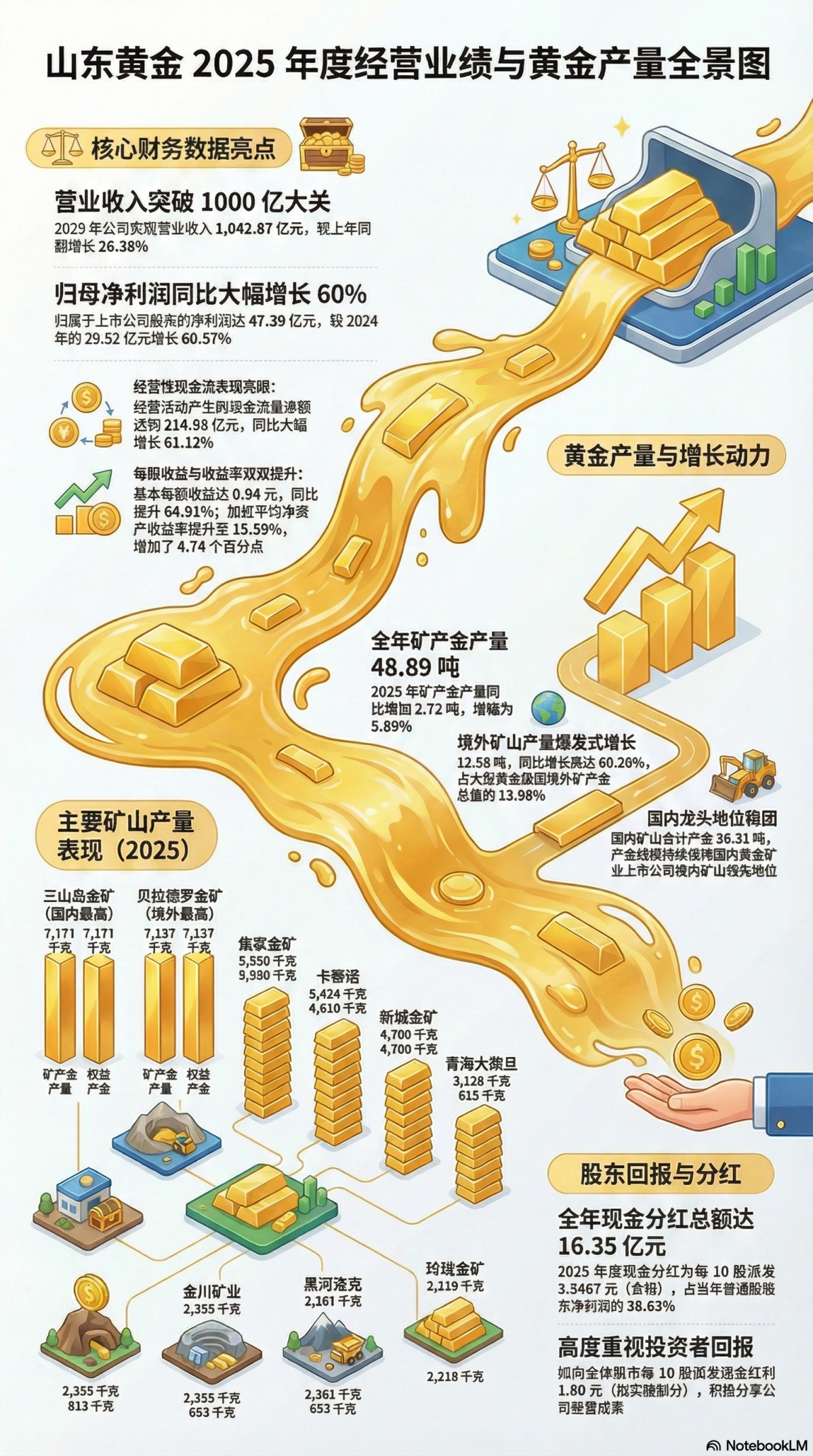
In 2025, when gold prices hit a record high, $SD GOLD (01787.HK)$ the company delivered impressive results characterized by both increased volume and price: annual revenue reached 104.287 billion yuan, representing a year-on-year increase of 26.38%; net profit attributable to shareholders was 4.739 billion yuan, up 60.57% year-on-year; non-GAAP net profit attributable to shareholders amounted to 4.993 billion yuan, with a year-on-year growth of 66.91%, demonstrating significant profitability expansion.
From an operational perspective, growth in gold production became another key theme: the company’s gold output in 2025 totaled 48.89 tons, marking a 5.89% increase year-on-year. Overseas mine production reached 12.58 tons, soaring 60.20% year-on-year, significantly raising its weight in total output and becoming the core driver of growth. Domestic mines collectively produced 36.31 tons of gold, remaining stable compared to the previous year, continuing to solidify the company’s leading position domestically.
In terms of shareholder returns, the company plans to distribute a cash dividend of 1.80 yuan per 10 shares (including tax). Combined with the interim dividend distributed in October 2025 (1.7467 yuan per 10 shares), the total cash dividend for the year is 3.5467 yuan per 10 shares, amounting to a total payout of 1.635 billion yuan, accounting for 38.63% of the consolidated net profit attributable to ordinary shareholders after deducting perpetual bond interest in 2025.
Revenue surpasses 100 billion yuan, with faster profit growth; non-recurring net profit exceeds net profit attributable to shareholders.
 Driven by rising gold prices and expanded production, the company’s revenue and profits both increased in 2025, but profit growth notably outpaced revenue growth:
Revenue: 104.287 billion yuan (+26.38%)
Total profit: 9.089 billion yuan (+59.95%)
Net profit attributable to shareholders: 4.739 billion yuan (+60.57%)
Non-recurring net profit attributable to shareholders: 4.993 billion yuan (+66.91%)
Notably, non-recurring net profit exceeded net profit attributable to shareholders, indicating that non-recurring losses weighed on the latter during the reporting period, resulting in relatively higher “profit quality.” Based on a rough calculation of net profit attributable to shareholders divided by revenue, the company's net profit margin attributable to shareholders in 2025 was approximately 4.5%, up from about 3.6% in 2024.
Quarterly Performance: A surge in Q2 and a decline in Q4, with fluctuations in profitability coexisting with the impact of non-recurring gains and losses.
According to quarterly data, the peak profitability in 2025 occurs in Q2:
Q1: Revenue of 25.935 billion yuan; net profit attributable to parent company of 1.026 billion yuan.
Q2: Revenue of 30.830 billion yuan; net profit attributable to parent company of 1.782 billion yuan (the highest for any single quarter of the year).
Q3: Revenue of 27.017 billion yuan; net profit attributable to parent company of 1.148 billion yuan.
Q4: Revenue of 20.504 billion yuan; net profit attributable to parent company of 783 million yuan (the lowest for any single quarter of the year).
On an adjusted basis excluding non-recurring items, Q4's adjusted net profit was 1.048 billion yuan, significantly higher than its net profit attributable to parent company, further confirming the impact of non-recurring gains and losses on the income statement for the quarter. Regarding cash flow, operating net cash flow stood out notably in Q2 and Q4 (approximately 7.977 billion yuan and 6.297 billion yuan, respectively), providing support for the company’s annual cash generation.
Output and Structure: Full-year gold production reached 48.89 tons, with overseas contributions acting as the key driver of incremental growth.
The company's gold production in 2025 totaled 48.89 tons, marking an increase of 2.72 tons year-over-year. The main source of growth came from overseas markets:
Domestic mines: 36.31 tons, remaining essentially flat year-over-year.
Overseas mines: 12.58 tons, an increase of 4.73 tons (+60.20%) year-on-year.
The company disclosed that it has reached 13 domestic and overseas mines producing more than 1 ton of gold annually. In terms of mine output, core domestic mines include Sanshandao Gold Mine (7,171 kilograms), Jiaojia Gold Mine (5,550 kilograms), and Xincheng Gold Mine (4,700 kilograms). Overseas production mainly comes from the Veladero Gold Mine (7,157 kilograms on a 50% consolidated basis) and Kadino (5,424 kilograms).
The company attributed domestic growth to breakthroughs in production continuity projects at Sanshandao, Jinzhou, and Guilaizhuang, which have enhanced capacity. Other factors include the resumption of operations at the Linglong mining area, technological upgrades at Changtai Mining that released additional capacity, and improved ore grades at some mines.
Dividends and Shareholder Structure: A total cash dividend of 1.635 billion yuan was distributed twice during the year, with a payout ratio close to 40%.
The company's board of directors approved the profit distribution plan for 2025, proposing a cash dividend of 1.80 yuan per 10 shares (including tax). Considering the interim dividend for the first half of 2025 (1.7467 yuan per 10 shares), the total annual cash dividend amounts to 3.5467 yuan per 10 shares, totaling 1.635 billion yuan, representing 38.63% of net profit attributable to ordinary shareholders after deducting perpetual bond interest.
In terms of equity structure, as of the reporting date, the controlling shareholder, Shandong Gold Group Co., Ltd., holds 35.17%, while Hong Kong Securities Clearing Company (Nominees) Limited holds 21.59% related to H-share positions. The total number of ordinary shareholders stood at 121,661 at the end of the reporting period, rising to 176,568 by the end of the previous month prior to the annual report disclosure, indicating increased shareholder activity.
As of the approval date of the annual report, the company’s outstanding corporate bonds include two perpetual corporate bonds and multiple science and technology innovation bonds, with a total balance of approximately 8 billion yuan and coupon rates ranging from 2.12% to 3.22%. Among these, the two perpetual science and technology innovation bonds issued in 2023 are structured in three-year interest cycles, allowing the company to choose renewal or redemption upon maturity, providing greater flexibility in funding expansion and overseas project advancement.
Progress is being made both in the Jiaodong base and overseas projects, with deep underground mining and 'zero-waste mine' initiatives accelerating implementation.
In terms of strategic progress, the company stated that it is accelerating the construction of a world-class gold production base in the Jiaodong region (including Jiaojia, Xincheng, and Sanshandao) and advancing the Twin Hills Gold Project of Osino Resources in Namibia. Additionally, efforts are underway to bring the Kadino Namutini Gold Mine and Changtai Mining into full production.
On the technical front, the company received one provincial-level Science and Technology Progress Award in 2025 and led or participated in the formulation of nine standards. In terms of engineering capabilities, the company successfully completed the 2,000-meter-deep auxiliary shaft at Sanshandao Gold Mine (the deepest large-diameter vertical shaft in Asia), strengthening its ability to develop deep resources.
In terms of green initiatives and safety, the company has advanced a three-year campaign focused on addressing the root causes of production safety. Notable progress has been made in the resource utilization of tailings — the 'Xinhui Company Flotation Tailings Backfilling Heiyang Mountain Project' has been designated as one of Shandong Province's first pilot projects for large-scale solid waste backfilling using tailings. Additionally, seven units, including the Sanshandao Gold Mine, have been awarded the municipal-level titles of 'Zero-Waste Mine' and 'Zero-Waste Factory'.
Editor/Doris