
The yen fell below the 160 mark during trading hours, prompting Japan's top foreign exchange official to issue his sternest warning yet of 'verbal intervention' on Monday. He explicitly noted that speculative activities have raised increasing concerns, and if the situation persists, the government may take 'bold action' 'very soon.'
Japan's top forex official issued the strongest warning yet to speculators after the yen fell below a key level, stating that if the current situation persists, the government may need to take bold action in the foreign exchange market.
Junichi Shimomura, Deputy Minister for International Affairs at Japan's Ministry of Finance, told reporters on Monday: 'We have noticed increasing speculation not only in the crude oil futures market but also in the forex market, raising growing concerns. If this situation continues, we believe decisive action may be needed soon.'
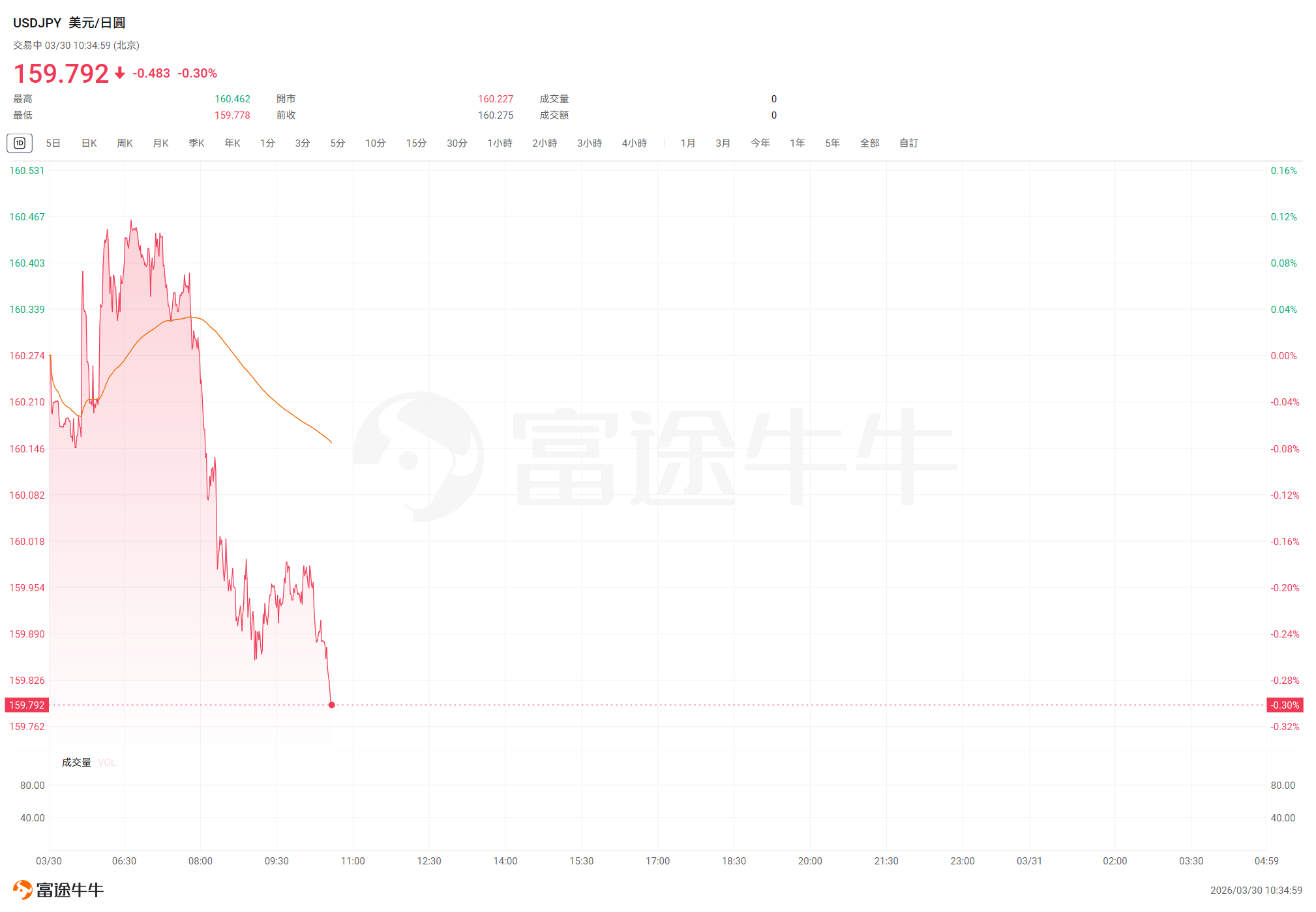
 Sanmura made the remarks after the yen fell below the 160-yen-per-dollar level over the weekend, marking its lowest point since Japanese authorities intervened in the market in July 2024. Following his comments, the yen strengthened, briefly rebounding to 159.85 after dropping to 160.46 earlier on Monday. During Monday's trading session,$Japan 30-Year Treasury Notes Yield (JP30Y.BD)$the yield rose by 4 basis points to 3.740%.$Nikkei 225 (.N225.JP)$plummeted by as much as 5%.
He stated, 'We are prepared to respond on all fronts, with our attention being broad and comprehensive.' This indicates that the government is not only monitoring the forex market but also keeping an eye on the crude oil futures market. Last week, the Japanese government hinted that it might intervene indirectly in the oil market to support the weakening yen.
Comments from Bank of Japan Governor Kazuo Ueda during a parliamentary session could also provide support for the yen, further highlighting the concerns of top Japanese policymakers about the current situation.
Finance Minister Satsuki Katayama has repeatedly mentioned since the end of last year the possibility of taking 'bold action'—a phrase typically interpreted by the market as a signal of intervention. However, this wording had not been used by Shimomura since he took office in July 2024. When such a statement comes from Japan’s top forex official, it is often regarded as the final warning before actual intervention.
Verbal interventions from Tokyo have continued to escalate, with the yen falling for four consecutive trading days last week and triggering greater volatility on Friday. Meanwhile, spillover effects from the Iran war also hit Japan’s bond market, driving yields sharply higher and increasing government financing costs.
As markets anticipate that the conflict in the Middle East will persist, the yen remains under pressure. The dollar has strengthened overall this month, supported by rising safe-haven demand, soaring energy prices fueling inflation expectations, and diminishing market expectations for Federal Reserve rate cuts.
Kazuo Ueda, in discussing the yen’s movements, noted that fluctuations in exchange rates significantly impact the economy and prices. He made these remarks during a parliamentary Q&A session, adding that the Bank of Japan is closely monitoring exchange rate changes.
He said, 'We will make policy decisions based on full consideration of the current financial and economic conditions and their underlying factors, including exchange rate trends.'
Since the end of 2022, Japanese authorities have injected over 24 trillion yen (approximately 150 billion US dollars) into the foreign exchange market to support the yen. The most recent intervention occurred in July 2024, when the yen fell below the 160 mark. Prior to this, Japan had implemented its largest-ever yen-support intervention in April and May of the same year.
In addition, Satsuki Katayama is expected to meet with the finance ministers and energy ministers of the G7 on Monday, where she may discuss related issues with her counterparts from various countries. Last week, she stated that concerns among global policymakers regarding recent market volatility are escalating.
Any decision to intervene in the market will be made by Japan's Ministry of Finance, while the Bank of Japan will execute the relevant operations under the direction of the fiscal authorities.
Yujiro Goto, Chief Foreign Exchange Strategist at Nomura Securities, stated on Bloomberg Television, 'The likelihood of intervention is relatively high.' He added that movements in Japan's bond market have also made yen-buying interventions 'increasingly necessary once again.'
Editor/Melody