
On March 31, the Kuwait National Petroleum Company confirmed that its oil tanker 'Al-Salmi' was attacked by Iran at the Port of Dubai in the United Arab Emirates. The hull was damaged and caught fire, and the incident may also cause an oil spill in the surrounding waters. Trump warned on social media that if Iran does not reopen the Strait of Hormuz, the United States will destroy its power facilities, oil facilities, and possibly even desalination infrastructure.
Oil prices surged significantly on Tuesday as Iran attacked a Kuwaiti oil tanker fully loaded with crude, coupled with Trump's threat to strike Iran's civilian infrastructure. The escalating tensions in the Middle East have thrown the energy market into a new round of turmoil.
On March 31, the Kuwait National Petroleum Company confirmed that its vessel 'Al-Salmi' was attacked by Iran while docked at the Port of Dubai in the UAE. The attack caused damage to the hull and triggered a fire, which could potentially lead to an oil spill in nearby waters.
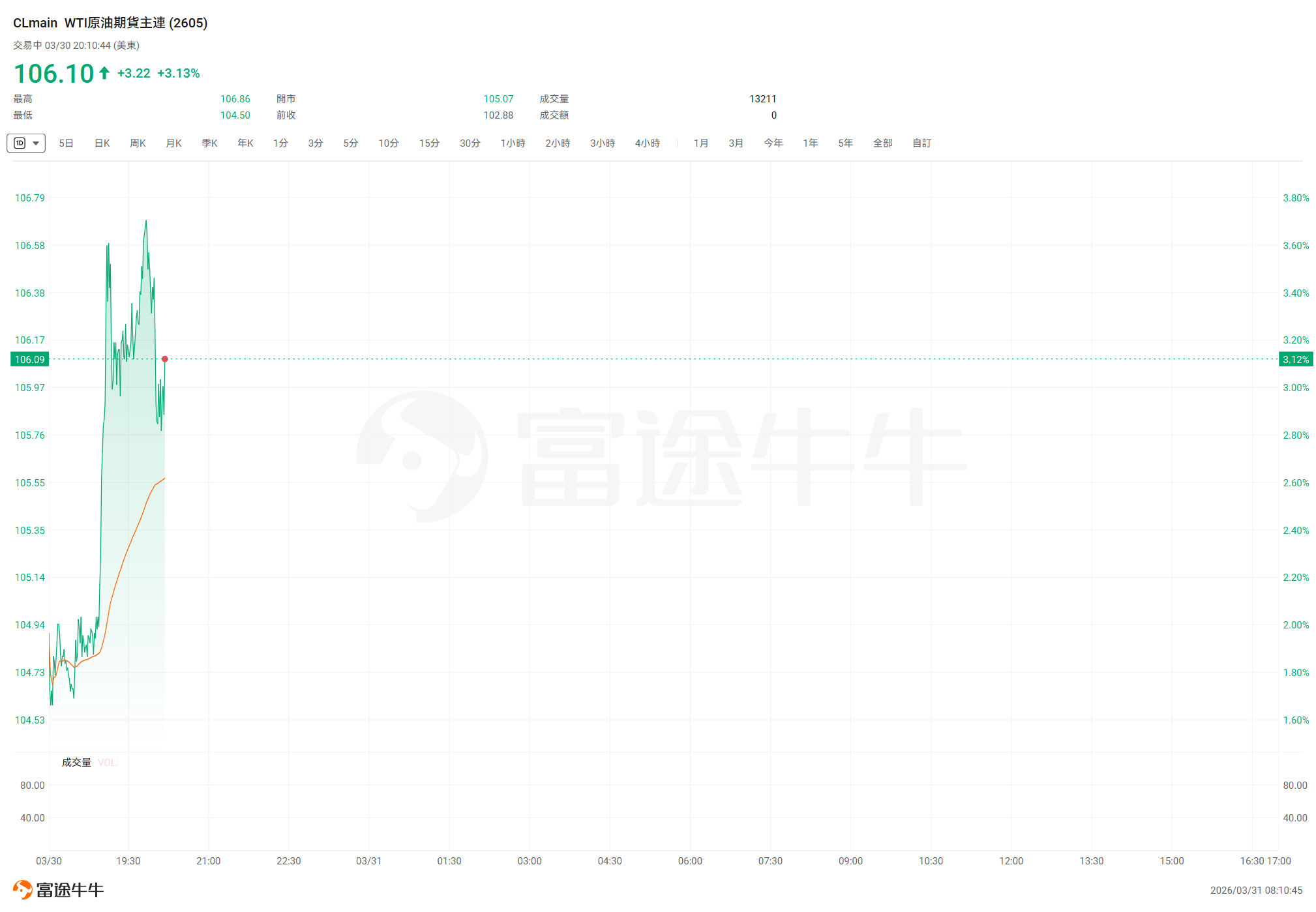
 Boosted by the aforementioned news,$Crude Oil Futures (MAY6) (CLmain.US)$prices surged by 3.7% at one point, reaching $106.70 per barrel, after closing at their highest level since July 2022 the previous day. The monthly gain for Brent crude futures is also on track to set a historical record.
Meanwhile, Trump posted on social media on Monday, warning that if Iran does not reopen the Strait of Hormuz, the United States will destroy its power facilities, oil installations, and possibly even desalination infrastructure.
Rebecca Babin, a senior energy trader at CIBC Private Wealth Group, stated: "Any path to de-escalation appears to take one step forward and five steps back. With daily supply of 10 to 12 million barrels still absent from the market, the buffer is shrinking, and verbal attempts to suppress oil prices are becoming increasingly ineffective."
The Strait of Hormuz has effectively been closed to shipping, severely disrupting supplies of crude oil, natural gas, and diesel products. Global energy prices continue to soar, leading to a sharp rise in inflationary pressures.
Tanker attack near the Port of Dubai may result in an oil spill.
According to CCTV News, the UK Maritime Trade Operations office issued a notice on the 30th local time stating that a tanker had been hit by an unknown object on its starboard side approximately 31 nautical miles northwest of Dubai in the UAE, causing a fire onboard. All personnel aboard were reported safe. In the early hours of the 31st local time, the Kuwait National Petroleum Company confirmed that one of its tankers had been attacked while at the Port of Dubai in the UAE.
The Kuwait National Petroleum Company confirmed that the attacked vessel was its subsidiary transport ship 'Al-Salmi,' which was fully loaded. The attack damaged the hull, prompting emergency response teams to mobilize immediately to control the situation. The incident may result in an oil spill in surrounding waters.
This is the latest instance of Iran's ongoing attacks against vessels in the Gulf region since the outbreak of war. Reports indicate that Iran recently struck two ships near Iraq, and this attack near the Port of Dubai further escalates the conflict into the core shipping area of the Gulf.
Kuwait's domestic infrastructure has also been targeted.
The scope of the attacks is not limited to the sea.
According to reports from the Xinhua News Agency, Fatima Hayat, spokesperson for Kuwait's Ministry of Electricity, Water, and Renewable Energy, stated that a power and desalination facility in the country was attacked 'from Iran' on the evening of the 29th, resulting in the death of an Indian worker and severe damage to the building.
On the same day, the Kuwaiti military reported that a military base was struck by multiple missiles, injuring 10 soldiers. Additionally, seven overhead power transmission lines across various regions of Kuwait were damaged due to falling shrapnel, four of which have been repaired and restored to operation. Kuwaiti authorities stated that technical teams are working around the clock to ensure the continuity of critical services.
Trump escalates threats as US-Iran negotiations reach a deadlock.
On the diplomatic front, there are still no signs of de-escalation.
Trump posted on social media on Monday, warning that if Iran does not reopen the Strait of Hormuz, the United States will target its power facilities, oil infrastructure, and even desalination facilities.
US Treasury Secretary Bessent, in an interview with Fox News, stated that the US would 'take back' control of the Strait of Hormuz, ensuring safe navigation through US-led or multi-national escort operations.
Analysts noted that despite Trump repeatedly claiming that an agreement with Iran is 'imminent,' the conflict has now extended into its fifth week, with no signs of easing tensions.
Notably, Yemen's Houthi forces fired missiles at Israel over the weekend, further expanding the scope of the conflict.
According to reports, Iran is pushing the Houthi armed group to prepare for restarting attacks on Red Sea shipping, which would threaten alternative transport routes beyond the Strait of Hormuz, including the pipeline channel used by Saudi Arabia to transfer crude oil from the east to the western Yanbu Port.
The supply gap continues to widen, with market buffers trending toward depletion.
The actual closure of the Strait of Hormuz has caused a profound shock to global energy supplies.
$Crude Oil Futures (MAY6) (CLmain.US)$The cumulative increase this month has approached 60%, marking the largest single-month rise since May 2020. Meanwhile, the monthly gain for Brent crude futures is poised to establish an all-time high. The national average gasoline price in the United States is also nearing the $4-per-gallon threshold, a level expected to exert significant political pressure on Trump.
Shaia Hosseinzadeh, Chief Investment Officer of OnyxPoint Global Management, noted:
"$100 is a purgatory state — too high to be sustainable, yet too low to reflect the true extent of disruptions in the physical market. Current price signals do not fully embody the physical realities on the ground."
Editor/Melody