
As traders have largely abandoned bets on Federal Reserve rate hikes, the market focus has shifted to concerns that escalating conflicts in Iran could exacerbate an economic slowdown, prompting a strong rebound in the U.S. Treasury market from its worst selloff in 17 months.
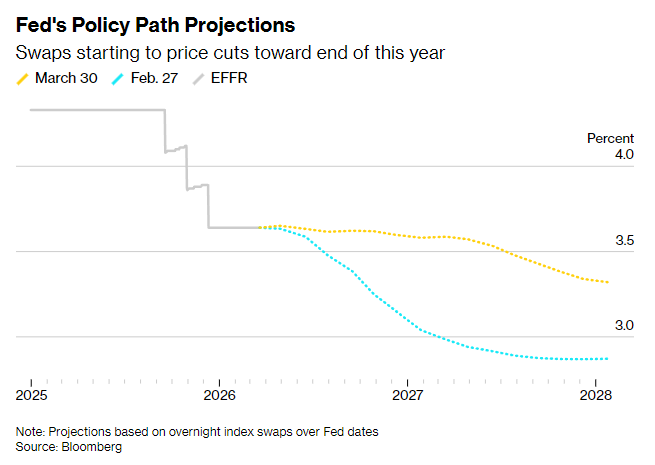
Federal Reserve Chair Powell, speaking at Harvard University, stated that central banks can do little about supply-side shocks, such as surging oil prices triggered by U.S.-Iran tensions. This statement alleviated market fears that the Fed might tighten monetary policy to curb accelerating inflation, prompting traders to start pricing in the possibility of rate cuts within the year, though the probability remains low.
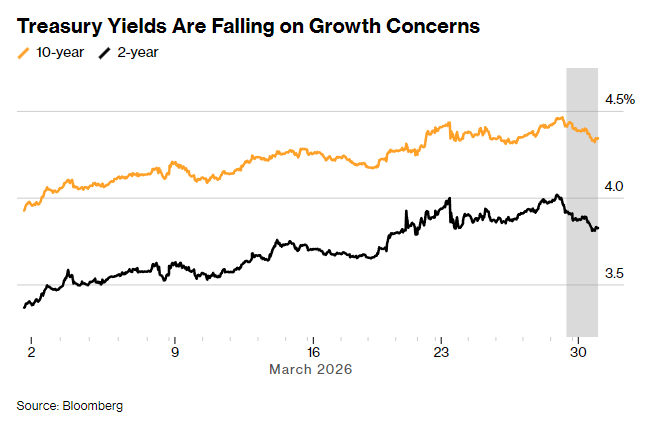
The abrupt shift in market sentiment drove short-term Treasury yields down by more than 10 basis points at one point, though declines later narrowed. This allowed the U.S. bond market to recover from its worst monthly losses since October 2024 — a period when investors bet that Trump's presidency would inject strong momentum into the economy.
 This rebound reflects growing market concerns that escalating conflicts in the Middle East will impact an already slowing U.S. economy, with rising fuel costs pushing up expenses for businesses and consumers. Monday’s rally marked the second consecutive day that yields fell even as oil prices rose. For much of March, yields moved higher alongside surging energy prices, amid fears that conflict involving Iran could spur inflation.
John Briggs, head of U.S. rates strategy at Natixis, said: “Before last Friday, investors seemed more concerned about inflationary shocks driven by rising oil prices, so they began pricing in Fed rate hikes, pushing Treasury yields higher. Since then, market sentiment has shifted, focusing instead on growth concerns despite rising oil prices.”
This marks a significant shift in the bond market — concerns over inflationary shocks potentially constraining the Fed had largely overshadowed worries about economic growth.
Gennadiy Goldberg, head of U.S. rates strategy at TD Securities, said: “Markets are uncertain about how to respond to recent geopolitical events — whether to focus on first-order inflation shocks or second-order growth impacts. Not only is the geopolitical outlook unclear, but markets also lack confidence in how the Fed might respond to these scenarios.”
At the beginning of last week, the futures market fully priced in one rate hike before the end of the year; as of last Friday, the likelihood was still considered very high. However, by Monday, sentiment reversed rapidly, with traders briefly assigning a 20% probability to a rate cut before the December meeting.
Macro strategist Alyce Andres said: “Signs of escalating conflict in Iran, along with concerns about economic growth, are driving the Monday rally in U.S. Treasuries. Other factors, such as thin trading due to month-end holidays and supply dynamics, may continue to support bond buying this week.”
Global Bond Market Linkages
The rebound in U.S. Treasury bonds drove a synchronized recovery in global bond markets, with yields on Japanese, British, and German government bonds falling across the board.$U.S. 2-Year Treasury Notes Yield (US2Y.BD)$Dropping 9 basis points to 3.82%,$U.S. 10-Year Treasury Notes Yield (US10Y.BD)$Falling approximately 9 basis points to 4.34%.
Large U.S. bond funds, including Pacific Investment Management Company (PIMCO), had previously warned that as inflation concerns rise, financial markets are underestimating the risks of an economic slowdown. Goldman Sachs raised its probability estimate for a U.S. economic recession over the next year to about 30%.
The conflict, now in its fifth week, shows no signs of abating, despite the U.S. extending the deadline for Iran to reopen the Strait of Hormuz. On Monday, a key crude oil benchmark remained above $110 per barrel.
Although Trump previously stated on social media that the administration was engaged in 'serious discussions' with the Iranian regime, he simultaneously reiterated threats to attack Iran’s oil and electricity infrastructure if no agreement is reached. However, Iran has repeatedly indicated that negotiations have not progressed and hinted at its ability to sustain a prolonged conflict, raising the risk of prolonged hostilities and potential disruption to global critical energy supplies.
Ian Lyngen, Head of U.S. Rates Strategy at BMO Capital Markets, summarized: 'The Treasury market rebounded on Monday as investors focused on the potential global growth risks associated with events in the Middle East, rather than trading the conflict purely from the perspective of inflationary impacts.'
Editor/Melody