
In March, China's manufacturing PMI returned to the expansion zone, with both production and demand strengthening. The business confidence of large, medium, and small enterprises improved, consolidating the positive momentum of economic recovery. The non-manufacturing PMI rose to 50.1% in the expansion zone, with improvements in the business climate for services and construction. Huo Lihui, Chief Statistician of the National Bureau of Statistics Service Industry Survey Center, stated that in March, as companies accelerated resumption of work and production after the Spring Festival, market activity increased.
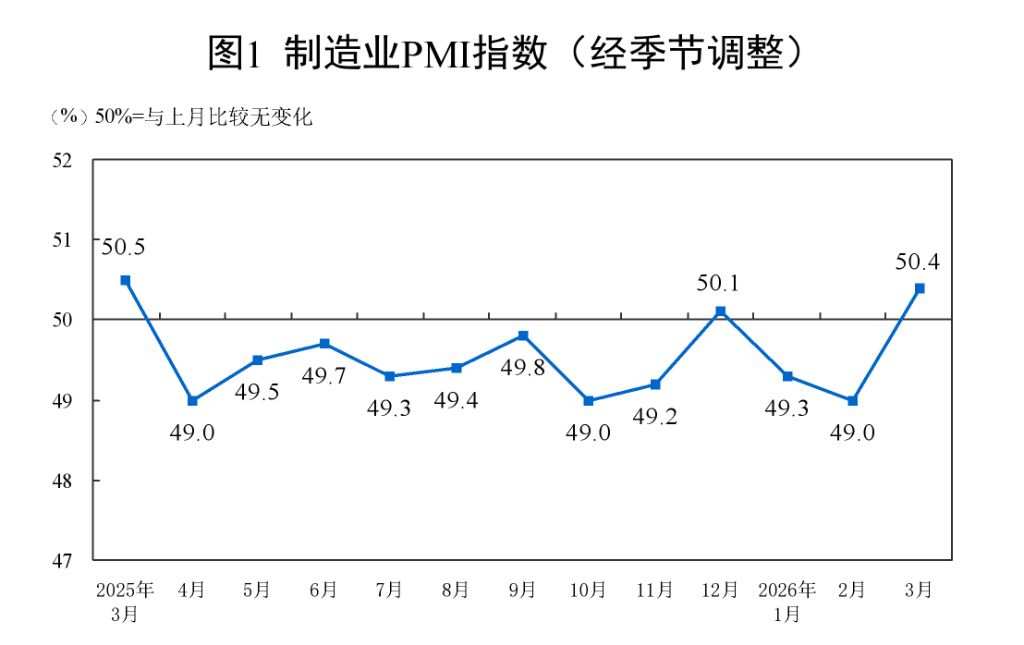
After operating below 50% for two consecutive months, China's manufacturing Purchasing Managers' Index (PMI) returned to the expansionary zone in March, indicating an improvement in manufacturing activity. The overall level of non-manufacturing sector activity also increased in March.
On March 31, the National Bureau of Statistics and the China Federation of Logistics and Purchasing released the March China Manufacturing Purchasing Managers' Index (PMI). The data showed that the manufacturing sector's business confidence improved in March, with robust market demand and an overall increase in corporate production activities.
The rise in the manufacturing business confidence indicates a positive economic recovery.
 In March, the manufacturing Purchasing Managers' Index (PMI) was 50.4%, up by 1.4 percentage points from the previous month and above the threshold, indicating a recovery in the manufacturing business climate.
By enterprise size, the PMI for large enterprises was 51.6%, up by 0.1 percentage points from the previous month and above the threshold. The PMIs for medium and small enterprises were 49.0% and 49.3%, respectively, up by 1.5 and 4.5 percentage points from the previous month but below the threshold.
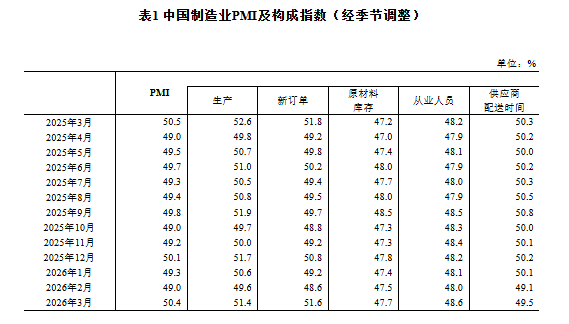
Among the sub-indices constituting the manufacturing PMI, the production index and the new orders index were both above the threshold, while the raw materials inventory index, the employment index, and the supplier delivery time index were all below the threshold.
The production index was 51.4%, up by 1.8 percentage points from the previous month, indicating an acceleration in manufacturing production activities.
The new orders index was 51.6%, up by 3.0 percentage points from the previous month, indicating a significant improvement in the business confidence level of manufacturing market demand.
The raw materials inventory index was 47.7%, up by 0.2 percentage points from the previous month, indicating a narrowing decline in the main raw materials inventory of the manufacturing sector.
The employment index was 48.6%, up by 0.6 percentage points from the previous month, indicating a recovery in the employment confidence of manufacturing enterprises.
The supplier delivery time index stood at 49.5%, up by 0.4 percentage points from the previous month, remaining below the critical threshold, indicating that the delivery times of manufacturing raw material suppliers were extended compared to the previous month.
Huo Lihui, Chief Statistician of the Service Industry Survey Center of the National Bureau of Statistics, commented that
In March, as enterprises accelerated resumption of work and production after the Spring Festival, market activity increased, with the manufacturing PMI reaching 50.4%, returning to the expansionary zone.
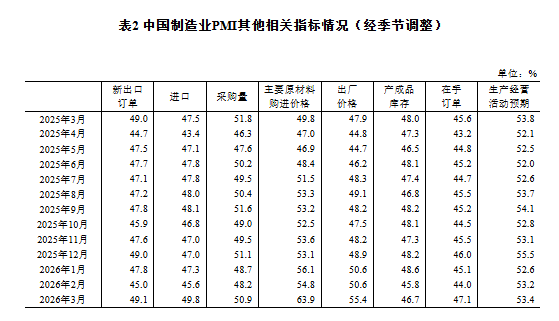
(1) Synchronized expansion at both the production and demand ends. The production index and new orders index were 51.4% and 51.6%, respectively, increasing by 1.8 and 3.0 percentage points from the previous month, both entering the expansionary range, indicating faster production activities in manufacturing enterprises and a significant improvement in market demand. By industry, the production indexes and new orders indexes for agricultural and sideline food processing, nonferrous metal smelting, and pressing industries were all above 55.0%, showing rapid release of production and demand among enterprises in these sectors; whereas in textile clothing and apparel, chemical fiber, and rubber and plastic products industries, both indexes remained below the critical point, reflecting weaker market activity. Driven by the recovery of production and demand, enterprises' willingness to procure increased, with the procurement volume index standing at 50.9%, up by 2.7 percentage points from the previous month.
(2) PMIs for large, medium, and small enterprises all improved. The PMI for large enterprises was 51.6%, up by 0.1 percentage points from the previous month, showing steady improvement in business conditions; the PMIs for medium and small enterprises were 49.0% and 49.3%, respectively, rising by 1.5 and 4.5 percentage points from the previous month, indicating a notable improvement in business conditions.
(3) Rapid expansion in the three key industries. The PMI for high-tech manufacturing was 52.1%, up by 0.6 percentage points from the previous month, remaining above the critical point for 14 consecutive months, with the industry’s development trend continuing to improve. The PMIs for equipment manufacturing and consumer goods industries were 51.5% and 50.8%, respectively, up by 1.7 and 2.0 percentage points from the previous month, both entering the expansionary zone; the PMI for high energy-consuming industries was 48.9%, up by 1.1 percentage points from the previous month, showing some recovery in business conditions.
(4) Significant rebound in price indices. Affected by factors such as recent continuous increases in prices of certain commodities and faster enterprise procurement activities, the main raw material purchase price index and factory-gate price index were 63.9% and 55.4%, respectively, rising by 9.1 and 4.8 percentage points from the previous month, indicating a clear rebound in overall price levels in the manufacturing sector. By industry, the two price indices for oil, coal, and other fuel processing, as well as chemical raw materials and chemical products, were both above 70.0%, with obvious increases in the overall level of purchasing and sales prices in related industries.
(5) Market expectations steadily improved. The business activity expectation index was 53.4%, up by 0.2 percentage points from the previous month, reflecting an increase in manufacturing enterprises’ confidence in near-term market development. By industry, the business activity expectation indexes for specialized equipment, automobiles, and railway, shipbuilding, and aerospace equipment industries were above 56.0%, within higher business confidence ranges, with relevant enterprises being more optimistic about future industry development.
Survey results also showed that, influenced by factors such as the current geopolitical conflicts in the Middle East, there were significant price increases in petroleum, chemical, and other related raw materials, compounded by rising logistics freight rates, resulting in an increase this month in the proportion of enterprises reporting high raw material costs and high logistics costs compared to the previous month.
Non-manufacturing Business Activity Index rose into the expansionary zone.
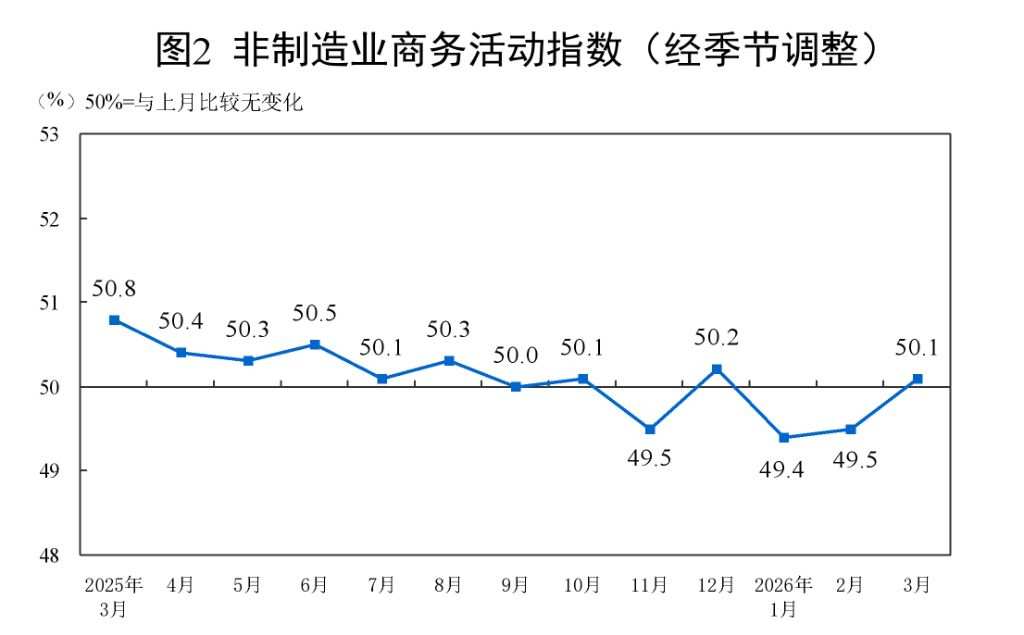
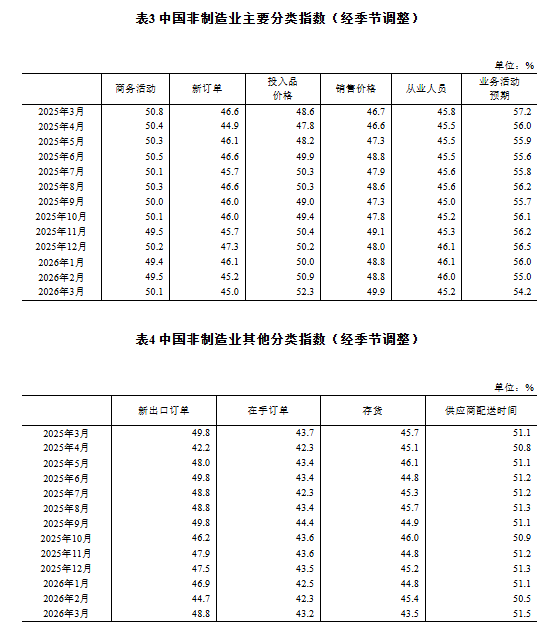
In March, the non-manufacturing business activity index stood at 50.1%, up by 0.6 percentage points from the previous month and above the critical threshold, indicating an improvement in the non-manufacturing sector's business climate.
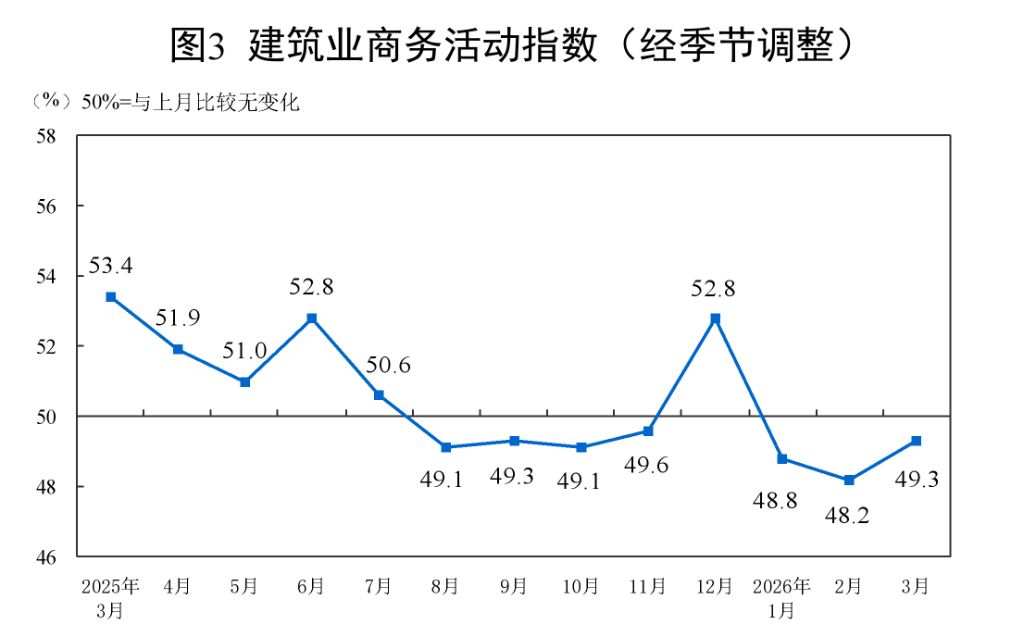
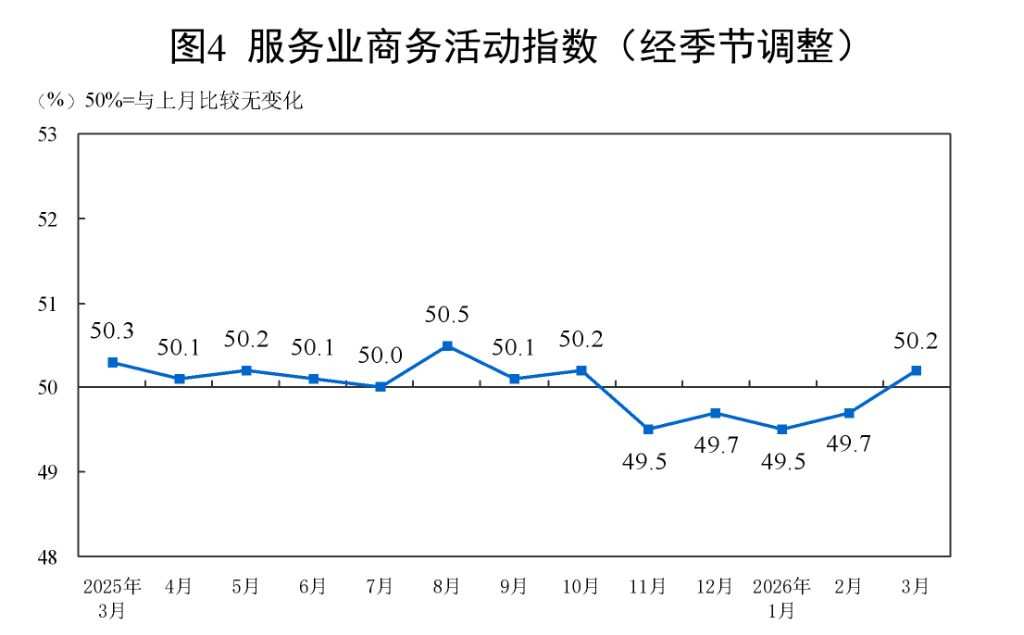
By industry, the construction business activity index was 49.3%, up by 1.1 percentage points from the previous month; the service sector business activity index was 50.2%, up by 0.5 percentage points from the previous month. In the service sector, industries such as railway transportation, telecommunications, radio and television, satellite transmission services, monetary financial services, and insurance all recorded business activity indices above 55.0%, reflecting a high level of prosperity. Meanwhile, industries including retail, accommodation, catering, and real estate had business activity indices below the critical threshold.
The new orders index was 45.0%, down by 0.2 percentage points from the previous month, indicating a decline in non-manufacturing market demand. By industry, the new orders index for the construction sector was 43.5%, up by 1.3 percentage points from the previous month; the new orders index for the service sector was 45.3%, down by 0.4 percentage points from the previous month.
The input price index was 52.3%, up by 1.4 percentage points from the previous month, indicating that the overall level of prices for inputs used in the operations of non-manufacturing enterprises continued to rise. By industry, the input price index for the construction sector was 52.7%, up by 3.6 percentage points from the previous month; the input price index for the service sector was 52.2%, up by 1.0 percentage point from the previous month.
The sales price index was 49.9%, up by 1.1 percentage points from the previous month but still below the critical threshold, indicating that the overall decline in sales prices in the non-manufacturing sector narrowed. By industry, the sales price index for the construction sector was 49.3%, up by 1.7 percentage points from the previous month; the sales price index for the service sector was 50.0%, up by 1.0 percentage point from the previous month.
The employment index was 45.2%, down by 0.8 percentage points from the previous month, indicating a decline in the employment climate among non-manufacturing enterprises. By industry, the employment index for the construction sector was 39.1%, down by 3.4 percentage points from the previous month; the employment index for the service sector was 46.2%, down by 0.4 percentage points from the previous month.
The business activity expectations index was 54.2%, down by 0.8 percentage points from the previous month but still above the critical threshold, indicating that non-manufacturing enterprises remained optimistic about market development. By industry, the business activity expectations index for the construction sector was 50.5%, down by 0.4 percentage points from the previous month; the business activity expectations index for the service sector was 54.8%, down by 1.0 percentage point from the previous month.
Huo Lihui, Chief Statistician of the National Bureau of Statistics Service Industry Survey Center, commented that
In March, the non-manufacturing business activity index was 50.1%, up by 0.6 percentage points from the previous month, indicating an improvement in the non-manufacturing sector's business climate.
(1) The service sector business activity index rose above the critical threshold. The service sector business activity index was 50.2%, up by 0.5 percentage points from the previous month. By industry, sectors such as railway transportation, telecommunications, radio and television, satellite transmission services, monetary financial services, and insurance all reported business activity indices above 55.0%, reflecting higher levels of prosperity and rapid growth in total business volume. Following the Spring Festival, industries related to consumer travel and spending, such as retail, accommodation, and catering, reported business activity indices below the critical threshold, indicating a weakening of market vitality. In terms of market expectations, the service sector business activity expectations index was 54.8%, remaining at a relatively high operational level, indicating that service sector enterprises maintained optimism regarding recent market developments.
(2) Improvement in the Business Activity Index for the Construction Industry. As construction projects across regions gradually resumed work after the holiday, the Business Activity Index for the construction industry reached 49.3%, up by 1.1 percentage points from the previous month. In terms of market expectations, the Business Expectations Index for the construction industry stood at 50.5%, above the critical threshold, indicating that construction companies remain confident about future industry development.
Composite PMI Output Index Rises Above the Critical Threshold
In March, the Composite PMI Output Index was 50.5%, up by 1.0 percentage point from the previous month and above the critical threshold, indicating an overall improvement in the business operating climate of enterprises in China.
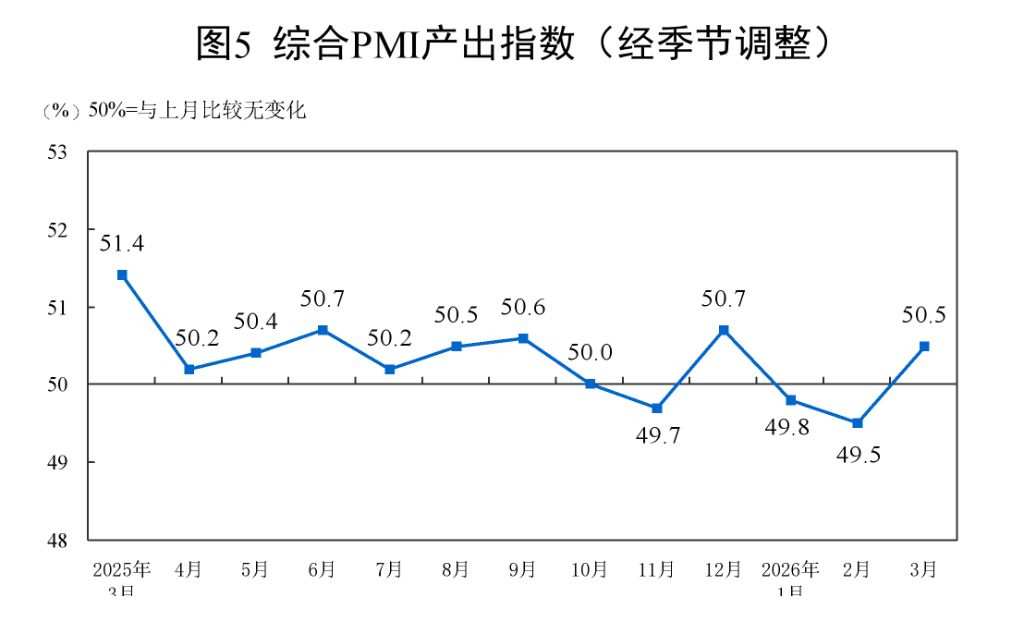
Huo Lihui, Chief Statistician of the Service Sector Survey Center of the National Bureau of Statistics, stated that the Manufacturing Production Index and the Non-Manufacturing Business Activity Index, which constitute the Composite PMI Output Index, were 51.4% and 50.1%, respectively.
Editor/Melody