
Global hedge funds are intensively adjusting their positions recently, betting on potential currency market stabilization actions that Japanese authorities may take at any time.
As$USD/JPY (USDJPY.FX)$Breaking through the key psychological level of 160 and continuing to decline, international financial markets are witnessing a hedging storm targeting potential interventions by the Japanese government in the currency market. Due to the extreme weakness of the yen and mounting inflationary pressures from imports, global hedge funds have recently been intensively adjusting their positions by purchasing large amounts of yen call derivatives, betting on possible exchange rate stabilization measures by Japanese authorities at any time.
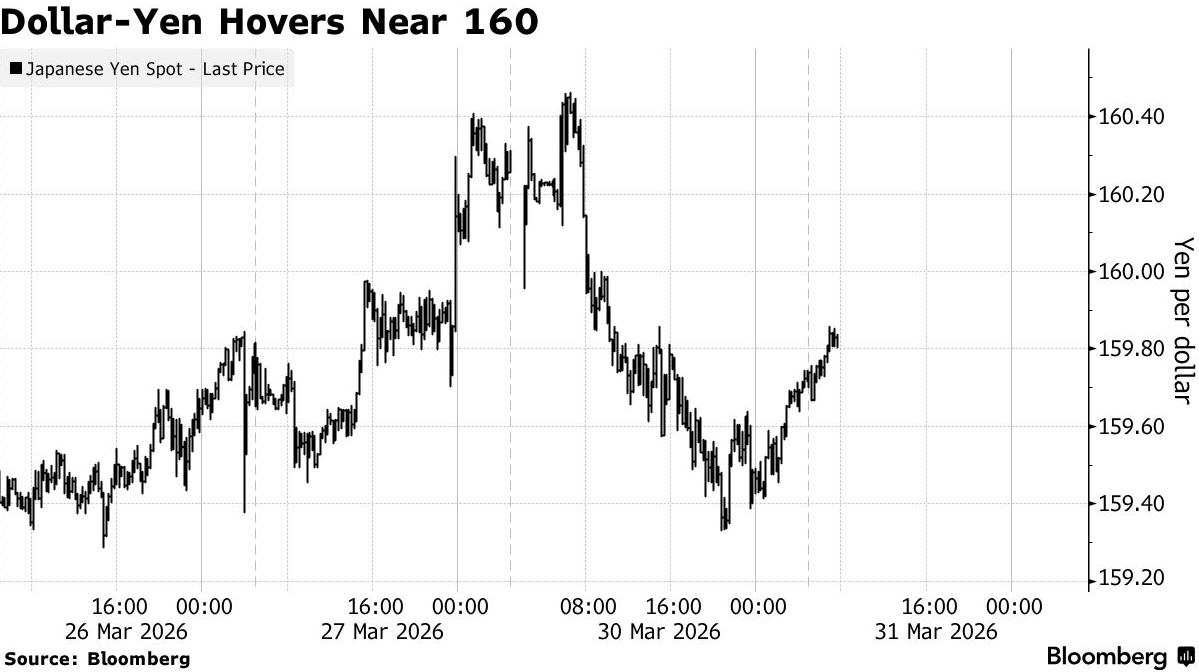
The trigger for this round of market turmoil was the yen's breach of the historic resistance level of 160.00 on Monday, falling to its lowest level since July 2024. Facing the risk of an out-of-control exchange rate, Junichi Shimamura, Japan’s top foreign exchange official, issued a stern warning publicly stating that if speculative volatility persists, authorities will not rule out taking any decisive measures in response.
 Meanwhile, surging energy prices driven by geopolitical tensions in the Middle East further deteriorated Japan's trade balance. This fundamental deterioration has forced Japanese policymakers to confront more severe inflation challenges.
In this context, signals of intervention released by senior officials such as Finance Minister Satsuki Katayama were interpreted by the market as imminent action, directly driving up trading volumes of yen put options (i.e., bets on dollar depreciation and yen appreciation) on platforms like CME Group to over three times that of call options.
Mukund Daga, Global Head of Currency Options at Barclays London Branch, stated: “Some hedge funds are showing interest in USD/JPY options as a way to position themselves against the possibility of sharp currency declines due to potential interventions.” He noted that current trading activity is concentrated on short-term structures, “indicating that the market is focused on near-term event risks rather than broader directional shifts.”
At the same time, since March 27, as spot exchange rates approached 160 and intervention rhetoric intensified, Nomura Securities has also observed a significant increase in demand for$USD/JPY (USDJPY.FX)$options. Sagar Sambrani, senior forex options trader at the bank’s London branch, stated: “Although the medium-term trend of USD/JPY strengthening remains intact, recent tactical operations related to potential interventions have increased, pushing up the implied volatility of near-term contracts.”
He also mentioned that some relative value hedge funds expect USD/JPY to remain range-bound in the short term and are thus capitalizing on rising short-term implied volatility to sell USD/JPY options—implied volatility measures expected price fluctuations over a specific period, and its increase makes option prices more expensive.
Moreover, market expectations regarding the Bank of Japan’s future interest rate hike path have strengthened. Kazuo Ueda’s focus on imported inflation suggests a potential shift toward tighter monetary policy, providing fundamental support for hedge funds positioning for medium- to long-term yen strength.
However, the prospect of Japanese government intervention is not without obstacles; international political factors remain a Damocles' sword hanging over the market. Given that the U.S. Treasury Department previously placed Japan on its “Monitoring List” for currency manipulation, Japan faces significant diplomatic pressure and policy constraints when conducting unilateral large-scale interventions.
In recent weeks, the yen has come under pressure due to rising oil prices driven by the Iran conflict, dragging down Japan’s trade balance while safe-haven demand supported the dollar. Since the beginning of the year, the yen has depreciated 1.9% against the dollar.
Looking back, Japan's Ministry of Finance intervened when the yen fell to around 160.17 in 2024 and conducted additional interventions near 157.99, 161.76, and 159.45. Officials repeatedly emphasized that their focus was on excessive volatility rather than defending specific levels.
In this regard, Mahjabeen Zaman, Head of FX Research at ANZ Bank, pointed out: 'In the short term, the key resistance level is near 162. If this level is reached, authorities may increase verbal intervention.' However, 'since the rise in the USD/JPY exchange rate has been primarily driven by shocks from deteriorating terms of trade rather than speculative capital flows, the threshold for intervention is higher.'
Editor/Melody