
Fierce Competition for AI Talent
Author | Huang Yu
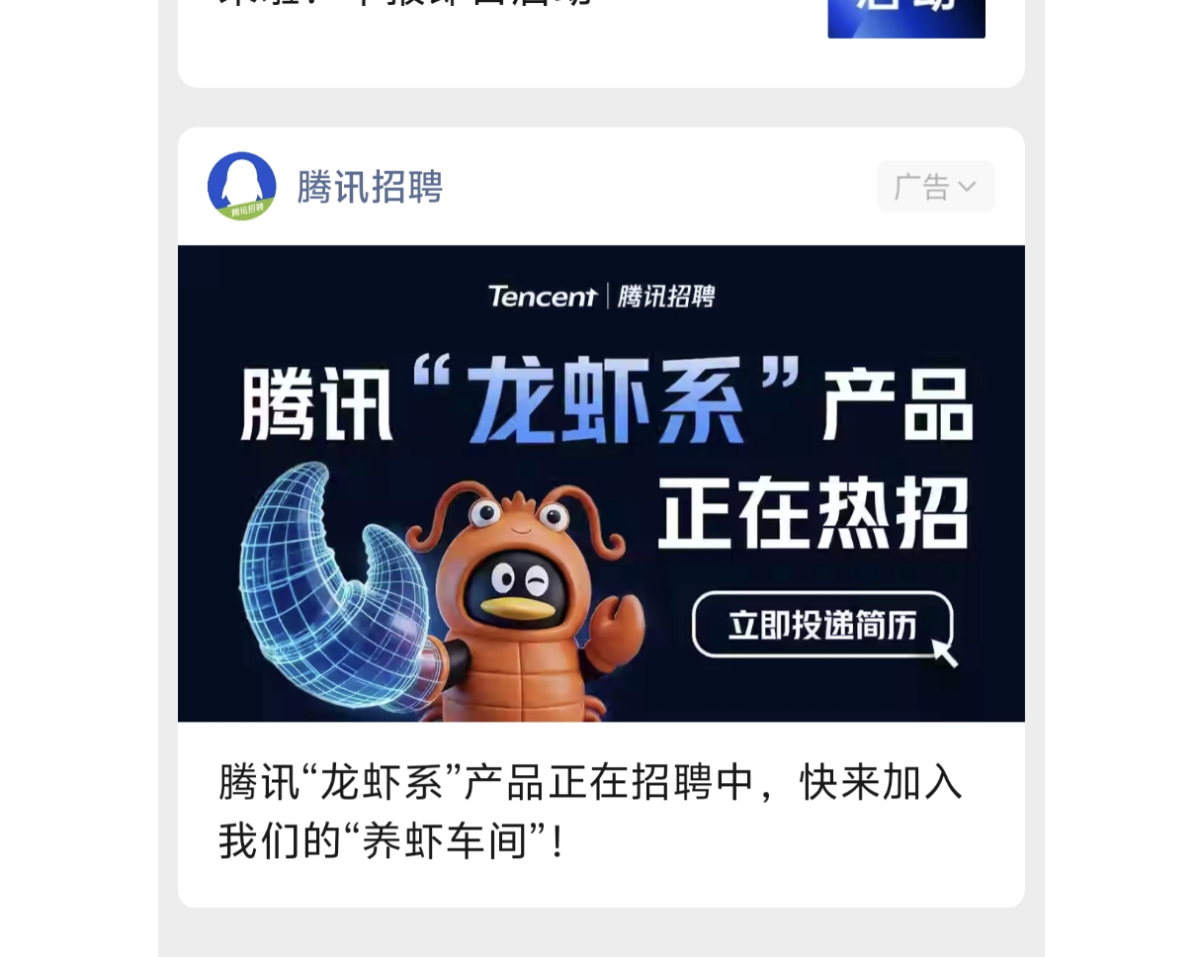
Wall Street Insights discovered that $TENCENT (00700.HK)$ a large-scale recruitment drive for the 'Lobster Series' products was recently launched, accompanied by significant promotional efforts on WeChat.
 All positions in this recruitment campaign belong to Tencent's CSIG (Cloud and Smart Industries Group), covering products such as WorkBuddy, QClaw, and Tencent Lighthouse Lightweight Cloud. Specific roles include Manager of User Growth Operations for Intelligent Agents, Data Engineering Leader, Full-Stack Development Engineer, Reinforcement Learning Algorithm Researcher, and AI-Native Product Manager.
Against the backdrop of Tencent's recent rapid launch of the 'Lobster Product Matrix,' this swift intensification of recruitment for AI Agent-related talent undoubtedly underscores Tencent's determination to excel in AI Agent products.
It is worth noting that when Tencent’s AI assistant Yuanbao was first introduced, it did not involve such high-profile external recruitment for product talent.
In this wave of enthusiasm for cultivating lobsters, Tencent can be regarded as one of the most responsive enterprises.
Starting from March, Tencent initiated a matrix-style product plan centered around lobster and referred to itself as the 'Lobster Task Force.' This product matrix not only caters to novice users but also targets hardcore developers and large enterprises.
Ma Huateng personally promoted Tencent’s lobster package, stating, 'Self-developed lobster, local lobster, cloud lobster, enterprise lobster, cloud desktop lobster, secure isolated lobster rooms, cloud security guards, knowledge bases... with more products on the way.'
This marks one of Ma Huateng’s rare appearances to support Tencent’s AI products amid the current wave of large AI model advancements.
During a recent earnings call, Ma Huateng also publicly discussed his thoughts on 'raising shrimp' for the first time. He believes that 'lobster' represents a decentralized entry point, which can better leverage Tencent's resource advantages, enable collaboration across business lines, and provide inspiration for the ongoing development of WeChat Agent.
Tencent Senior Executive Vice President and CEO of the Cloud and Smart Industries Group, Thomas Tong, recently stated that the current application paradigm of artificial intelligence is transitioning from 'Chatbot' to 'AI Agent.' The implementation of AI is not just an algorithmic challenge but also an engineering one— as the performance gap among mainstream large models gradually narrows, companies are no longer competing on 'whose model is stronger,' but rather on who can best utilize models through engineering approaches.
In Tong’s view, in the future, every individual and enterprise will be able to quickly build their own specialized intelligent applications using standardized tools, collectively constructing a decentralized and highly prosperous Agent ecosystem.
In fact, during this round of AI competition, Tencent, which had once been questioned by outsiders for 'falling behind,' began quietly accelerating at the end of last year, including efforts in recruiting AI talent and upgrading organizational structures.
Tencent President Martin Lau pointed out that over the past few months, Tencent has intensively carried out organizational upgrades and workflow restructuring for the HunYuan large model team. At the same time, it has rebuilt the entire infrastructure for pre-training and reinforcement learning and further improved data quality.
Through a series of adjustments, Tencent hopes to create a more intelligent model while accelerating overall iteration speed.
In terms of talent recruitment, while Tencent introduced top talents such as former OpenAI researcher Yao Shunyu at the end of last year, there were also reports that Tencent was offering double salaries to top researchers from ByteDance's AI department (especially in large models and multimodal teams) and successfully recruited some key personnel.
During the third-quarter earnings call last year, Martin Lau also noted that Tencent is actually hiring more top talents, especially in research, to complement its existing engineering team.
Tencent recruiters revealed that among the internship positions opened this year, technical roles expanded by 36%, product roles by 39%, and AI-related positions also saw significant expansion. Additionally, to embrace AI changes, a new 'AI Application Skills Module' has been added to resume submissions.
We look forward to more partners with an 'AI Native' mindset joining us,' said the Tencent recruiter.
During this critical period of争夺 AI technology leadership, tech giants are competing for AI talent with an almost arms-race-like posture.
An insider at a leading video generation company told Wall Street Insight that the list of AI technology teams is currently not accessible on the internal OA system to prevent poaching by other companies.
Hudson, a talent solutions provider, recently released the '2025 Talent Trends Report,' which highlights that breakthrough advancements in AI have pushed talent demand to new heights. The competition for top-tier AI talent has reached a fever pitch, with the scarcity of elite professionals becoming even more pronounced.
In this context, top-tier AI talent now holds the power to set their own price.
According to Hudson's data, the top 20% of elite AI professionals can achieve salary increases of 30%-50% when switching jobs. Among them, leading researchers and engineers in reinforcement learning have become the focus of competition for top companies. Authors who have published papers in top international journals dominate the talent market, with bargaining power far exceeding that of other competitors.
Editor/Rocky