
As of the market close this Monday, NVIDIA's stock price corresponds to a forward price-to-earnings (P/E) ratio of 19.9 times, the lowest level in seven years. In contrast, Apple's forward P/E ratio is 28.7 times, significantly higher than NVIDIA's. However, Apple's revenue for the current fiscal year is projected to grow by 12%, which is only one-sixth of NVIDIA’s expected growth rate of 71%. Analysts noted that the decline in the broader market caused by geopolitical conflicts does not sufficiently account for the extent of valuation contraction in the AI sector.
$NVIDIA (NVDA.US)$ 、 $Microsoft (MSFT.US)$ 、 $Amazon (AMZN.US)$ — These tech giants, regarded as the most direct beneficiaries of the artificial intelligence wave, are collectively seeing their stock valuations drop to multi-year lows. A rare valuation inversion phenomenon is spreading across the market: the price-to-earnings ratio of the dominant AI chip maker is lower than that of Apple, whose growth rate is less than one-sixth of its own.
According to The Information, at the close of trading on Monday this week, NVIDIA's share price stood at $165.17, corresponding to a forward price-to-earnings ratio of just 19.9 times, the lowest level in seven years. Meanwhile, $Apple (AAPL.US)$ Apple’s forward price-to-earnings ratio is as high as 28.7 times—while NVIDIA’s revenue for the current fiscal year is expected to grow by 71%, Apple’s growth rate is only about 12%.
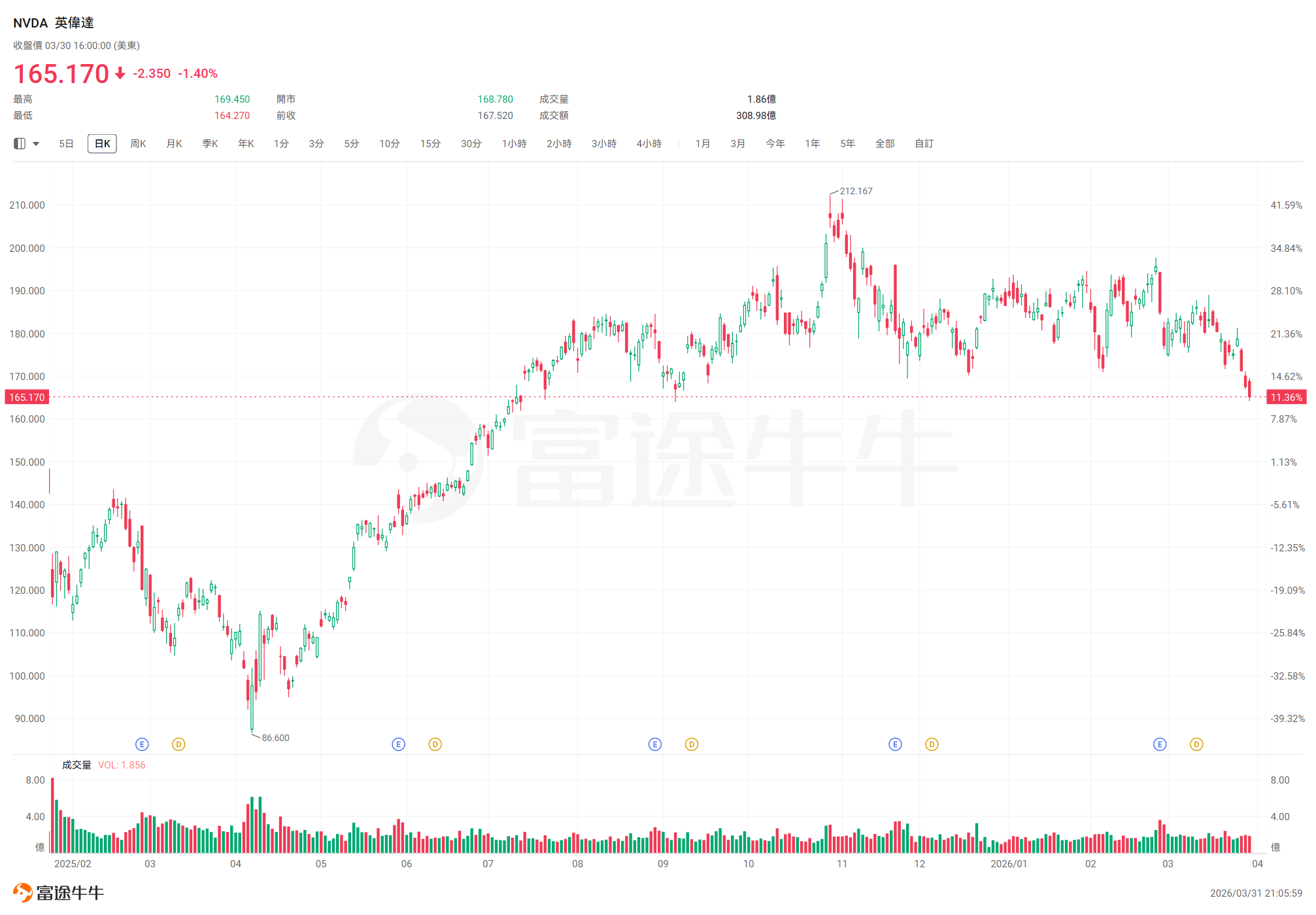
 The collective repricing of the market can be partly attributed to the overall sell-off triggered by recent geopolitical shocks. However, analysts point out that the broad market decline alone does not fully explain the extent of the valuation compression seen in these high-growth technology stocks.
For institutions focused on AI-themed investments, the current valuation structure may indicate systemic mispricing or suggest that market patience with the AI growth narrative is quietly waning.
NVIDIA: The Biggest Beneficiary of AI Trading at 'Ordinary Stock' Valuation
NVIDIA’s current valuation is at its lowest level in nearly seven years. According to Koyfin data cited by The Information, the stock’s forward P/E ratio has dropped to 19.9 times, below Apple’s 28.7 times, despite the vast difference in growth potential between the two companies.
Based on data from S&P Global Market Intelligence, NVIDIA’s revenue for the fiscal year ending January next year is expected to grow by 71%, while Apple’s revenue growth for the fiscal year ending September this year is projected to be only around 12%.
In terms of monetization capabilities within the AI supply chain, NVIDIA is by far the company that has benefited the most directly and significantly; Apple, on the other hand, has gained little from the AI boom and has yet to make any noticeable contribution to earnings.
However, the market’s pricing logic seems to overlook this reality. Investors are assigning a higher valuation premium to Apple, while treating NVIDIA with multiples closer to those of traditional manufacturing firms. This contrast constitutes one of the most prominent valuation paradoxes within the tech sector today.
Microsoft and Oracle: A Decade-Long Valuation Gap Suddenly Narrows
Also drawing attention is the significant narrowing of the valuation gap between Microsoft and $Oracle (ORCL.US)$ , with the valuation disparity narrowing considerably.
Two years ago, Microsoft's forward price-to-earnings ratio was 34 times, while Oracle's was 20 times; now, Microsoft has fallen by approximately 26% year-to-date, with its forward P/E ratio dropping to 20.4 times, compared to Oracle's 18.5 times—marking the first time in nearly a decade that their valuations have converged.
The fundamental logic supporting this repricing lies in the divergence of growth expectations. Analysts expect Microsoft’s annual revenue growth rate to remain at around 16% in the coming years, lacking any clear signs of growth acceleration. In contrast, Oracle’s revenue growth rate is projected to surge from 8.4% in fiscal year 2025 to 46.5% in fiscal year 2028.
However, this comparison has significant limitations. Oracle’s scale is much smaller than Microsoft’s, and it is aggressively leveraging debt to support its expansion, resulting in higher financial leverage and non-negligible risk premiums. The Information refers to this structural difference as the "AI opportunity."
Amazon: Lowest Valuation Since the Financial Crisis, First Discount Relative to Walmart
This valuation anomaly is not unique to NVIDIA. According to Koyfin data, Amazon’s current price-to-earnings multiple is at its lowest level since the 2008 financial crisis; even more unusually, Amazon’s stock is trading at a discount to Walmart for the first time in history.
This phenomenon is equally difficult to explain on a fundamental basis. Amazon’s annual revenue growth rate is above 12%, while Walmart’s is approximately 5%; moreover, Amazon’s strategic position in cloud computing and AI infrastructure is far beyond Walmart’s reach.
This cross-sector valuation inversion reflects the structural disarray in the current market’s pricing of technology stocks.
The Information commented that if this represents a form of "selective AI caution syndrome," its spread extends far beyond chip stocks, reaching into cloud computing and e-commerce platforms, and could potentially place downward pressure on the IPO pricing of AI unicorns like OpenAI and Anthropic.
Editor/KOKO