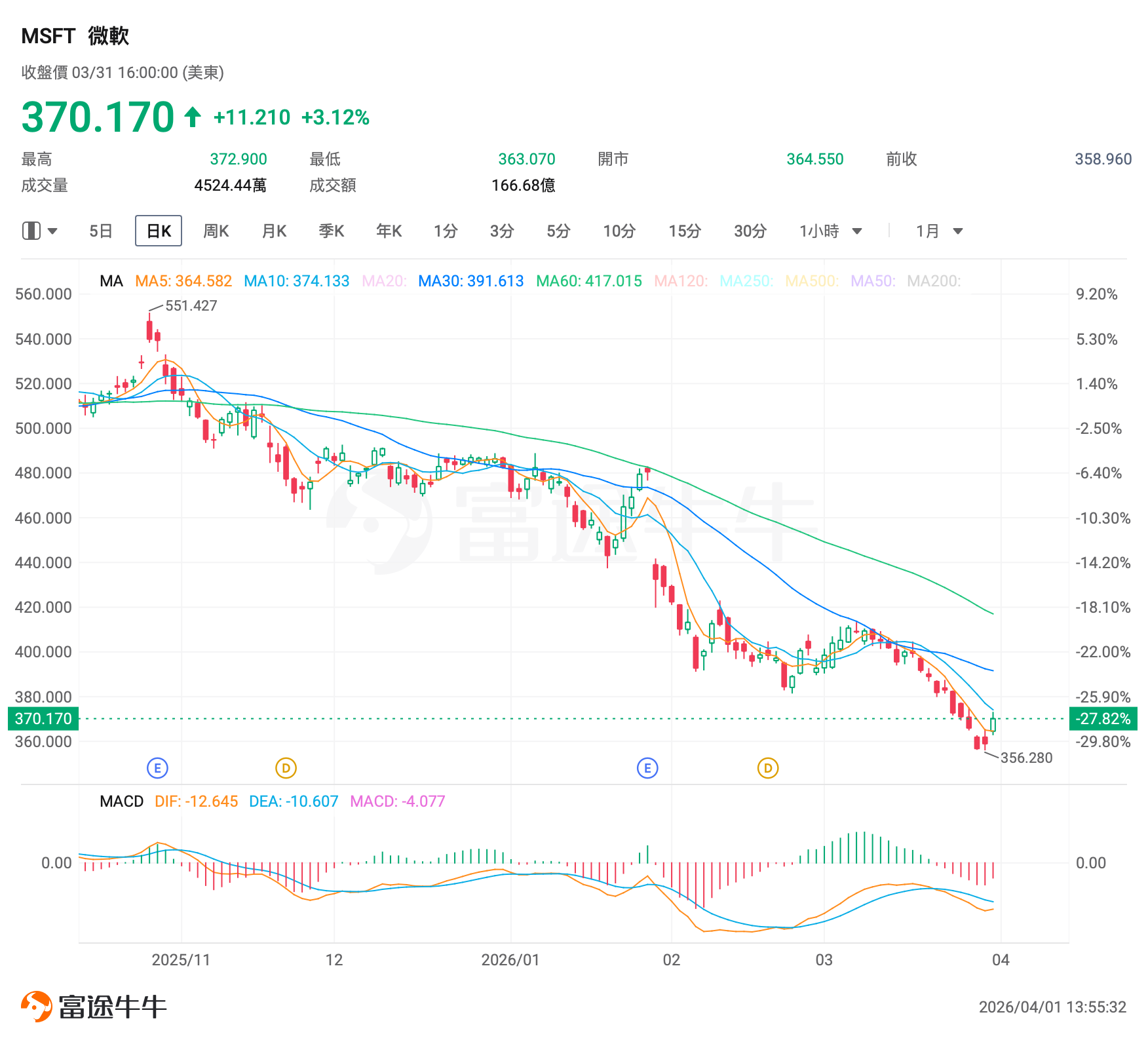
Microsoft's stock price plummeted 23% in the first quarter, marking its worst performance in nearly 20 years and significantly underperforming the Nasdaq index. Despite maintaining a 17% revenue growth, weaker-than-expected AI prospects and a Copilot penetration rate of only 3% have led the market to reassess the growth narrative of this software giant.
$Microsoft (MSFT.US)$ It experienced the worst quarter on Wall Street since the 2008 financial crisis, as investors were disappointed by the software giant's prospects in the artificial intelligence field.
The company’s stock plummeted 23% in the first quarter, a decline surpassing all tech peers as well as the 7% drop in the Nasdaq index during the same period. On Tuesday, Microsoft shares rebounded by 3.3%, marking their largest single-day gain since July, amid a broader market recovery.
 Although Microsoft continues to dominate the office productivity software sector and through its Windows operating system, the company is facing dual pressures: achieving efficient growth in the AI sector while building cloud-based AI infrastructure to meet surging demand.
Meanwhile, software stocks are facing an 'SaaS apocalypse' triggered by AI. $Adobe (ADBE.US)$ 、 $Atlassian (TEAM.US)$ and $ServiceNow (NOW.US)$ Stock prices of companies such as Adobe, Atlassian, ServiceNow, and Snap Inc. have all fallen more than 30% this year.
Jason Lemkin, founder of SaaStr, wrote on X platform this week that 'most of traditional SaaS is dying or has entered terminal decline.' In his blog, he noted that software companies' earnings multiples have lagged behind the S&P 500 Index.
According to Capital IQ data, Microsoft’s valuation multiple has dropped to its lowest level since the fourth quarter of 2022, when OpenAI launched ChatGPT.
DA Davidson analyst Gil Luria stated in an interview that the sell-off was not justified and recommended buying the stock. In the most recent quarter, Microsoft achieved nearly 17% revenue growth, accelerating from the same period last year.
“The disconnect between Microsoft’s fundamentals, stock performance, and valuation is the largest in decades,” Luria said. He expects the company’s earnings growth this year to outpace the overall market.
“Across the entire enterprise software landscape, there are no products stickier than Microsoft Windows and Office.”
Pressure from AI transformation and Copilot challenges
Due to the conflict with Iran, oil prices surged, which could drive up the construction and operational costs of data centers. At the product level, Microsoft’s AI assistant Copilot has not yet demonstrated sufficient appeal, with users shifting towards competing services. $Alphabet-A (GOOGL.US)$ Competing services from OpenAI and Anthropic.
Microsoft has been attempting to expand its revenue base from productivity software through Microsoft 365 Copilot, an AI plugin. However, only 3% of enterprise Office customers have purchased the service so far. Luria stated that while he can use 365 Copilot, he does not particularly like it. More importantly, he noted that Microsoft holds pricing power for Office subscriptions and announced a price increase plan in December.
"Redmond is in trouble," wrote Melius Research analyst Ben Reitzes in a report on March 23, referring to Microsoft's headquarters in Washington State.
Reitzes rates the stock as "Hold" and noted that the company must allocate precious Azure cloud computing resources to improve Copilot but has "no choice, as Copilot is crucial for maintaining growth momentum in its most profitable and largest business segment."
Management Adjustments and Internal Disputes
As Copilot struggles to win user favor, Microsoft announced two weeks ago that Mustafa Suleyman, co-founder of DeepMind and previously responsible for consumer-facing Copilot development, will now focus on AI model building.
Microsoft has appointed former Amazon executive Jacob Andreou to oversee the Copilot experience for both consumer and enterprise customers. $Snap Inc (SNAP.US)$ Jacob Andreou
"The market is concerned that Microsoft 365 Copilot's performance has fallen short of expectations, and this area could see new competitors," said Kyle Levins, an analyst at Harding Loevner. As of the end of December, the firm held Microsoft shares worth $219 million.
Levins viewed Suleyman's personnel adjustment as positive news, but others disagreed.
"At best, it sounds like a demotion," wrote Agustin Lebron, a former Jane Street trader, on X. This change came after the departure of several executives, including Phil Spencer, head of gaming, and Rajesh Jha, Microsoft’s top executive overseeing productivity businesses, who retired.
Resilience of Cloud Business and AI Competitive Landscape
Microsoft continues to achieve robust growth from Azure, which ranks second only to Amazon’s AWS in the cloud infrastructure sector. The division reported a 39% revenue increase over the past 12 quarters. $Amazon (AMZN.US)$ Chief Financial Officer Amy Hood stated in January that if the company allocated all its AI chips to Azure instead of service teams like Microsoft 365 Copilot, the growth rate could exceed 40%.
Azure has benefited from a substantial backlog of orders from OpenAI and Anthropic. Microsoft Azure’s commercial remaining performance obligations more than doubled year-over-year in the 12th quarter, reaching $625 billion.
This serves as a reminder that among tech giants, Microsoft was once regarded as an early leader in generative AI due to its 2019 investment in and strategic partnership with OpenAI. However, the two are no longer in exclusive cooperation in cloud infrastructure and now compete across multiple domains.
In February this year, OpenAI announced the launch of a service called Frontier, which the company described as helping businesses 'build, deploy, and manage AI agents capable of performing real-world tasks.'
Microsoft CEO Satya Nadella remains optimistic, actively promoting the company’s AI advancements on social media.
“The competition is indeed intense, but it is not a zero-sum game as some have suggested,” he said in January.
Aaron Foresman, Director of Equity Research at Crawford Investment Counsel, noted that Nadella, who has led the company since succeeding Steve Ballmer in 2014, plays a crucial role in Microsoft’s continued success.
“We have great trust and confidence in Satya,” Foresman said.
Editor/Doris