
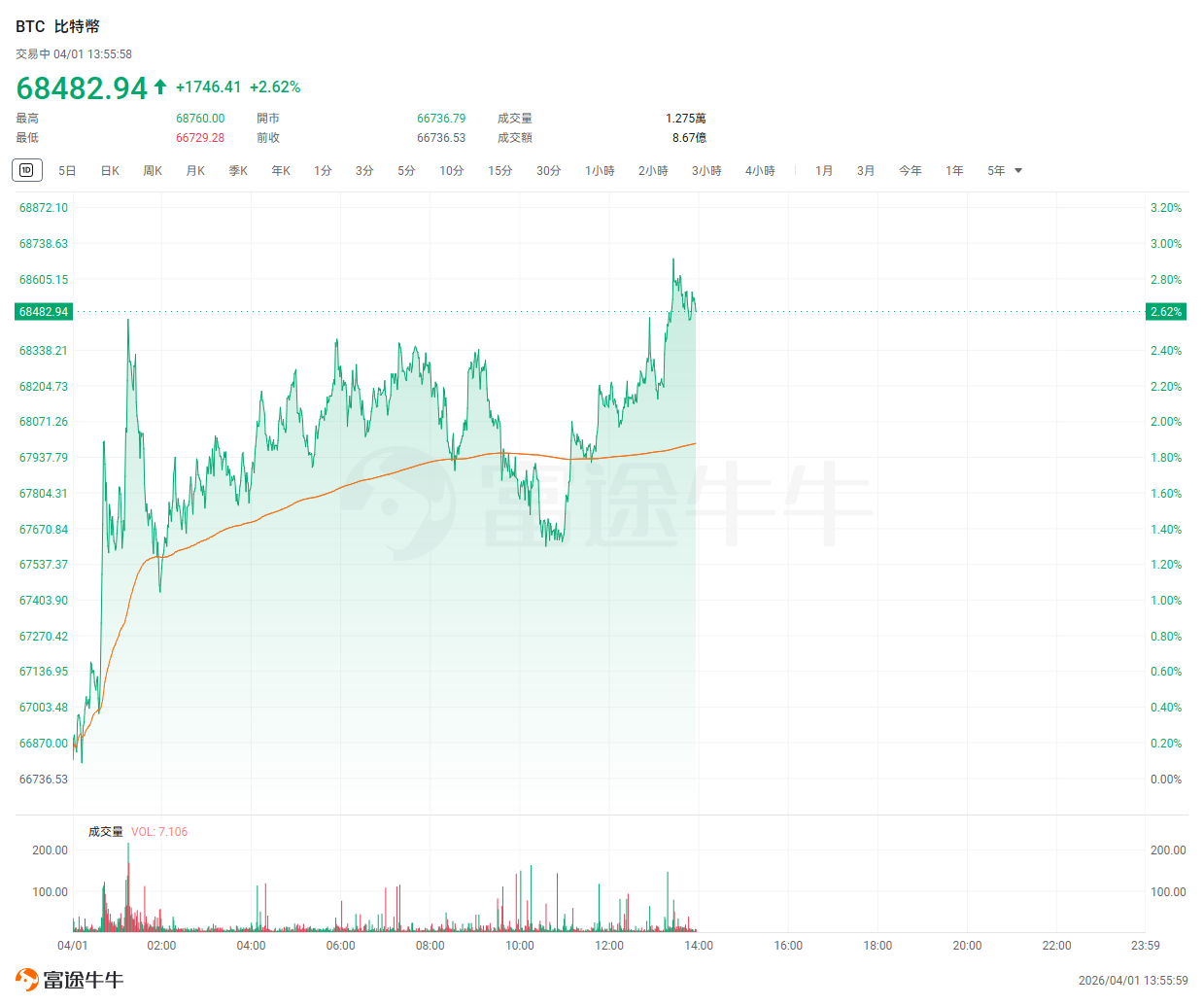
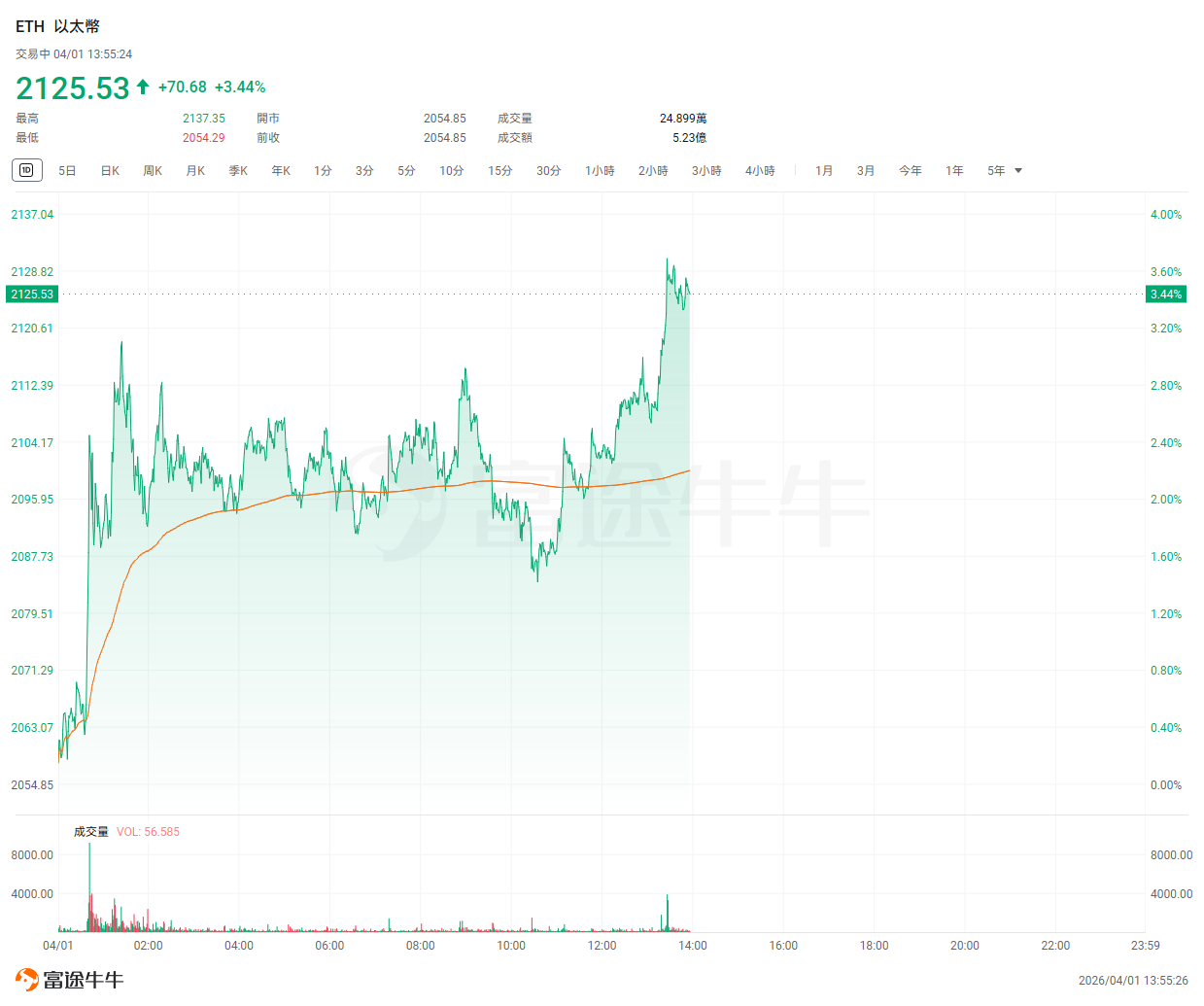
On April 1st, news indicated that the cryptocurrency market trended upwards. As of press time, $Bitcoin (BTC.CC)$ Bitcoin rose by 2.62%, trading at $68,482.94; $Ethereum (ETH.CC)$ Ethereum increased by 3.44%, reaching $2,125.53.
Key Focus
S&P tokenizes its iBoxx U.S. Treasury Index on the Canton Network
According to Cointelegraph, S&P Dow Jones Indices has tokenized its iBoxx U.S. Treasury Index on the Canton Network, enabling this key fixed-income benchmark to be represented in the form of digital assets. The tokenized index is not an investment product but allows financial institutions to directly integrate benchmark data such as pricing and index levels into blockchain systems. The Canton Network is a public chain focused on institutional applications, with over 600 participating organizations and validators, supported by institutions like Goldman Sachs and Citadel. S&P Dow Jones Indices will continue to control access permissions to the index, with permissions embedded within the token itself. Currently, U.S. Treasury products account for the largest share of the tokenized asset market, with on-chain tokenization exceeding $12.5 billion.
 Hong Kong Monetary Authority responds to delay in issuance of first batch of compliant stablecoin licenses: Progressing with full efforts
According to Caixin, the first batch of issuer licenses in Hong Kong, originally scheduled for issuance in March 2026, were not issued as planned. A spokesperson for the Hong Kong Monetary Authority (HKMA) stated that the HKMA is making every effort to advance the licensing process and will announce developments at the appropriate time. Regarding which entities will receive the first batch of stablecoin licenses, the market had been closely watching two major Hong Kong dollar note-issuing banks, HSBC Holdings and Standard Chartered Bank. HSBC has not publicly disclosed whether it submitted an application for a stablecoin license.
However, as early as mid-January this year, rumors emerged in the market suggesting that HSBC had a strong chance of obtaining one of the first licenses. No official clarification has been provided regarding why the issuance of stablecoin licenses was delayed compared to the initial timeline. A source close to the stablecoin license application revealed that the HKMA has recently been engaging intensively with the first group of potential compliant licensees, and modifications to the issuance plan are still being proposed. Additionally, applications for the second batch of compliant stablecoin licenses in Hong Kong are also underway.
Resolv founder denies rumors of insider involvement in exploit but provides no specific timeline for recovery plan
According to Cryptopolitan, Ivan Kozlov, co-founder of Resolv Labs, provided an update on the previous USR stablecoin attack, denying rumors of insider involvement in the exploit. He stated that no relevant evidence has been found thus far. The vulnerability stemmed from a privileged minting role's private key being controlled by a single account, lacking multi-signature protection and an on-chain minting cap. Resolv has engaged the law firms Paul Hastings and Carey Olson for legal advice and is collaborating with Mandiant, a cybersecurity firm under Google, and the on-chain analysis agency Zero Shadow to reconstruct the attack and trace accountability.
Magic Eden Wallet to Enter Export-Only Mode on April 1, Fully Cease Operations on May 1
According to a report by Cryptopolitan, the NFT marketplace Magic Eden announced that its native wallet will enter export-only mode on April 1 and cease operations entirely on May 1. Users must export their private keys or mnemonic phrases before this deadline, otherwise they will be unable to recover their assets. The wallet has already been removed from major app stores, and new users cannot download or restore it. Magic Eden has previously shut down its Ethereum and Bitcoin markets, shifting its focus to entertainment and the Dicey application. The ME token will remain the core incentive of the ecosystem, with stakers eligible to receive USDC rewards. The project team has also established an ME buyback program.
Google Warning: The threshold for quantum decryption may be significantly lower than expected, and the cryptocurrency sector needs to transition to post-quantum solutions by 2029 to address the challenge.
Researchers at Google have warned that future quantum computers could potentially crack some of the encryption methods used to protect Bitcoin and other digital assets with fewer resources than previously anticipated, making discussions on how the industry should respond more urgent. The researchers did not claim that such machines already exist but noted that recent studies indicate the computational power required for such attacks may be lower than many earlier estimates.
In a Google Research blog post, the researchers stated that future quantum computers might compromise elliptic-curve cryptography, a widely adopted form of public-key encryption technology in the market. Their latest estimates suggest that the scale of quantum computing hardware needed to break ECDLP-256, which secures cryptographic wallets and transactions, could be reduced by approximately 20 times.
Google positioned this paper as a warning aimed at giving the industry time to prepare, rather than predicting an imminent collapse. Last week, Google proposed a timeline to fully migrate its own security systems to post-quantum cryptography by 2029.
Cardano founder expresses skepticism about the Clarity Act, warning that future lawmakers may 'weaponize' it.
According to a CoinDesk report, Cardano founder Charles Hoskinson expressed concerns about the Clarity Act, warning that even if passed, it could require up to 15 years of rule-making and might be 'weaponized' by future lawmakers. He noted that the current regulatory environment is a direct consequence of the FTX collapse, which shifted the Democratic Party's stance on cryptocurrency from curiosity to hostility, initiating a three-year crackdown.
Hoskinson criticized the bill for classifying all new projects as securities by default, making it difficult for them to exit this classification. This benefits existing crypto assets like Cardano, XRP, and Ethereum but hinders the growth of new projects. Hoskinson believes that the current discussion around the bill focuses on secondary issues, such as whether stablecoins pay yields, while ignoring fundamental flaws.
New Hampshire plans to issue $100 million in municipal bonds backed by Bitcoin, receiving a Moody's Ba2 rating.
According to Bloomberg, the New Hampshire Business Finance Authority plans to issue $100 million in municipal bonds backed by Bitcoin, marking the first financial product to combine high-risk crypto assets with traditional safe assets. The bond received a Moody's Ba2 rating, two levels below investment grade. Principal and interest payments will be funded by returns generated from Bitcoin collateral, and if the price of Bitcoin falls below a specific threshold, the trust will be liquidated to fully repay bondholders.
Wave Digital Assets manages daily trading operations, BitGo Bank & Trust serves as the custodian, and Bitcoin mining firm CleanSpark borrows funds and provides Bitcoin collateral. The governor of New Hampshire stated that this initiative does not involve state funds or taxpayer risk.
Fed's Barr warns of stablecoin risks, emphasizing the need to strengthen regulation and reserve audits.
According to Bloomberg, Federal Reserve Governor Michael Barr stated that stablecoins pose money laundering and financial stability risks, with the quality and liquidity of their reserve assets being crucial to their long-term viability. He pointed out that stablecoin issuers have incentives to maximize reserve asset returns by expanding their risk spectrum. Barr also acknowledged the potential advantages of stablecoins in fund management, remittance transfers, and faster settlement capabilities compared to wire transfers.
Regulatory agencies, including the Federal Reserve, are drafting rules under the Genius Act, requiring stablecoin issuers to formally register and hold dollar-for-dollar reserves. Barr stated that strict control over reserve assets, combined with regulatory, capital, and liquidity requirements, could enhance the stability of stablecoins and make them more viable payment tools. However, success will depend on the details of regulatory enforcement.
Crypto-friendly bank Cross River Bank completes $50 million in new funding.
According to Bloomberg, the crypto-friendly bank Cross River Bank has raised $50 million from existing investors, led by a fund under T. Rowe Price, with a valuation slightly above $3 billion. The new funds will be used to accelerate product launches, deepen partnerships, and expand international operations, with a focus on enhancing artificial intelligence and cryptocurrency sectors. Founded in 2008, Cross River provides banking infrastructure for over 100 technology and fintech companies such as Stripe, Coinbase, and Affirm. This month, it also reached a payment cooperation agreement with the X platform. The bank gained attention due to its integration with the Solana chain and participation in Visa's USDC stablecoin settlement pilot.
Mercado Libre to discontinue loyalty program of its proprietary cryptocurrency Mercado Coin.
Latin American e-commerce giant Mercado Libre announced the closure of its proprietary cryptocurrency Mercado Coin's loyalty rewards program. Starting April 17, users will no longer be able to buy or sell through Mercado Coin or receive cashback, and its functionality within the platform ecosystem will be removed.
After aggressively buying gold, 'stablecoin leader' Tether suddenly dismisses two gold traders just months after poaching them from HSBC.
The 'stablecoin' giant Tether has disbanded its precious metals trading team, which was poached from HSBC. According to Bloomberg on March 31 citing insiders, the 'stablecoin' giant Tether has dismissed senior precious metals traders Vincent Domien and Mathew O'Neill, both of whom joined the company several months ago from $HSBC HOLDINGS (00005.HK)$ switching to the company.
The reasons for their departure are unclear. When they joined Tether, the company was in the midst of a record year for gold purchases, with its purchases nearly surpassing those of all central banks. In response to Bloomberg News inquiries, Tether stated: The company remains committed to maintaining a lean team and continuously optimizing operations.
Stablecoin cross-border payment network raises $8 million in funding, led by NEA.
According to Fortune, Latitude, a cross-border payment startup founded by former employees of Stripe and Coinbase, announced the completion of an $8 million funding round, led by NEA with participation from Lightspeed Faction, Coinbase, Paxos, Solana Foundation, and others. Latitude’s core product, 'Global Payouts,' targets U.S. businesses, supporting payments from U.S. dollars to personal accounts in over 50 countries via stablecoin links, enabling automatic conversion from U.S. dollars → stablecoins → local currencies. It has already served content creator platforms like Zencastr.
TD Cowen: Only One-Third Probability of Crypto Market Structure Bill Passing This Year
On April 1, Jaret Seiberg, Managing Director of TD Cowen, stated in a Monday research report that he was becoming increasingly pessimistic about the prospects of the Clarity Act, a bill aimed at structuring the cryptocurrency market. He estimated that there was only a one-third probability of the Senate advancing the bill and it being passed by the House of Representatives.
The bill remains stalled in the U.S. Senate as Congress has entered a two-week Easter recess. Seiberg pointed out that a recent compromise proposal on stablecoin yields, led by Senators Thom Tillis and Angela Alsobrooks, is 'insufficient' to drive progress on the bill.
KB Card of South Korea partners with Avalanche to launch a 'hybrid stablecoin' credit card
KB Card, one of South Korea’s largest credit card companies, announced a partnership with Avalanche to introduce a "hybrid stablecoin" credit card payment model. This model is based on KB Card’s hybrid payment patent, integrating stablecoins with traditional credit cards. Users can link their existing credit cards to digital wallets, prioritizing payments using stablecoin balances, with any shortfall automatically charged to the credit card.
In addition, KB Card announced a collaboration with digital asset infrastructure company OpenAsset to jointly develop a complete stablecoin system encompassing top-ups, payments, and settlements. This initiative aims to lower the barriers for users adopting stablecoins while preserving the benefits and rewards associated with credit cards.
Bitfarms to be renamed Keel and plans to sell $161 million Bitcoin stake to invest in AI
Bitfarms, a Nasdaq-listed Bitcoin mining company, reported revenue of $229 million for the fiscal year 2025, representing a 72% year-over-year increase, but incurred a net loss from continuing operations of $209 million. As of March 27, its cash and Bitcoin liquidity amounted to approximately $520 million. The company also announced that shareholders had approved its plan to redomicile in the United States and rebrand as Keel Infrastructure by April 1, 2026, with the stock ticker expected to change to KEEL. Additionally, the company intends to opportunistically sell around 2,400 Bitcoin, valued at approximately $161 million, to fund investments in HPC and AI infrastructure, further shifting away from its pure Bitcoin mining focus.
Chainalysis launches blockchain intelligence agent tool, with plans to gradually roll it out to the market starting this summer.
According to a report by The Block, blockchain analytics firm Chainalysis has launched "blockchain intelligence agents" trained on its historical investigative data. These agents are designed for law enforcement agencies, compliance teams, financial institutions, and crypto enterprises to automate monitoring and investigations of illicit activities on the blockchain. The agents can operate in either deterministic processes or exploratory modes, generating comprehensive audit trails that document all utilized data, reasoning paths, and specific actions to meet compliance and forensic requirements.
USA₮ expands to Celo and introduces Google Cloud-supported distribution
According to an official announcement by USA₮, the compliant digital dollar issued by Anchorage Digital Bank has officially expanded to Celo, marking its first supported network after Ethereum. The project has also collaborated with Self and Google Cloud to launch a mainnet faucet, enabling the distribution of USA₮ to compliant users through privacy-preserving human identity verification.
Stablecoin liquidation platform Better Money has completed a $10 million seed funding round led by a16z crypto.
According to Fortune, The Better Money Company, founded by former a16z crypto investor Sam Broner and partner Adam Zuckerman, announced the completion of a $10 million seed funding round led by a16z crypto, with participation from BoxGroup, Sunflower Capital, Sean Neville, co-founder of Circle, and former Microsoft executive Charlie Songhurst.
Bitcoin aims to enhance its quantum resistance through the BIP360 proposal, with the corresponding testnet already deployed.
According to Bitcoin Magazine, Bitcoin developers are advancing a Bitcoin Improvement Proposal (BIP360) titled 'Pay to Merkle Root (P2MR)' aimed at enhancing Bitcoin's quantum resistance. The corresponding testnet has been deployed. Screenshots indicate that the relevant code submission was completed and verified on February 11, reflecting the community’s proactive technical preparations for potential quantum computing threats.
OpenFX, a stablecoin-based cross-border payment infrastructure company, has completed a $94 million financing round.
According to Reuters, OpenFX, a startup specializing in foreign exchange market-making and cross-border remittances, has completed a $94 million financing round led by Accel, Lightspeed Faction, M13, Northzone, and Pantera, with a post-money valuation of approximately $500 million. OpenFX leverages stablecoins as a bridge between banking systems and blockchain infrastructure to provide faster and lower-cost settlement services for large cross-border transactions. The company claims that over 98% of transactions on its platform can be settled within 60 minutes, with its annualized payment processing volume increasing from about $4 billion to approximately $45 billion. OpenFX plans to use the proceeds from this round to expand into Southeast Asia and Latin America markets.
Editor/Joe