
Tom Lee, a well-known bull on Wall Street and founder of Fundstrat, pointed out that the S&P 500 Index typically bottoms within the first 10% of the duration of a war; inflation-adjusted oil prices are below the average since the beginning of this century, exerting limited impact on the U.S. economy; considering the current extremely cautious market positioning, he believes that the current adjustment has completed 90% to 95%.
The recent sharp fluctuations in the U.S. stock market may be approaching a turning point. Tom Lee, founder and head of research at Fundstrat, released a research report to investors on the last trading day of the first quarter, stating that the market has already priced in most of the downside risks, with over 90% of the adjustment process completed.
Lee cited historical data to indicate that $S&P 500 Index (.SPX.US)$ the market typically bottoms during the early stages of a war rather than its conclusion, as investors tend to price in adverse risks quickly. He also questioned the forecasts of some pessimistic institutions, deeming their bearish expectations for the S&P 500 'unrealistic.'
 Comments made by Trump on his Truth Social platform on Tuesday were interpreted by the market as a signal of de-escalation. The S&P 500 surged 2.9% to 6,528 points on the same day. Lee noted that the rapid market response precisely reflects how cautious investor positioning currently is, implying substantial room for a rebound once risk sentiment improves.
Historical Pattern: The Early Stages of War Often Present Buying Opportunities
Lee reviewed seven major conflicts since 1900 and found a significant pattern in the S&P 500 Index, which typically bottoms within the first 10% of the duration of a war.
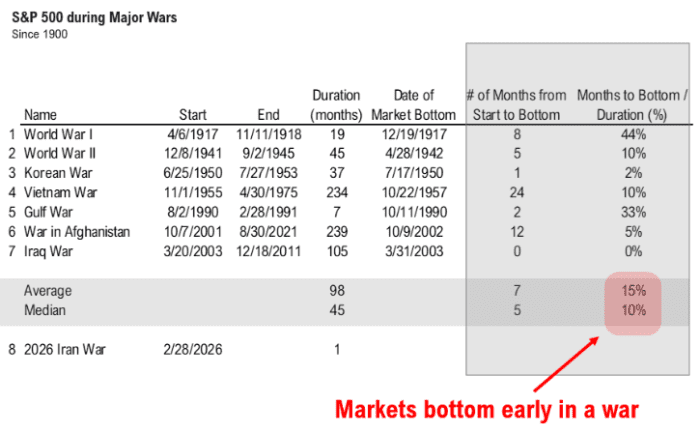
The rationale behind this is that investors are accustomed to 'pricing in adverse risks in advance' rather than continuously lowering valuations as events unfold.
Based on this historical pattern, Lee believes the current market situation mirrors the early stages of a war. Mark Newton, Fundstrat's technical strategy head, estimates that the short-term low range for the S&P 500 is between 6,200 and 6,300 points.
Lee went further, explicitly stating, 'We are much closer to the bottom than those issuing pessimistic warnings believe,' and predicted a V-shaped rebound after this sharp decline.
Limited Oil Price Impact; U.S. Demonstrates Resilience
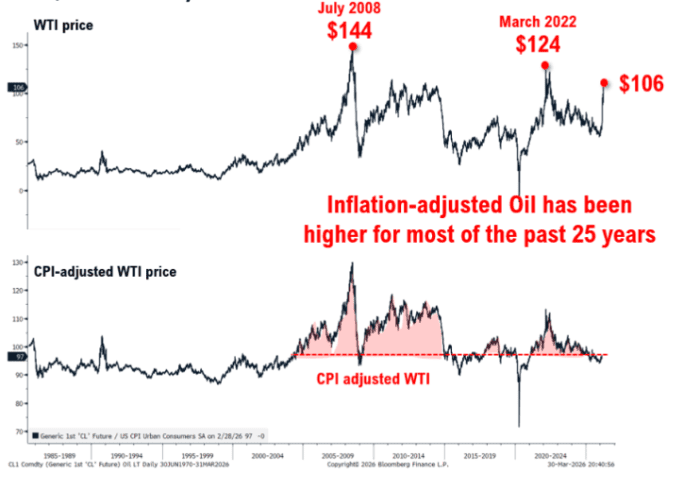
Regarding the market's greatest concern about the impact of high oil prices, Lee holds a relatively optimistic view. He pointed out that as a net oil exporter, the United States actually benefits from rising oil prices. Even if $Crude Oil Futures (MAY6) (CLmain.US)$ oil prices rise to $100 per barrel, after adjusting for inflation, they are still far below historical highs.
Lee provided specific data to support his argument: the nominal peak oil price in the summer of 2008 was $144 per barrel, but cumulative inflation since then has increased by approximately 53%. This means WTI would need to rise to between $220 and $240 to match the historical record in terms of real purchasing power.
In other words, the current $100 oil price, after adjusting for inflation, remains below the average level since the beginning of this century.
Moreover, Lee added that the increase in defense spending during wartime contributes an incremental $20 to $30 billion to GDP each month, offsetting some of the economic pressure caused by high oil prices.
Technical indicators and positioning signals jointly point to a market bottom.
Sentiment indicators also provide technical support for Lee’s assessment.
He noted that the current reading of the put-call ratio for stock options is 0.9, comparable to the level seen at a market trough following the announcement of new tariff policies by the Trump administration in April 2025.
This indicator is generally regarded as a measure of market panic. The current reading indicates that investors’ defensive sentiment has risen to an extreme level, which historically often corresponds to a market bottom area.
Combined with the extremely cautious positioning, Lee concluded: "We have already completed 90% to 95% of this decline."
Editor/KOKO