
①The AI adoption rate of U.S. enterprises is 18.9%, and it is expected to rise to 22.3% within the next six months; ②AI-related investments remain robust, particularly in semiconductors; ③The impact of AI on the overall job market is still not significant, with disruptions remaining confined to specific sectors; ④In the limited areas where generative AI has been deployed, productivity has significantly improved.
Cailian Press, April 1 (edited by Xia Junxiong) — Goldman Sachs stated in its latest research report that the artificial intelligence (AI) adoption rate of U.S. enterprises is 18.9%, and it is expected to rise to 22.3% within the next six months, marking the entry into a 'steady growth phase' for AI adoption.
On March 31, analysts including Sarah Dong from Goldman Sachs released the 'AI Adoption Tracking Report,' covering dimensions such as AI adoption rates, AI investment, and the impact on the labor market and productivity.
 The report stated that AI investment remains in a high-growth cycle; the impact on employment is limited, but structural effects have begun to emerge; improvements in productivity are already becoming evident.
AI Investment and the Industrial Chain
Goldman Sachs pointed out that AI-related investments remain strong, particularly in semiconductors.
Analysts predict that by the end of 2026, global semiconductor revenue will increase by 49% compared to current levels. By the fourth quarter of 2026, AI-related hardware revenue is expected to exceed 700 billion U.S. dollars.
The United States continues to lead other developed markets, such as Canada, Japan, and the United Kingdom, in AI hardware and software investment.
U.S. AI-related investments are currently 325 billion U.S. dollars higher than in 2022, accounting for approximately 1.1% of its GDP. The investments primarily flow into data center construction, power and HVAC systems, servers and computers, and semiconductors.
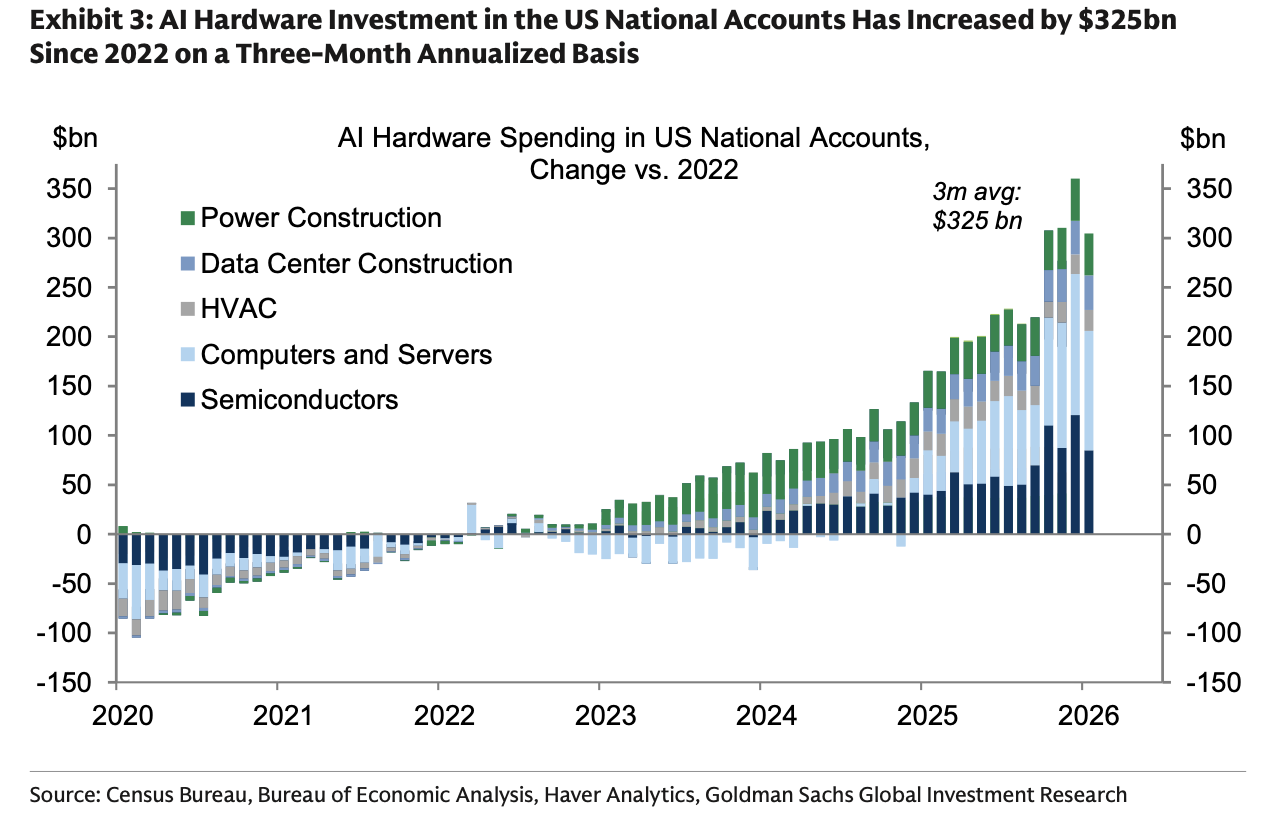
(Fields of U.S. AI investment allocation)
In February this year, AI-related hardware exports from Taiwan, China reached USD 44.6 billion, showing a slight decline month-over-month but remaining at a high level, indicating that global demand for AI hardware remains very strong.
Enterprise AI Adoption
Goldman Sachs cited data showing that as of March this year, the AI adoption rate among U.S. enterprises stood at 18.9%, unchanged from the previous month; it is expected to rise to 22.3% within the next six months. Enterprise AI adoption has moved from the 'initial surge phase' into the 'steady penetration stage.'
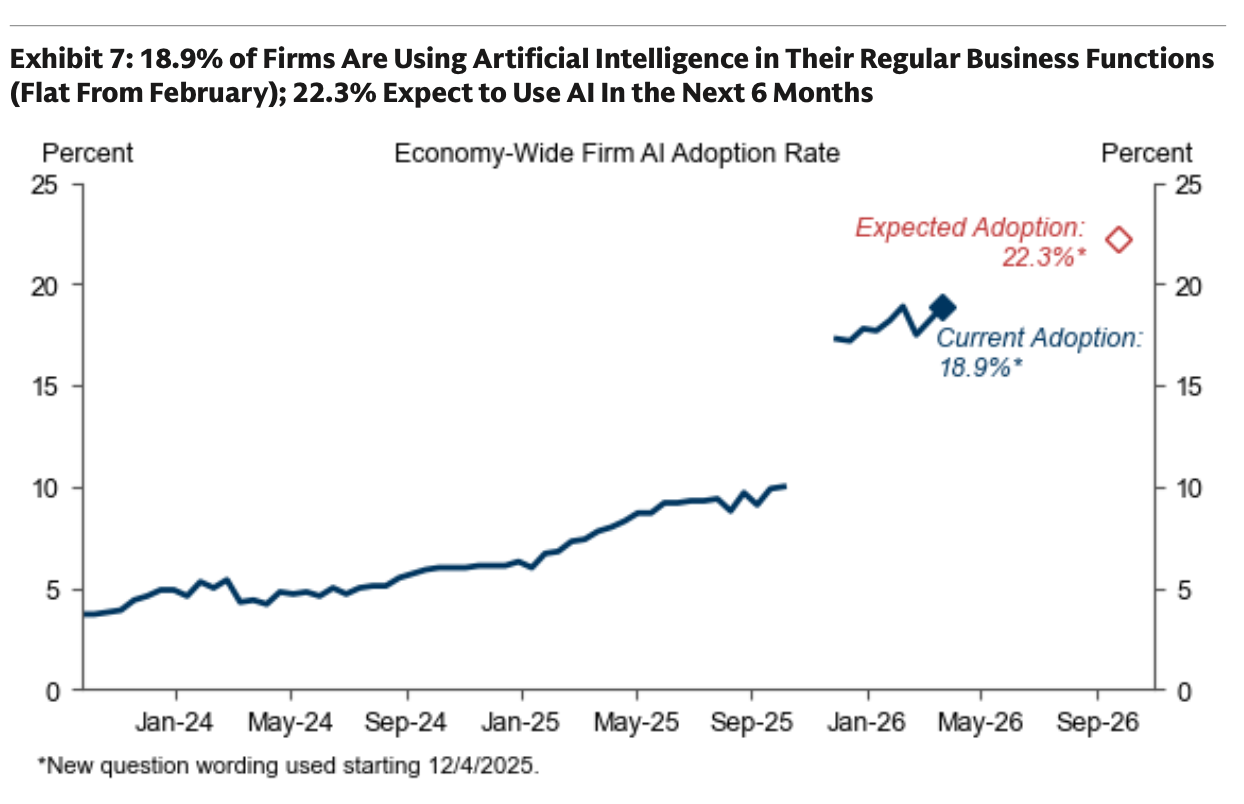
(AI Adoption Rate Among U.S. Enterprises)
Industries leading in AI adoption include information services, professional services (consulting/technology), education, and finance/insurance, all of which are knowledge-intensive sectors.
Among specific sub-sectors, computing and network hosting companies have the highest AI usage rate, reaching 60%, followed by financial insurance and content industries such as publishing.
The entertainment and media industry is experiencing the fastest growth in AI adoption, highlighting AI’s increasing penetration into creative industries; the broadcasting and television sector is expected to see the largest increase in adoption rates within the next six months.
Differences in enterprise size also influence AI adoption rates. Large enterprises (with over 250 employees) are leading the way with an adoption rate of 35.3%. Medium-sized enterprises (with 20–49 employees) showed the most significant growth, increasing by 2.1 percentage points compared to the last survey, reaching 21.5%.
AI adoption is highly correlated with the 'degree of substitutability by AI,' with AI prioritizing entry into industries characterized by high information density and repetitive cognitive labor.
Impact on the Labor Market
The report indicates that the impact of AI on the overall job market remains insignificant, with disruptions still confined to specific sectors.
Industries already affected include marketing, graphic design, customer service, and technology, with a reduction of approximately 5,000 jobs per month.
In February this year, only 4,600 layoffs were explicitly attributed by companies to AI, suggesting that 'AI-induced mass unemployment' has not yet occurred.
Meanwhile, AI has also created new job opportunities. For instance, in the infrastructure construction sector, construction jobs driven by data center development have increased by 212,000 since 2022.
From the perspective of corporate recruitment, the proportion of AI-related job postings in major developed markets continues to rise, with particularly rapid growth in Canada.
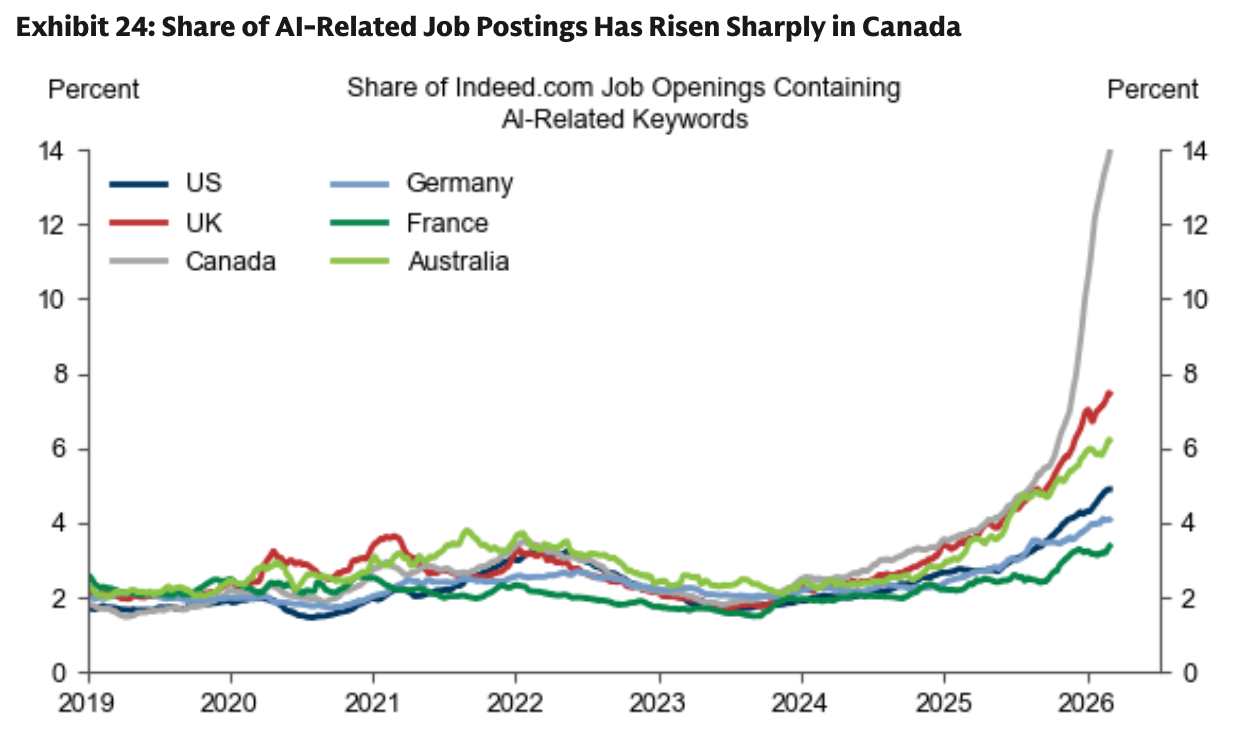
(Growth in AI-related jobs in developed countries)
Productivity improvement
Goldman Sachs analysts noted that productivity has significantly improved in the limited areas where generative AI has been deployed.
In academic research, AI has boosted productivity by an average of 23%. Corporate feedback indicates even higher efficiency gains, averaging 33%.
Official U.S. data is beginning to show a slight acceleration in productivity growth over the past year in industries with higher AI adoption rates.
Some third-party surveys also support this conclusion.
According to NVIDIA's survey, 64% of companies have adopted AI, 86% plan to increase their AI budgets, and 53% of respondents believe AI enhances productivity.
Data from OpenAI indicates that enterprise users save an average of 40 to 60 minutes daily by using AI; 75% of users report being able to accomplish new tasks that were previously unachievable.
A survey by the consulting firm McKinsey states that 88% of companies use at least one AI application, but most remain in the pilot stage.
Multiple surveys have also highlighted obstacles and challenges to AI adoption, such as a shortage of relevant skills, a lack of internal expertise, and insufficient employee training, which are identified as the biggest barriers to AI integration.
Data security, privacy concerns, and the accuracy of AI-generated information (the issue of hallucinations) are key risks that companies are closely monitoring.
Companies are also focused on the costs and returns of AI. While approximately 75% of businesses have observed positive ROI (Return on Investment), for very large enterprises, due to the high complexity of integration, it is still too early to measure productivity gains.