This tech giant, which once reshaped the consumer electronics industry with the iPod and iPhone, is now facing multiple challenges including lagging AI development, weak hardware innovation, pressure in the Chinese market, and an undecided successor. The direction of its second fifty years is under close scrutiny by Wall Street and the industry.
On the occasion of its 50th anniversary, $Apple (AAPL.US)$ stands at a crossroads filled with uncertainties.
This tech giant, which once reshaped the consumer electronics industry with the iPod and iPhone, is now facing multiple challenges including lagging AI development, weak hardware innovation, pressure in the Chinese market, and an undecided successor. The direction of its second fifty years is under close scrutiny by Wall Street and the industry.
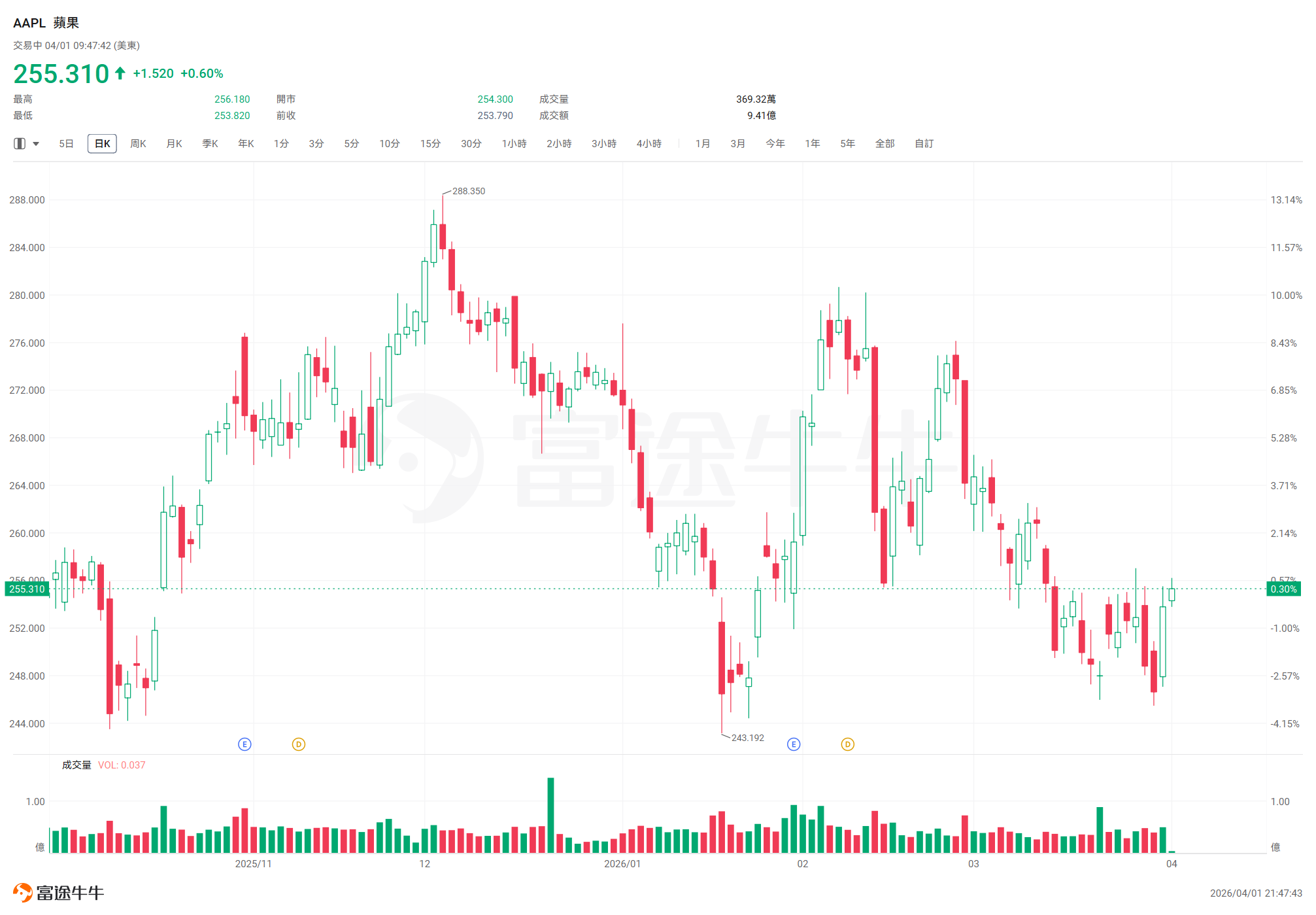
 Since 2026, Apple's stock price has fallen by nearly 7% cumulatively, outpacing the decline of $S&P 500 Index (.SPX.US)$ , continuing last year's underperformance relative to the broader market. Meanwhile, Apple has relinquished its position as the world's most valuable company — NVIDIA, leveraging its pivotal role in the AI infrastructure boom, has surpassed Apple.
In the current most critical technological arena of AI, Apple is notably lagging behind its peers. Tech giants such as Microsoft, Google, and Amazon have collectively invested hundreds of billions of dollars this year in AI infrastructure, while upgrades to Apple's voice assistant Siri have been significantly delayed. In January, Apple announced a multi-year partnership with Google to integrate the Gemini model and cloud technology to support future upgrades to Siri and foundational models, but doubts remain about whether Apple can truly establish itself in the AI era.
Where is the next 'iPhone moment'?
Apple currently boasts 2.5 billion active devices globally, providing a solid foundation for its applications and services business. However, Wall Street continues to await Apple’s discovery of the next breakthrough product. The company has terminated its Apple Car project, and the Vision Pro headset remains a niche product.
According to Bloomberg, Apple is accelerating the development of three AI wearable devices centered around Siri, including smart glasses, pendant-style devices, and AirPods equipped with cameras.
Ben Bajarin, CEO of Creative Strategies, stated, "The biggest question is what comes after the iPhone. These are mature categories, and we don’t know what’s next, but it will certainly be some form of AI hardware."
Nabila Popal, an IDC analyst, bluntly stated that she does not expect Apple’s upcoming products — whether it’s the Siri upgrade or foldable phones — to reach the heights of the 'next iPhone moment.' Referencing Steve Jobs’ 1997 'Think Different' speech, Popal remarked, "That kind of energy is exactly what everyone expects from the next-generation product."
Succession uncertainties loom large.
Current CEO Tim Cook turned 65 last November. Despite publicly stating in a mid-March interview with ABC that he "cannot imagine life without Apple," reports indicate that Cook has privately expressed fatigue to colleagues.
The person currently considered most likely to succeed is John Ternus, Apple's hardware chief.
Ternus is approximately 15 years younger than Cook. He graduated in mechanical engineering from the University of Pennsylvania and has been with Apple for about 25 years. He oversees the hardware engineering teams behind the iPhone, iPad, Mac, Apple Watch, AirPods, and Vision Pro. Recently, he has been featured in reports by The New York Times and Bloomberg.
Forrester analyst Dipanjan Chatterjee believes that if the theme of Cook’s era was 'operational excellence and scale expansion,' the next decade will be turbulent for Apple. 'The way consumers interact with technology, particularly in generative AI, has changed significantly.'
Morgan Stanley analyst Erik Woodring noted that Apple's future leadership will be closely tied to 'next-generation products.' Popal emphasized that Apple needs a leader who can effectively engage with governments around the world, stating, 'Cook has been at the forefront, and Apple needs someone who can continue that.'
China: A Dual Critical Factor in Sales and Supply
China is both a vital sales market and a core manufacturing base for Apple, but the current trade tensions have made this relationship increasingly complex.
In terms of financial data, Apple’s Greater China revenue for the 2025 fiscal year was $64.4 billion, marking an 11% decline over two years and making it the only one of its five regions to experience sustained contraction. However, there was a significant rebound in the December quarter last year, with Greater China sales surging 38% year-on-year to $25.5 billion, primarily driven by iPhone sales. On earnings day, Cook stated, 'We set a record for upgrades in mainland China, with switchers also achieving double-digit growth.'
Despite this, long-term risks remain. While Apple has accelerated capacity relocation to India and Vietnam, China remains irreplaceable.
Woodring stated, 'They are already diversifying their reliance on China, but China remains an integral part of Apple’s story.' He pointed out that Apple must demonstrate its ability to reduce geopolitical concentration without compromising profitability. Additionally, AI implementation in China faces unique challenges—Apple Intelligence must connect to local engines.
Can AI features truly drive device upgrade demand?
In the absence of a clear AI strategy, Apple is under increasing pressure to demonstrate that its on-device AI capabilities are sufficient to drive upgrades for the iPhone and Mac. The partnership with Google is widely regarded as the best path for Apple to enhance Siri's capabilities, but whether this will be enough remains uncertain.
Unlike Microsoft, Google, and Amazon, Apple does not have a cloud infrastructure business and has consistently avoided large-scale capital expenditure commitments. However, consumer expectations for advanced on-device AI experiences are rising.
Bajarin noted, "Apple has a fundamental trait: they don’t really lose customers. So the question is, can they attract new users?"
He added that currently, consumers are not upgrading devices specifically for AI features, but this could change in the future. Woodring candidly remarked, "I still think the question of what AI means for Apple remains unanswered. Frankly, Apple’s strategy over the past two years has been somewhat unclear. But I believe that once they identify a truly significant opportunity, you will see them execute effectively."
Can the moat of a premium brand be maintained?
Apple’s services business has surpassed $100 billion in annual revenue, encompassing the App Store, iCloud, Apple Music, Apple Pay, and the newly launched Apple Business platform, serving as a crucial source of the company’s profits.
To expand its user base, Apple recently introduced its first low-cost computer, the MacBook Neo, while discontinuing the high-priced Mac Pro desktop; it also increased advertising for its Maps product and the App Store.
Woodring believes that affordable products help bring more users into the services ecosystem, but he also pointed out, "They are still figuring out how to differentiate themselves in the low-end market," as Apple devices themselves are no longer a high-growth area.
The expansion of the advertising business presents another challenge. This business model has built the empires of Google and Meta, but it creates inherent tension with Apple’s long-standing commitment to user experience.
Chatterjee stated, "Over the past few years, Apple has made some unusual missteps in redefining the iterative experience of the iPhone. However, we haven’t seen users truly leave, so the ecosystem they have built remains strong enough – but how long this state can last is unclear." He added, "Users are sacred, and this is something Apple must carefully weigh."
Editor/KOKO