
U.S. President Trump delivered a speech, self-proclaiming a "swift, decisive, and overwhelming victory" in the conflict with Iran. Once the conflict concludes, the Strait of Hormuz will naturally reopen. An extremely intense strike against Iran will be carried out over the next two to three weeks.
At 9:00 AM Beijing Time on April 2 (9:00 PM EST on Wednesday), U.S. President Trump delivered a nationwide televised address regarding the conflict with Iran. This marks his first prime-time national address since the U.S.-Israel joint military operation against Iran began over a month ago.
According to reports from the Xinhua News Agency, Trump proclaimed in his speech that he had achieved a "swift, decisive, and overwhelming victory" in the conflict with Iran. The core strategic objectives of the U.S. campaign against Iran are "nearing completion."
 The military campaign against Iran is expected to achieve all its objectives within a 'very short period.' 'In the next two to three weeks, we will launch an extremely fierce attack on them... Meanwhile, negotiations are also underway.'
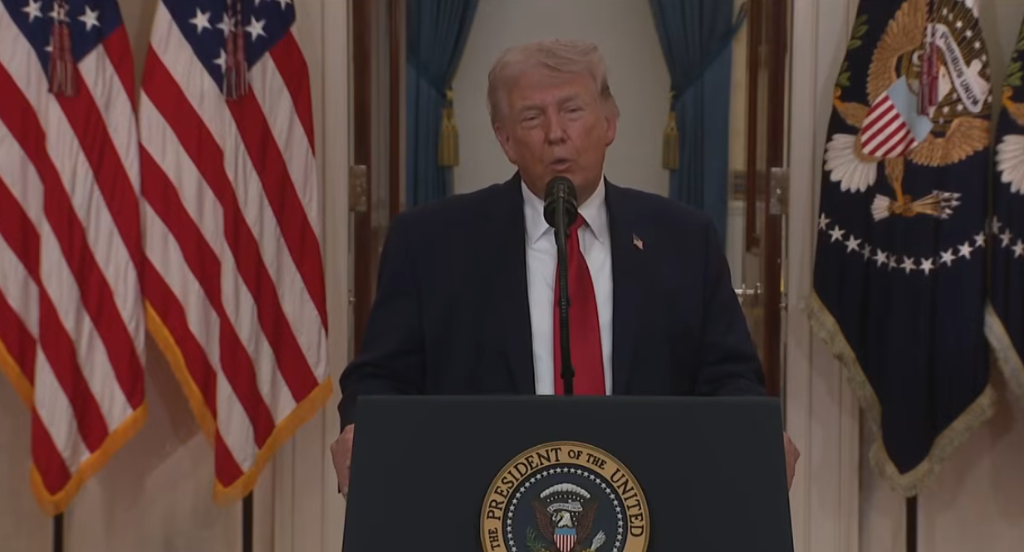
Trump stated: 'We will never allow Iran to possess nuclear weapons.' 'Iran’s navy has now been completely destroyed, and its air force and missile programs have also suffered severe damage.'
Regarding the Strait of Hormuz, Trump claimed: 'The U.S. does not need oil from the Middle East; we hardly import any oil transported through the Strait of Hormuz.' Once the conflict concludes, the strait will naturally reopen.
He also stated that relations with Venezuela on oil and gas matters remain favorable.
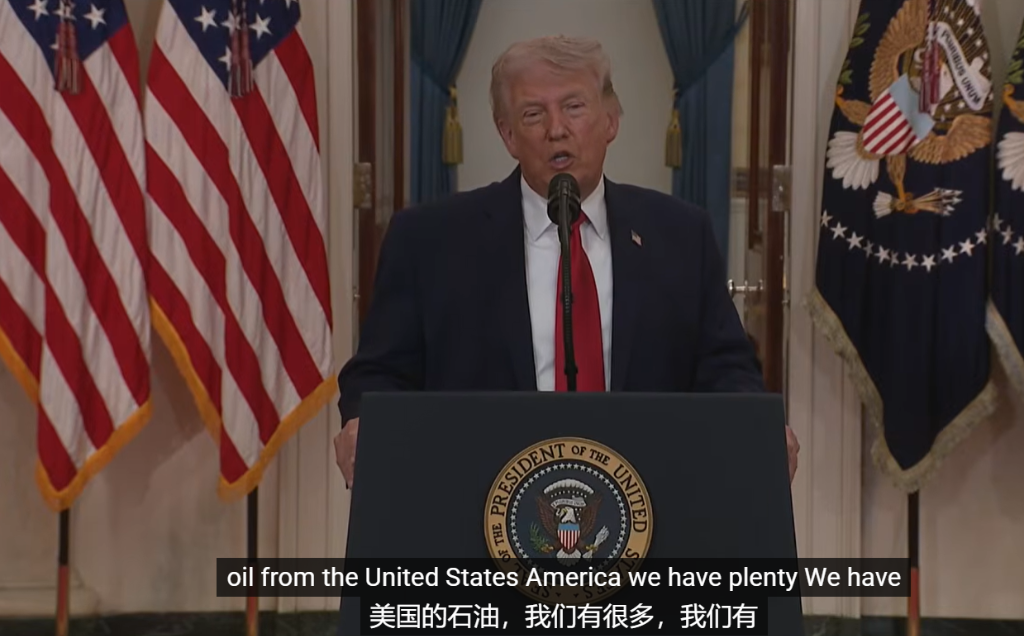
In less than half an hour, Trump concluded his remarks. Given that Trump explicitly stated that military operations would continue over the next two to three weeks and that the Strait of Hormuz remains under substantial blockade, the crude oil market reversed earlier losses and surged sharply during the address.
Brent crude temporarily breached $105 per barrel, with intraday gains reaching 4%.
At the same time, global equities came under broad pressure. As of press time, S&P 500 futures fell by 0.6%; in the Asia-Pacific markets, Japan's Nikkei 225 Index extended its decline to 1.1%, South Korea's Seoul Composite Index deepened its intraday drop to 2.1%, and the MSCI Asia-Pacific Index fell by 1%.
Bloomberg analyst Jake Lloyd-Smith pointed out that the immediate judgment of the commodities market on the message conveyed by Trump this time is: 'Negative for economic growth, negative for risk assets.' Affected by this, except for a surge in crude oil, spot gold fell more than 1%, and London copper also showed weakness.
'If no agreement is reached, it will hit power plants,' once again urging countries to go to the Strait of Hormuz to 'seize oil'
Trump issued a new strike warning directly in his speech. He stated that Iran’s new leadership is less radical and more rational. However, Trump emphasized: 'If no agreement is reached, we will impose extremely severe strikes on every one of their power plants.'
'We will strike them extremely hard in the next two to three weeks,' Trump added, 'We haven’t attacked their oil yet, although that would be the easiest target.'
Facing high gasoline prices domestically in the U.S., Trump attempted to reassure the public, stating that it was a 'short-term phenomenon' caused by Iran's attacks. He directly addressed the market: 'Gasoline prices will drop quickly. Stock prices will rebound rapidly as well.'
However, on the issue of resuming shipping through the Strait of Hormuz, which the market is most concerned about, Trump did not provide a clear plan for U.S. involvement.
According to Xinhua News Agency, Trump reiterated in his speech that the United States hardly needs to import oil through the Strait of Hormuz and that countries relying on the Strait for their oil supplies must "take responsibility for securing this route themselves." "We will provide assistance, but they should take the lead."
Trump encouraged these countries to either 'buy oil from the U.S.' or gather the courage to directly go to the Strait of Hormuz to 'seize oil.' He stated that when the conflict with Iran ends, the Strait 'will naturally reopen.'
Market Analysis: Ceasefire Lacks Details, Offers Little New Information
Multiple analysts have pointed out that the lack of substantive details addressing the core supply chain crisis in this highly anticipated speech has heightened market concerns.
Thepchai Yong, Executive Advisor of Thailand's Public Broadcasting Service, commented: Trump’s latest statement offered nothing new. He spent 19 minutes boasting about the success of the strike on Iran but did not mention when the war would end.
Amena Bakr, a reporter for the Energy Intelligence Group, stated: 'We haven't heard anything new here. It's just a repetition of all the posts and tweets. This is yet another message assuring the world that everything is fine, even though the conflict is dragging on and navigation through the Strait of Hormuz remains highly restricted.'
Dilin Wu, a research strategist at Pepperstone Group, stated that Trump's remarks were indeed disappointing. While declaring victory, Trump also threatened to strike Iran's energy and electricity facilities and indicated the possibility of launching a major attack in the next two to three weeks — essentially implying 'business as usual.' Previous comments about withdrawing troops from the Middle East now appear more like an attempt to calm the markets while keeping pressure options open. Clearly, he still leans toward a 'pressure-first' strategy rather than a complete de-escalation.
Bloomberg senior editor Derek Wallbank commented, 'If you’ve been listening to the President’s remarks over the past week, there wasn’t much new content tonight.'
He noted that Trump completely failed to mention Iran’s current de facto control over traffic in the Strait of Hormuz. This situation, which grants Iran 'de facto veto power,' is unacceptable to many Gulf nations. Additionally, according to U.S. officials, a third U.S. aircraft carrier strike group departed Virginia on Tuesday for the Middle East, indicating ongoing military buildup.
Columnist Clara Ferreira Marques stated that instead of providing new details or a lasting solution regarding the Strait of Hormuz, Trump urged other countries to find 'belated courage' to address the issue, a statement that 'will unsettle the crude oil market.'
From a longer-term investment perspective, the market is pricing in 'energy disruptions' into long-term valuations. Analyst Abhishek Vishnoi pointed out that Trump’s remarks urging other countries to take responsibility for the Strait of Hormuz increase the likelihood of a sustained risk premium in the crude oil market.
“Even if a ceasefire is reached and oil prices decline, the market has already begun pricing in 'prolonged high energy prices.'” Vishnoi stated, “Persistent shipping disruptions are seen as a potential long-term drag on global fundamentals.”
Vishnoi further noted that the crude oil futures curve is signaling that inflation will remain elevated in the coming months. Based on the Brent crude futures curve, the market expects oil prices to remain around $85 per barrel over the next year, significantly higher than the pre-U.S.-Israel attack on Iran expectation of approximately $70. This will greatly increase the risks of declining corporate profit margins and rising interest rates, making the outlook for non-U.S. assets, particularly in emerging markets and oil-importing countries, extremely cautious.
Looking to pick stocks or analyze them? Want to know the opportunities and risks in your portfolio? For all your investment-related questions,just ask Futubull AI!

Editor/joryn