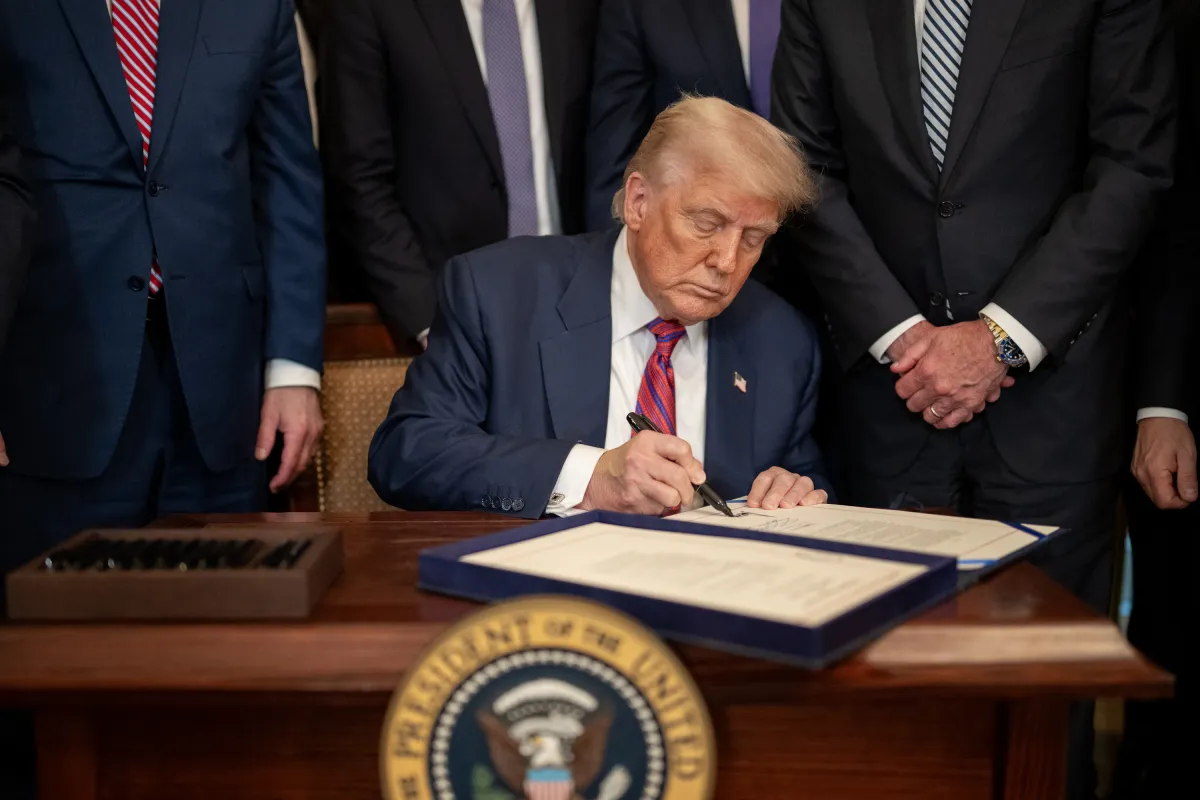
The market had expected Trump's nationwide television address to send a de-escalation signal, but instead, an escalation threat was delivered: he announced that within the next two to three weeks, an "extremely powerful strike" would be launched against Iran.
Institutions such as Nomura and National Australia Bank (NAB) have pointed out that the speech did not issue a clear de-escalation signal. The blockade situation in the Strait of Hormuz is unlikely to be resolved in the short term, and global oil prices may remain under pressure until late April. Trump’s speech was "indeed disappointing."
At 2:00 AM Beijing time on April 2,U.S. President Trump delivered a nationwide televised address regarding the conflict with Iran.The market had bet on him sending a de-escalation signal, but instead, a new threat emerged.
 In his speech, Trump claimed a 'quick, decisive, and overwhelming victory' in the conflict with Iran, while explicitly stating that 'in the next two to three weeks, we will launch an extremely forceful strike against them,' and issued an ultimatum: 'If there is no agreement, we will launch a fierce strike against every power plant in Iran.' He provided no answer regarding when the Strait of Hormuz would reopen.
Oil prices reflected the market’s immediate reaction:$Brent Last Day Financial Futures (JUN6) (BZmain.US)$Prices surged above $105 per barrel at one point during trading, with intraday gains reaching 4%. Stock markets across the Asia-Pacific region came under widespread pressure,$Nikkei 225 (.N225.JP)$The decline widened to 1.1%,$Korea Composite Index (.KOSPI.KR)$with losses widening to 2.1%,$E-mini S&P 500 Futures (JUN6) (ESmain.US)$and falling by 0.6%.
Nick Twidale, Chief Market Analyst at AT Global Markets, stated, 'Investors clearly are not buying it; global markets may see further downside today.' 'Although he said the war is about to end, the key message—that strikes against Iran will continue in the coming weeks—is highly negative for the market.'
Institutional Analysis: A Strategy of Pressure, Not De-escalation
Several institutions quickly issued assessments after the speech, with highly consistent core conclusions: this was not the signal the market had hoped for. Following Trump’s remarks, the market seemed more focused on the fact that the war in Iran has not yet ended.
Robert Subbaraman, Head of Global Market Research at Nomura Securities, stated that Trump's speech 'did not send a clear de-escalation signal as the market had hoped.' He noted that in the foreign exchange market, Asian currencies may weaken against the dollar, and if volatility becomes too rapid, central banks might increase intervention efforts. At the same time, this could also bring upward pressure on government bond yields. After the speech, the Bloomberg Dollar Spot Index rose by 0.2%.
Rodrigo Catril, a strategist at National Australia Bank (NAB) in Sydney, believes that 'the market seems to focus on the idea that the war is not over.' He stated, 'The U.S. is seeking escalation in hopes of forcing Iran into an agreement, but this strategy is not without risks—oil prices need to be closely monitored.'
Dilin Wu, a research strategist at Pepperstone Group, frankly stated that Trump's speech was "indeed disappointing." She pointed out that Trump’s earlier remarks about withdrawing from the Middle East now appear to be more aimed at appeasing the market while retaining the option to exert pressure. "He clearly still prefers a strategy of applying pressure first and then easing tensions, rather than straightforward de-escalation."
OCBC Bank also expressed a similar view, stating that Trump's remarks reduced hopes for a swift end to the war, prompting markets to prepare for a potential short-term escalation of tensions, rising oil prices, and a stronger US dollar.
"Persistently high oil prices are shifting concerns from inflation to growth, which could not only begin to weigh on the currencies of risk-sensitive energy importers such as the New Zealand dollar, British pound, and Swedish krona, but may also affect those of risk-sensitive energy exporters like the Australian dollar and Norwegian krone," said Moh Siong Sim, a foreign exchange strategist at the bank.
"If US Treasury yields fall due to heightened growth concerns, the Japanese yen could shift from being an underperforming currency to outperforming," he added.
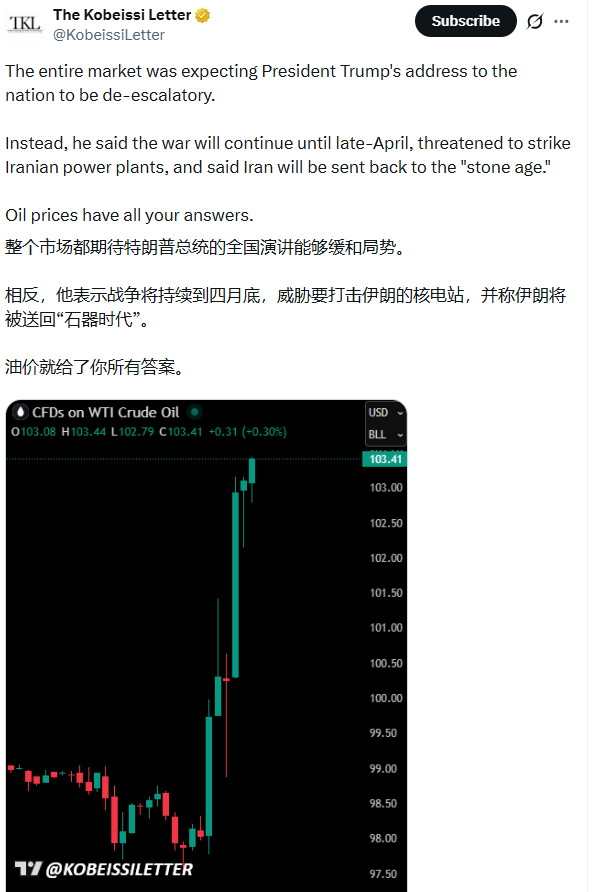
Lack of details on the ceasefire, with nothing new to offer.
Due to the lack of substantial details addressing the core supply chain crisis in the speech, market concerns are escalating.
Bloomberg senior editor Derek Wallbank commented, 'If you’ve been listening to the President’s remarks over the past week, there wasn’t much new content tonight.'
He noted that Trump completely failed to mention Iran’s current de facto control over traffic in the Strait of Hormuz. This situation, which grants Iran 'de facto veto power,' is unacceptable to many Gulf nations. Additionally, according to U.S. officials, a third U.S. aircraft carrier strike group departed Virginia on Tuesday for the Middle East, indicating ongoing military buildup.
Columnist Clara Ferreira Marques stated that instead of providing new details or a lasting solution regarding the Strait of Hormuz, Trump urged other countries to find 'belated courage' to address the issue, a statement that 'will unsettle the crude oil market.'
From a longer-term investment perspective, the market is pricing in 'energy disruptions' into long-term valuations. Analyst Abhishek Vishnoi pointed out that Trump’s remarks urging other countries to take responsibility for the Strait of Hormuz increase the likelihood of a sustained risk premium in the crude oil market.
Editor/Melody