
① U.S. President Trump stated on social media that countries unable to obtain aviation fuel due to the disruption at the Strait of Hormuz can purchase it from the United States; ② Analysts noted that the U.S. cannot compensate for the global aviation fuel shortfall as its export volume is much lower than that of the Strait of Hormuz; ③ The U.S. consumes a significant amount of aviation fuel domestically, and with increased exports, American consumers will experience rising prices.
U.S. President Trump said on Tuesday on the social media platform Truth Social that countries unable to obtain aviation fuel due to the Strait of Hormuz disruption can either buy it from the United States or control the Strait of Hormuz and extract oil themselves.
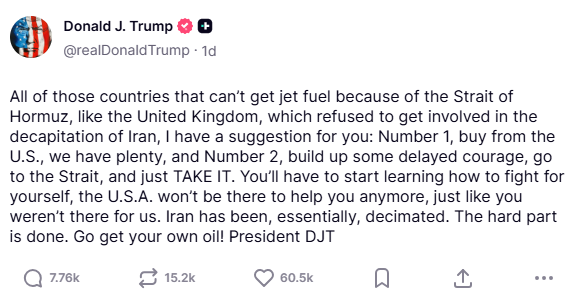
This statement left markets and professionals feeling both absurd and confused, seemingly indicating that the U.S. is being dragged into the quagmire of the Iran conflict. Trump’s claim of abundant U.S. energy resources to supply aviation fuel to other countries also lacks credibility, with analysts unanimously pointing out that the U.S. is incapable of filling the global fuel gap.
 Data from shipping tracking service Kpler shows that approximately 500,000 barrels of aviation fuel are exported daily from the Strait of Hormuz, primarily to Europe, with some going to Asia and Africa. Meanwhile, data from the Energy Information Administration (EIA), the statistical arm of the U.S. Department of Energy, indicates that last year the total average daily export of aviation fuel from the U.S. was 219,000 barrels.
The latest report from the EIA found that U.S. refineries and fuel blending plants produced 1.97 million barrels per day of jet fuel last week, but their output was only slightly higher than the demand of 1.79 million barrels per day. This means that the amount of aviation fuel the U.S. can allocate for exports is actually quite limited.
Increased exports add domestic price pressure
Kpler analyst Matt Smith stated that even if the U.S. has sufficient aviation fuel supplies, there are also many airlines within the country. Therefore, it is unlikely that the U.S. could replace the supply from the Strait of Hormuz.
Most of the U.S. aviation fuel production is concentrated in the Gulf Coast region, while major demand centers on the East and West Coasts have historically relied on imports to meet their needs. Currently, the West Coast has turned to the Gulf Coast for more fuel, intensifying domestic demand competition within the U.S.
Due to the aviation fuel demand gaps in markets like Asia and Europe, U.S. fuel suppliers, driven by profit, have increased exports. However, this has added to domestic price inflation pressures in the U.S.
Tom Kloza, Chief Energy Analyst at Gulf Oil, stated that since the outbreak of the Iran war, aviation fuel prices in the U.S. have surged, though the increase has been smaller compared to other markets directly affected by the blockade of the Strait of Hormuz, which has incentivized increased U.S. exports.
He added that at least four to five batches of jet fuel and diesel were loaded onto ships in the New York Harbor area for delivery to Europe, products that are typically shipped from Europe to the U.S. East Coast.
According to data from GasBuddy, wholesale prices for jet fuel across most of the United States currently range between $4 and $5 per gallon. Patrick De Haan, head of petroleum analysis at GasBuddy, stated that by comparison, jet fuel prices along the U.S. Gulf Coast typically fall between $2.50 and $3 per gallon.
De Haan warned that with the rise in export demand, American consumers will face price increases, posing a new challenge to the Trump administration.
Editor/Doris