
Iran's blockade of the Strait of Hormuz has put the oil exports of Gulf nations in jeopardy. Saudi Arabia’s east-west pipeline is being hailed as a 'masterstroke,' prompting several countries to consider reviving a multi-billion-dollar pipeline plan to bypass Iran-controlled waters, despite high costs, political complexities, and the years required for completion.
The Financial Times reports that the threat posed by Iran’s indefinite control over the Strait of Hormuz is prompting Gulf states to revisit costly pipeline projects as a means to circumvent this vital chokepoint and ensure continued exports of oil and gas. Officials and industry executives say that constructing new pipelines may be the only long-term solution to reduce Gulf nations’ vulnerability to disruptions in strait-based transportation, even though such projects are expensive, politically intricate, and could take years to complete.
The current conflict underscores the strategic value of Saudi Arabia’s 1,200-kilometer east-west pipeline. Built in the 1980s amid fears that the 'Tanker War' during the Iran-Iraq conflict might block the strait, it has now become a critical lifeline, transporting 7 million barrels per day to the Red Sea port of Yanbu while completely bypassing the Strait of Hormuz. “In hindsight, the east-west pipeline was a stroke of genius,” said a senior energy executive in the Gulf region.
 Amin Nasser, CEO of Saudi state oil giant Aramco, told analysts last month that the pipeline is 'the primary route we are currently focusing on utilizing.' Saudi Arabia is now considering how to export more of its daily production of 10.2 million barrels via pipelines rather than through Iran-controlled waters, including exploring whether to further expand the capacity of the east-west pipeline or construct new lines.
Previous cross-regional pipeline plans have repeatedly stalled due to high costs and complex implementation challenges. However, Maisoon Kafafy, a senior advisor at the Atlantic Council’s Middle East program, said that mindsets in the Gulf have shifted. 'I sense a trend moving from hypothetical discussions toward actionable realities,' she said. 'Everyone is looking at the same map and drawing the same conclusions.'
Kafafy noted that the most resilient option, compared to individual projects, would be 'not a single alternative pipeline but a network, a corridor system,' although she added that this would also be the most difficult to achieve.
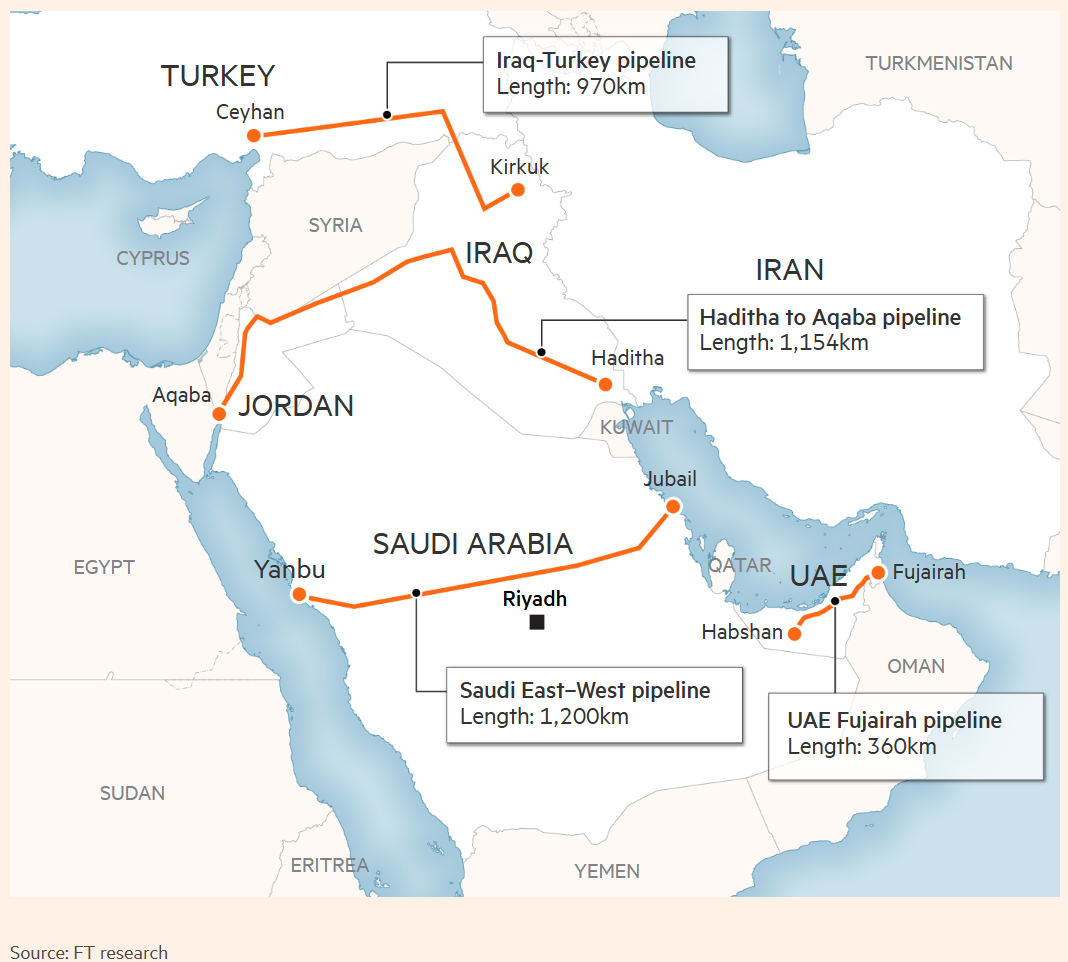
Existing oil and gas pipelines in the Middle East
In the longer term, any newly constructed pipelines could become part of trade routes facilitating the flow of broader commodities beyond oil and gas. One option under consideration is reviving the ambitious U.S.-led 'India-Middle East-Europe Economic Corridor' plan—a route stretching from India through the Gulf to Europe (dubbed IMEC), although parts of the project initially included a pipeline to Israel’s Haifa port, which poses significant political challenges.
Yossi Abu, CEO of Israel’s NewMed Energy, expressed confidence that a pipeline to the Mediterranean will eventually be built, whether terminating at a port in Israel or Egypt. 'People need to take control of their destiny with their friends,' he said. 'We need to build onshore oil pipelines and rail connections across the region, leaving no bottlenecks that others can exploit to choke us.'
Christopher Bush, CEO of private Lebanese firm Cat Group, said there was already substantial market interest in new projects even before the outbreak of war. His company was one of the main contractors for Saudi Arabia’s east-west pipeline. 'We’ve received inquiries about various pipeline proposals,' he said. 'I have several different plans sitting on my desk.'
But he added that significant obstacles remain. Bush estimated that the cost of replicating the East-West pipeline today would be at least $5 billion — a project that Pengao Holdings once needed to blast through the hard basalt of the Hijaz Mountains along Saudi Arabia's Red Sea coast.
More complex multinational route options, such as those from Iraq via Jordan, Syria, or Turkey, could cost between $15 billion and $20 billion. 'This has been studied before. Front-end engineering design has even been carried out for such routes originating from Iraq. This is an opportunity that has been discussed,' he said. However, security risks include a large number of unexploded ordnance within Iraq and the continued presence of Islamic State or other armed groups.
Bush warned that pipelines extending southward to Omani ports would also face challenges in traversing deserts and hard rock mountains. Oman's ports are not immune to security threats from Iran. A recent drone attack on the critical port of Salalah forced its temporary closure.
Political challenges also include who will operate the pipeline and control the flow. Bush added that establishing a pipeline network would require Gulf countries to 'abandon their individualistic policies and collaborate. It has long been believed that bringing in a ship, loading it, and setting sail is cheaper and safer.'
In the short term, the most feasible option might be to expand the capacity of the East-West pipeline and the existing pipeline from Abu Dhabi to Fujairah. This can increase capacity without adding the complexity of new cross-border infrastructure. Saudi Arabia could also develop more export terminals along its Red Sea coast, including a deep-water port being built for the 'Neom' project. 'I'm sure they are considering this possibility,' Bush said. 'There are many smart people studying all of this now. It's a tricky issue.'
The Saudi Energy Ministry did not respond to requests for comment. A senior energy executive stated that Abu Dhabi 'has always had Plan B to construct a second pipeline to Fujairah.' However, the person added that no decisions may be made until there is clarity on the long-term status of the Strait of Hormuz. ADNOC, Abu Dhabi’s state-owned oil company, declined to comment.
The UK is leading negotiations among 35 countries aimed at forming an alliance to reopen the strait. Kafafi agreed that Gulf nations would need time to assess the situation of this waterway, but she noted that these countries now recognize that the scale of the current energy crisis requires a new way of thinking. 'Relevant discussions have already progressed along the chain,' she said. 'I don't think (the situation) can return to the pre-conflict state.'
Editor/Rocky