
The latest HSBC report highlights a market misjudgment: the AI monetization capabilities of Alibaba and Tencent have been systematically underestimated. The recent pullback in their stock prices is not due to pessimism about AI prospects but rather concerns over short-term operating expenses. If they can capture market share in the advertising sector, their revenues could see an upside of up to 11% by 2027. HSBC maintains a 'Buy' rating, with target prices implying potential upside of 44% and 51%, respectively.
The market's concerns about the potential for AI monetization on the consumer side by Chinese Internet giants may be a misjudgment.
In its latest report released on April 2, HSBC stated that the AI monetization capabilities of Alibaba and Tencent are systematically underestimated by the market. The potential for AI-driven revenue in core scenarios such as advertising, e-commerce commissions, and payments has not yet been fully reflected in their stock prices.
 Despite Alibaba and Tencent recently disclosing large-scale AI investment plans and raising their cloud business revenue outlook—with Alibaba setting a goal of reaching $100 billion in cloud revenue within five years, implying a compound annual growth rate of over 40%—the share prices of both companies retreated after their earnings announcements. This is not a signal that the market has turned pessimistic about AI prospects but rather reflects short-term investor concerns about rising operating expense ratios due to investments in consumer-facing (to-C) AI.
If Tencent, Alibaba, and ByteDance can capture 10% to 50% of the advertising revenue share from transaction-based and search-based platforms and equally divide the gains, this opportunity could increase Tencent’s and Alibaba’s revenues by up to approximately 8% to 11% by 2027. Based on this assessment, HSBC maintained its “Buy” ratings for Alibaba and Tencent, with target prices of $180 and HK$750, respectively, implying upside potential of approximately 44% and 51% relative to current share prices.
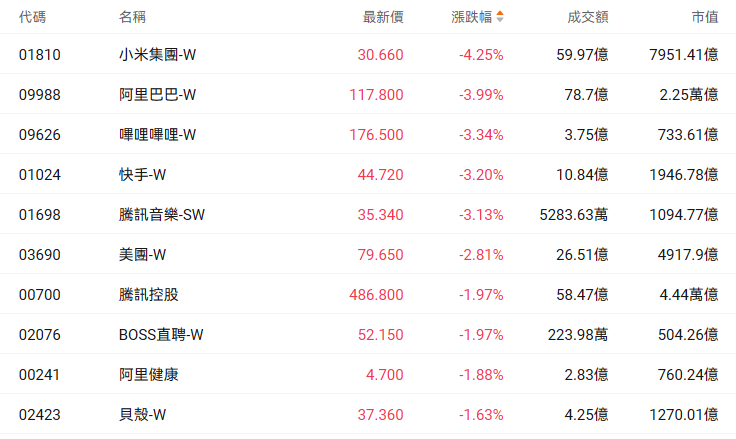
As of press time, the tech sector's stock prices extended their declines in the afternoon session.$BABA-W (09988.HK)$dropped by more than 4%,$TENCENT (00700.HK)$Down more than 3%.
The market has misinterpreted signals regarding AI investments.
The sell-off in Alibaba and Tencent shares stems from short-term concerns about rising operating expenses rather than doubts about AI’s long-term returns. The report argues that the market remains confident in the long-term return on capital expenditures for both companies, as well as the sustainability of their free cash flow and balance sheets. What truly triggered concern was the increase in operating expense ratios caused by investments in consumer-side AI.
The largest AI monetization opportunity on the consumer side lies in advertising. The report predicts that China’s online advertising market will reach RMB 1.91 trillion by 2027, assuming growth rates of 10% in 2026 and 9% in 2027. On this basis, transaction-based and search-based platforms (excluding Tencent, Alibaba, and ByteDance) are estimated to account for approximately 30% of the advertising market share by then.
If Tencent, Alibaba, and ByteDance leverage their larger user bases, higher usage frequencies, and stronger closed-loop transaction capabilities to capture 10% to 50% of advertising revenue from these platforms and equally divide the proceeds, Tencent’s total revenue could see an upside of 2.1% to 10.6%, while Alibaba’s could rise by 1.5% to 7.5%.
If AI can expand overall consumer demand, increase online penetration rates, or if platforms emulate overseas counterparts by introducing subscription-based pricing models, the above estimates could have further upside potential.
Tencent: An ecosystem moat that is difficult to replicate.
Tencent's advantage lies in the high user stickiness of its WeChat ecosystem and diversified monetization pathways.
Data shows that WeChat’s DAU/MAU ratio reached 82% in February 2026, significantly higher than Doubao's 30% and Qwen's 16%. The average daily usage frequency per user reached 40 times, also notably higher than Doubao and Qwen’s 4 to 5 times. This high-quality, high-frequency user base forms a network effect moat that is difficult to replicate.
In terms of monetization pathways, Tencent is deeply integrating AI product functionalities akin to OpenClaw into WeChat, covering scenarios such as chat, search, video accounts, official accounts, mini-programs, and small shops to build next-generation AI agent services. Tencent's monetization growth potential will come from three areas: first, advertising—enhancing advertisers' ROI through AI-driven ad targeting, bidding, and placement, and improving conversion rates under equivalent ad loads; second, commissions—AI-enhanced shopping experiences will drive GMV growth for small shops; third, payment fees—increased transaction volumes in mini-programs and small shops will directly contribute to payment revenue.
On the enterprise side (B2B), Tencent Cloud achieved an adjusted operating profit of RMB 5 billion in 2025, with revenue growth showing signs of recovery. Tencent Cloud's growth potential will stem from its PaaS and SaaS offerings, including proprietary AI agent products like WorkBuddy and Qclaw, as well as AI-powered collaboration tools such as WeCom and Tencent Meetings.
Alibaba: Dual-Driven Growth in B2B and B2C
Alibaba possesses clear AI monetization pathways on both the enterprise and consumer sides.
On the enterprise side, Alibaba Cloud's external cloud revenue grew by 35% year-over-year in the December 2025 quarter, with AI-related revenue maintaining triple-digit growth for ten consecutive quarters. Alibaba ranks first in China’s LLM token market share, accounting for 32% in the second half of 2025, with platform token consumption increasing sixfold over the past three months. As of February 2026, T-Head, Alibaba’s in-house chip division, had shipped 470,000 AI chips cumulatively, generating annual revenue exceeding RMB 10 billion, with more than 60% of T-Head chips serving external clients across over 400 enterprise customers in sectors such as internet, financial services, and autonomous driving.
On the consumer side, Alibaba’s Qwen-to-C monthly active users reached 300 million in February 2026, integrated into platforms such as Taobao, Tmall, Alipay, Fliggy, Damai, and AutoNavi. By the end of February 2026, 140 million users had completed their first AI-driven shopping experience using Qwen application’s agent functionality, spanning scenarios such as food delivery, fresh produce, ticketing, and travel reservations. With further increases in user scale, usage frequency, and stickiness, this will lay the groundwork for monetizing commission and advertising revenues in transaction-related verticals.
Platform Companies Outperform Pure Model Companies
The report explicitly expresses a preference for platform-based internet companies, considering them to have structural advantages over pure model companies (model pure plays).
In China's foundational model ecosystem, participants are divided into four layers: chips, infrastructure, models, and applications. Alibaba is the only company that covers all four layers, while ByteDance is accelerating its self-developed chip layout. In contrast, pure model companies such as Zhipu and MiniMax rely on cloud service providers (CSPs) for computing power. Once CSPs prioritize internal use of computing resources or raise prices, both their revenue and costs face risks.
HSBC has assigned a 'Hold' rating to both Zhipu and MiniMax, with target prices of 920 Hong Kong dollars and 1,000 Hong Kong dollars, respectively. Since their listing, the year-to-date gains for the two companies have reached 542% and 687%, respectively (during the same period, the Hang Seng Index fell by 1%). Their valuations already largely reflect their modeling capabilities, while computational bottlenecks may constrain the upside potential of their revenue growth.
In the B2B competitive landscape—encompassing three dimensions: AI computing power (GPU reserves, cloud ecosystems, self-developed chips), MaaS (token market share, Artificial Analysis Intelligence Index ranking, modality coverage), and coding capabilities—it shows that Alibaba and ByteDance are in a more advantageous position for enterprise monetization, while Zhipu and MiniMax lead in coding capabilities.
Looking to pick stocks or analyze them? Want to know the opportunities and risks in your portfolio? For all your investment-related questions,just ask Futubull AI!

Editor/joryn