
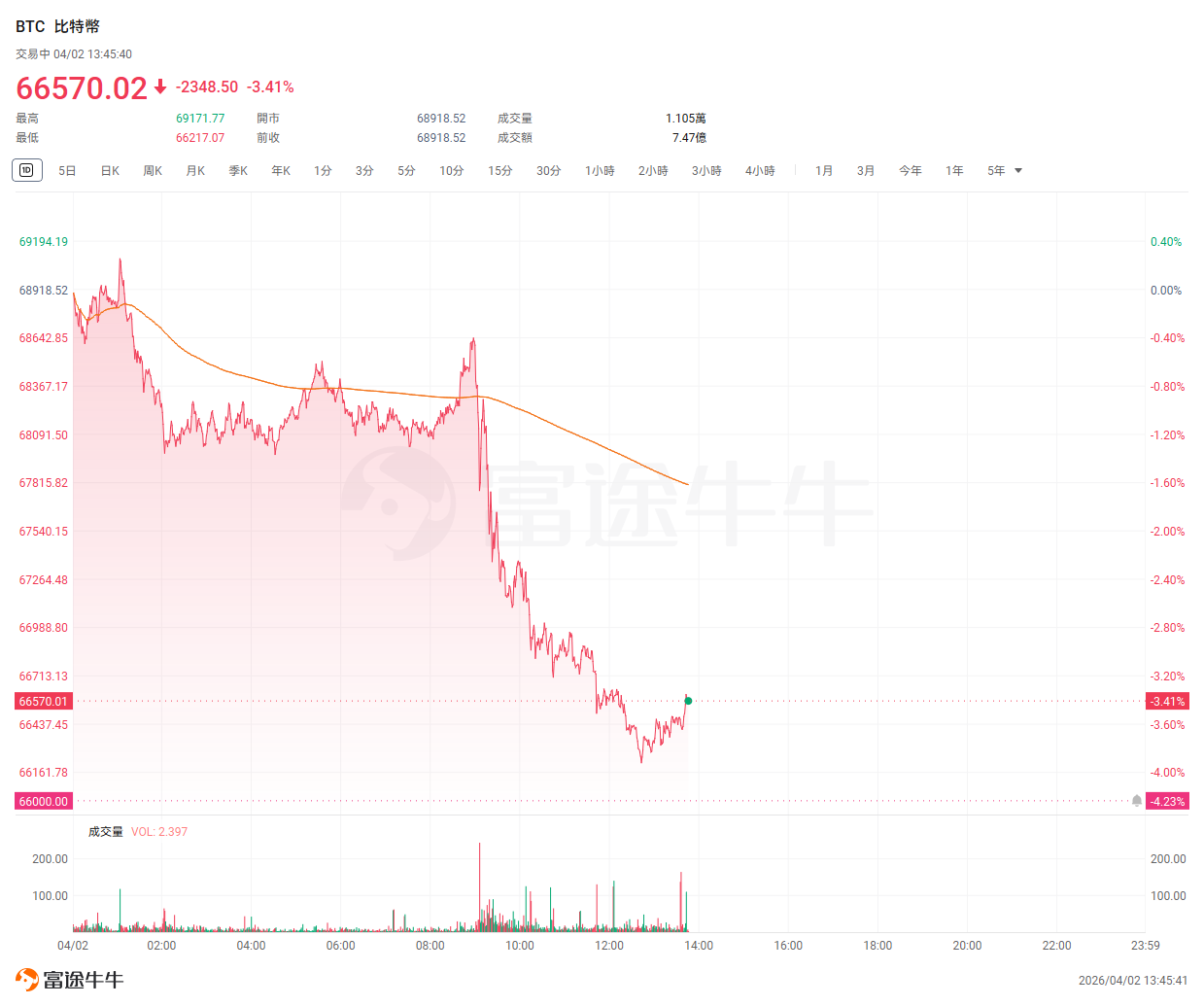
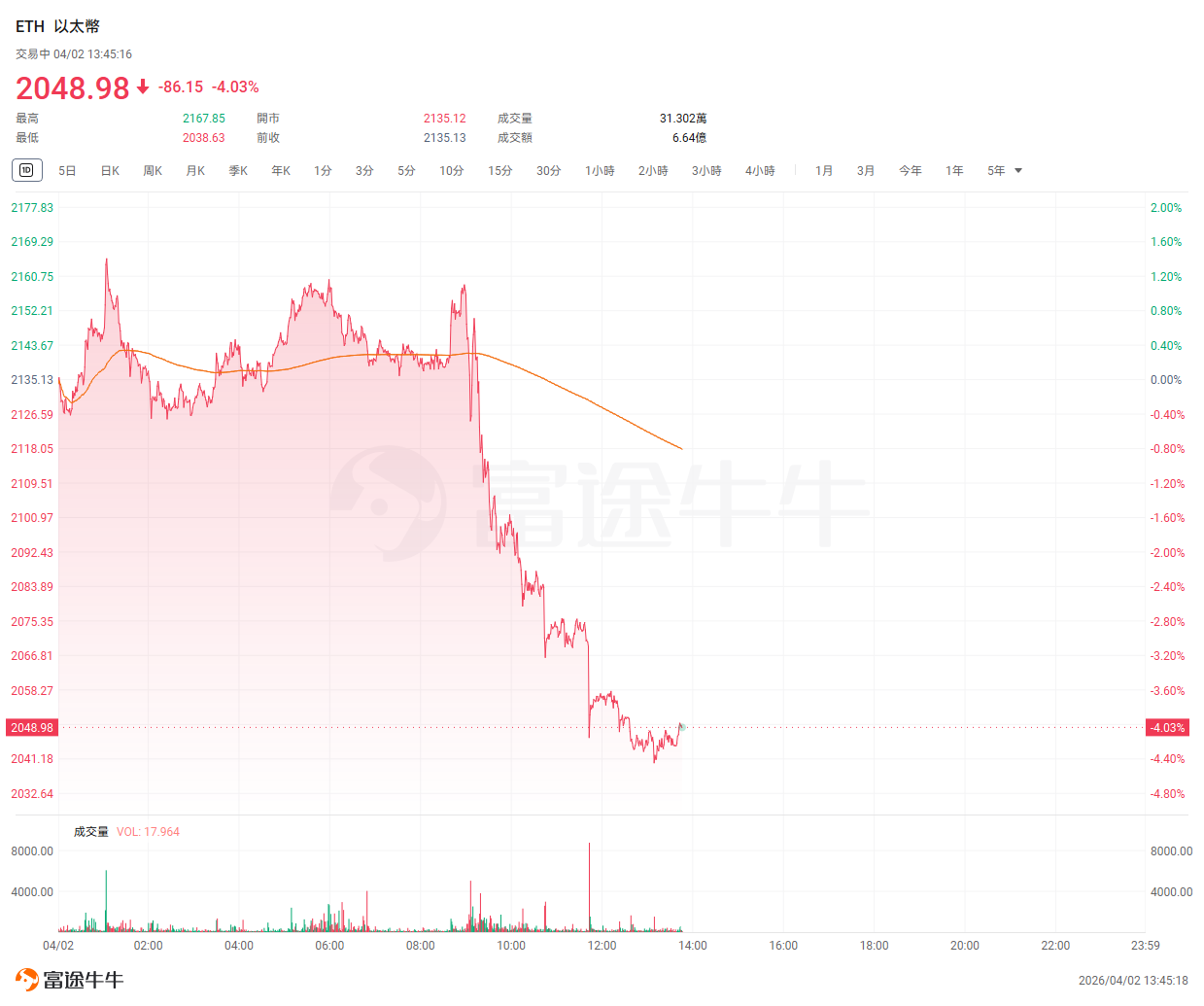
On April 2, the cryptocurrency market declined. As of press time, $Bitcoin (BTC.CC)$ fell by 3.41% to $66,570.02; $Ethereum (ETH.CC)$ dropped by 4.03% to $2,048.98.
At 9:00 AM Beijing Time on April 2 (9:00 PM EST on Wednesday), U.S. President Trump delivered a nationwide televised address regarding the conflict with Iran. This marks his first prime-time national address since the U.S.-Israel joint military operation against Iran began over a month ago.
Following the latest warning from U.S. President Donald Trump that the United States would launch an 'extremely fierce' strike against Iran within the next two to three weeks, risk assets including equities, cryptocurrencies, and high-yield bonds collectively turned downward. Global stock markets, which had just experienced a supercharged rebound on Wednesday, fell sharply on Thursday. Meanwhile, international crude oil prices and the U.S. dollar index reversed course and rose during Trump’s speech. Contrary to market expectations, Trump failed to repeat the so-called 'TACO moment.' Investors remained on edge as traders who had anticipated clearer signs of a short-term resolution to the conflict were left disappointed.
Key Focus
 CFTC Chair: CFTC Ready to Regulate Entire Cryptocurrency Market
According to Cointelegraph, the U.S. CommodityFutures TradingMichael Selig, Chairman of the Commodity Futures Trading Commission (CFTC), stated that the agency is prepared to regulate the entire $3 trillion cryptocurrency industry and reiterated that the CFTC is the sole regulator of predictive markets. However, Congress has not yet established a timeline for passing key market structure legislation. In his 100-day statement, Selig noted that the CFTC is “ready to take on responsibility.”
Under Selig’s leadership, the CFTC has implemented several policies indicating a more relaxed enforcement and regulatory stance toward digital assets compared to the previous administration. Last month, the agency signed a Memorandum of Understanding (MoU) with the SEC to coordinate regulatory efforts, including those related to digital assets.
The U.S. Department of the Treasury released its first draft implementation rule for the GENIUS Act, seeking public comments on state-level regulatory frameworks for small stablecoin issuers.
On April 2, the U.S. Department of the Treasury released the first Notice of Proposed Rulemaking (NPRM) for the Guidance and Establishing National Innovation for U.S. Stablecoins Act (GENIUS Act), seeking public comments on the criteria for determining whether small stablecoin issuers qualify for state-level regulatory frameworks. The proposal aims to clarify that stablecoin issuers with issuance volumes below $10 billion may opt for state regulation over full federal oversight when the state-level regulatory system is “substantially similar” to the federal framework.
The public will have a 60-day comment period following the publication of the rule in the Federal Register. The Treasury Department stated that the rule will establish general principles for assessing whether state-level regulations meet federal standards. Currently, major U.S. banking regulators, including the Federal Deposit Insurance Corporation (FDIC) and the Office of the Comptroller of the Currency (OCC), are also releasing draft rules to advance the implementation of the stablecoin regulatory framework. Meanwhile, the GENIUS Act does not yet cover regulations for interest-bearing stablecoins, which has become a significant obstacle for Congress in advancing broader cryptocurrency market structure legislation.
Mining company Riot is suspected of selling 500 Bitcoins, worth $34.13 million.
On April 2, according to Lookonchain monitoring, Bitcoin mining company $Riot Platforms (RIOT.US)$ reportedly sold another 500 Bitcoins two hours ago, valued at $34.13 million.
SEC Approves NYSE American Listing of Multi-Crypto Asset Commodity Trust Options
The U.S. Securities and Exchange Commission (SEC) announced the approval of a rule change application by NYSE American to list options on multi-cryptocurrency commodity trusts. Previously, only options on trusts holding a single cryptocurrency asset were allowed; now, the scope has been expanded to include trusts holding multiple cryptocurrency assets.
The prerequisites for listing are as follows:
Each cryptocurrency asset held by the trust must individually meet high liquidity standards—with an average daily market value of at least $700 million over the past 12 months—and derivative contracts for the cryptocurrency asset must be traded on platforms with comprehensive surveillance-sharing agreements.
Trust shares must comply with the initial and continued listing standards for ETF options set by the trading platform and qualify as NMS stocks.
After review, the SEC concluded that this rule change will provide investors with greater exposure to cryptocurrency assets and hedging tools without requiring separate SEC approval for each instance, thereby enhancing market efficiency.
In Q1 2026, a total of 53 projects secured financing exceeding $10 million, with the prediction market projected to reach $1.67 billion.
According to Octopus analysis on the X platform, in the first quarter of 2026, venture capital firms invested over $10 million in 53 projects within the crypto sector. The distribution of funding is as follows: the prediction market secured $1.67 billion through three deals, the payments sector received $679 million across nine deals, the trading sector garnered $418 million from six deals, and the DeFi space raised $337 million via eight deals. Excluding Kalshi’s fundraising of over $1 billion in the prediction market, the payments sector became the most funded track. Overall VC funding fell by 12% year-on-year, but capital is shifting toward more substantive areas.
SlowMist’s Yu Xian comments on the Drift attack: DeFi project teams need to simulate extreme scenarios of private key compromise and response mechanisms.
Yu Xian, founder of SlowMist, commented on the Drift attack incident on the X platform, stating, 'All DeFi project teams should urgently and regularly review what extreme scenarios could arise if their owner/admin private keys are compromised, whether timely alerts can be received, whether they can respond promptly, and what the response measures are. All users should also understand clearly what their potential financial loss exposure is when participating in DeFi under extreme conditions (e.g., assuming internal malfeasance).' Earlier today, it was reported that Drift Protocol suffered a hacker attack, resulting in losses of at least $200 million.
Prediction market trading volume reached $75 billion in Q1 2026, marking a 70% increase quarter-on-quarter.
According to CryptoRank data, prediction market trading volume hit $75 billion in the first quarter of 2026, setting a new record high and representing a 70.45% increase compared to Q4 2025. CryptoRank noted that the prediction market grew from zero to $75 billion in just two years, demonstrating rapid market expansion. Growth accelerated in the second half of 2025 and continued into 2026. Prediction markets are becoming a significant sub-sector of cryptocurrencies.
Morgan Stanley resubmits an S-1 amendment for its Bitcoin ETF, with analysts expecting a launch next week.
According to a report by Cointelegraph, $Morgan Stanley (MS.US)$ An S-1 amendment was resubmitted for its Bitcoin ETF, with analysts expecting this to be the final update before the fund launches next week.
CryptoQuant: Bitcoin buying failed to offset the selling wave from large holders.
According to Bloomberg, CryptoQuant data shows that despite increased institutional buying, Bitcoin demand remains under pressure. As of the end of March, apparent demand (a measure of how much demand exceeds or falls short of newly mined Bitcoin) stood at a negative value of approximately 63,000 BTC, indicating insufficient new demand to offset existing holders’ selling. The report highlighted that retail and other market participants’ selling exceeded the scale of institutional accumulation.
Whale addresses have transitioned from continuous accumulation to net selling, with significant reductions over the past year. The sell-off has accelerated since the fourth quarter of 2025. Since late November 2025, demand has continued to decline, confirming that the market remains in the distribution phase. Demand from U.S. investors has also weakened, with Coinbase's premium turning negative again.
Empery Digital: Released 1,800 Bitcoin previously held as collateral and sold 370 Bitcoin last week.
Nasdaq-listed Bitcoin treasury company $Empery Digital (EMPD.US)$ disclosed last week's sale of 370 Bitcoins, generating approximately $24.7 million in proceeds, reducing its Bitcoin holdings to 2,989. Additionally, Empery Digital announced that recent funds raised through a share placement and the sale of part of its Bitcoin holdings have fully repaid its term loan. The company’s balance sheet will be strengthened by reducing ongoing interest expenses and releasing approximately 1,800 Bitcoins previously held as collateral.
EDX Markets, a crypto exchange backed by Wall Street giants, has applied for a national bank charter with the U.S. OCC.
According to The Block, EDX Markets, a cryptocurrency exchange supported by Citadel Securities, Fidelity Investments, and $Charles Schwab (SCHW.US)$ other Wall Street giants, has applied to the U.S. Office of the Comptroller of the Currency for a national trust bank charter.
The CEO of EDX stated that obtaining an OCC-chartered trust license would give it a competitive advantage in serving large banking clients. While this license does not allow crypto companies to engage in traditional banking activities such as accepting deposits or issuing loans, it helps attract institutional clients. In its application documents, EDX noted that the digital asset market currently lacks functional separation mechanisms present in traditional markets and aims to fill this gap through licensing.
South Korean crypto exchange Bithumb postpones IPO timeline to 2028.
According to The Block, South Korean crypto exchange Bithumb has postponed its IPO plans to 2028, further delaying from the previously anticipated second half of 2025. The exchange has signed an IPO consulting agreement with Samjong KPMG until the end of 2027 and is still in the preparation stage, focusing on strengthening accounting policies, internal controls, and internal verification. Bithumb reported revenue of approximately 651 billion won (about $430 million) in 2025, with a market share exceeding 30%.
Earlier this year, the exchange mistakenly distributed about 620,000 Bitcoins (worth approximately $43 billion at the time) during a promotional event, prompting an investigation by the Korean Financial Supervisory Service into its internal controls and risk management. Additionally, the exchange faces regulatory pressures, including a fine of approximately 36 billion won (about $27 million) from the Financial Intelligence Unit and partial suspension of operations.
Bitmine purchased 45,000 ETH through BitGo at a value of approximately $95.3 million.
According to Onchain Lens,$Bitmine Immersion Technologies (BMNR.US)$Purchased 45,000 ETH through BitGo at a value of approximately $95.3 million.
Paradigm is developing a prediction market trading terminal targeting professional trading demand.
According to Fortune, the crypto venture capital firm Paradigm is developing a prediction market trading terminal aimed at professional traders and market makers, led by partner Arjun Balaji since late 2025. Reports indicate that Paradigm is also evaluating the possibility of establishing its own prediction market market-making operations and working with researchers to bundle multiple prediction markets into tradable indices. The relevant data has been compiled into a public dashboard.
Paradigm is a key investor in the prediction market platform Kalshi, having participated in multiple funding rounds, with the latest round valuing it at approximately $22 billion. Its competitor, Polymarket, is also reportedly in talks for a new funding round at a valuation of around $20 billion.
eToro Group gains approval from New York to offer cryptocurrency trading to local users.
According to Crowdfund Insider,$eToro Group (ETOR.US)$Announced that residents of New York State can now trade cryptocurrencies on its platform. The company stated that this adjustment was made after obtaining New York's BitLicense and money transmission license.
Currently, eToro offers cryptocurrency services across 48 states in the U.S. In 2024, eToro reached a $1.5 million settlement with the U.S. SEC for failing to register as a broker-dealer and clearing agency, subsequently delisting most cryptocurrencies from its U.S. platform and adjusting its compliance strategy. eToro stated that it has reached 40 million registered users globally, covering 75 countries.
Ripple Launches Unified Treasury Management System Supporting Native Digital Assets
Ripple announced the launch of its Digital Asset Accounts and Unified Treasury features within Ripple Treasury, claiming to be the first enterprise treasury management system with native digital asset capabilities. The platform allows CFOs and treasury teams to view, hold, and allocate both fiat and digital assets in a single interface, eliminating the need for manual reconciliation across multiple custodians or trading platforms.
The system currently supports RLUSD, the stablecoin issued by Ripple, $Ripple (XRP.CC)$ as well as multiple fiat currencies. It builds on the infrastructure Ripple accumulated after acquiring traditional treasury management service provider GTreasury in 2025, which handled approximately $13 trillion in payments that year.
The digital asset reserve bill in Arizona will undergo a final vote.
On April 1, the digital asset reserve bill in Arizona will undergo a final vote. The bill allows the state to hold seized BTC and XRP instead of auctioning them off.
Cango Secures $75 Million in Financing to Expand Bitcoin Mining and AI Infrastructure
According to PR Newswire, $Cango (CANG.US)$ the company announced the completion of two financing transactions: First, entities controlled by Chairman Jin Xin and Director Qiu Changwei collectively subscribed to 49,242,424 Class A ordinary shares, raising a net amount of $65 million settled in USDT. Second, a securities purchase agreement was signed with DL Holdings Group Limited (HKEX: 1709), a Hong Kong-listed financial group, involving the issuance of zero-coupon convertible bonds with a face value of $10 million and warrants allowing the subscription of 370,370 Class A ordinary shares at $2.70 per share.
Genius Group Liquidates Bitcoin Reserves, Plans to Restart Bitcoin Reserve Strategy When Conditions Are Favorable
According to Globenewswire, Genius Group ($GNS.US), a U.S.-listed company, $Genius Group (GNS.US)$ Released the unaudited financial performance report for the first quarter ended March 31, 2026, disclosing that the company has restructured its debt agreement, sold its remaining Bitcoin reserves, and fully repaid approximately USD 8.5 million in debt. The company plans to restart the accumulation of Bitcoin reserves when market conditions become more favorable.
Genius Group reported first-quarter revenue of USD 3.3 million, representing a 171% increase from USD 1.2 million in the first quarter of 2025. Gross profit surged 228% to USD 2 million, up from USD 0.6 million in the same period last year.
JPMorgan CEO: Considering offering predictive market services to clients, but will not venture into areas such as sports and politics.
According to CBS News, $JPMorgan (JPM.US)$ CEO Jamie Dimon stated that the bank is considering providing predictive market services to clients but explicitly ruled out involvement in areas like sports and politics. Former CFTC Commissioner Brian Quintenz responded on X, stating it was 'absurd' to assume JPM would face no risks related to specific election outcomes. He pointed out that, with already efficient and regulated products available, shareholders might eventually demand hedging strategies against risks tied to events such as elections, drawing an analogy to interest rate risk management.
Franklin Templeton acquired 250 Digital, a spin-off from CoinFund, and integrated the associated operations under the new unit “Franklin Crypto.”
Traditional asset management giant Franklin Templeton announced plans to acquire 250 Digital, a digital asset company spun off from venture capital firm CoinFund, as part of its strategy to expand its cryptocurrency investment business.
Editor/Joe