Bank of America has issued a latest warning that, driven by surging energy prices, the peak of the overall PCE inflation rate in the United States will approach 4%, far exceeding the Federal Reserve's 2% target. More troubling is that even if oil prices fall next year, disruptions in fertilizer supply and persistent supply chain issues will keep inflation elevated until 2027.
Inflationary pressures in the United States are intensifying rapidly. Bank of America has warned that, driven by surging energy prices, the overall PCE inflation rate in the U.S. will climb sharply in the coming months, with its peak approaching 4%, far exceeding the Federal Reserve's policy target of 2%.
According to Storm Chasing Trading Desk, a report released on April 1 by Bank of America Global Research shows that economists Stephen Juneau and Shruti Mishra have significantly raised their forecasts for overall PCE inflation. The new forecast trajectory is markedly higher than before, with the peak expected to occur this quarter (the second quarter of 2026). This revision is directly due to the bank's commodities team raising its oil price forecast, as the rapid transmission effect of energy prices will be prominently reflected in overall inflation data in the short term.
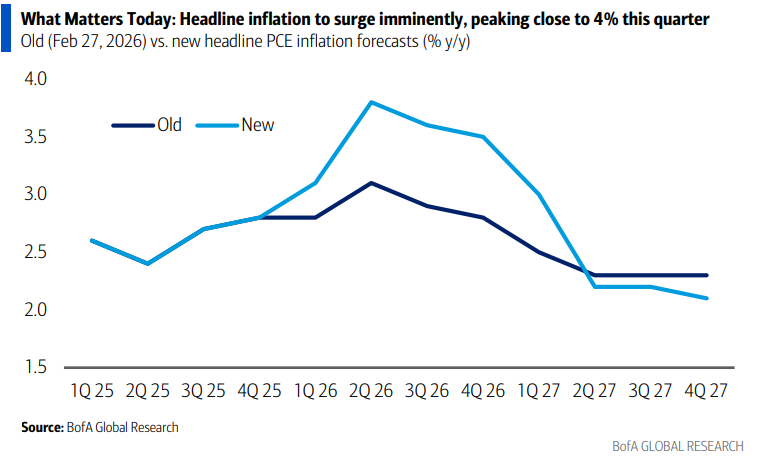
 Even more concerning for the market is that inflationary pressures are not a fleeting phenomenon. Bank of America points out that even if oil prices decline next year, the overall inflation level will still be about 50 basis points higher than previously predicted. This is due to two persistent disruptive factors: fertilizer supply interruptions pushing up food inflation in 2027, and the protraction of global supply chain issues. This means the path for inflation to return to target will be more convoluted than previously anticipated by the market, directly constraining the Federal Reserve's timeline for interest rate cuts.
Supply chain disruptions are considered by Bank of America to be a core variable in the persistence of inflation. The report highlights that fertilizer supply interruptions are sticky and will continue to push up food prices. Meanwhile, fundamental solutions to global supply chain problems remain elusive, and their impact on price levels will persist until 2027.
On the economic growth front, Bank of America has also lowered its GDP tracking estimate for the first quarter, now forecasting a seasonally adjusted annual rate of 2.2%, a significant drop from the previous 2.8%, primarily due to lower-than-expected construction spending. This combination of 'slowing growth and high inflation' exacerbates the policy dilemma.
Editor/Melody