
Driven by easing signals between Trump and the Iranian President, the U.S. stock market experienced a brief rebound on March 31. However, analysts noted that this was merely a short squeeze driven by news, with the rally unlikely to be sustained, making it an opportune moment to sell.
The Iran conflict has continuously influenced fluctuations in the stock market. Following the easing signals from Trump and the Iranian President, the U.S. stock market saw a temporary rebound on March 31. Analysts, however, pointed out that this was solely a news-driven short squeeze, with the rebound unlikely to last and instead presenting a good opportunity to sell.
Market rebound
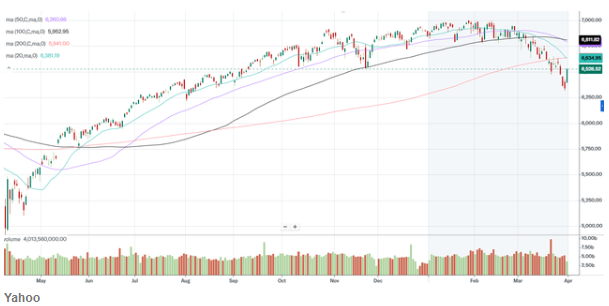
Financial analyst Damir Tokic has consistently warned that holding $S&P 500 Index (.SPX.US)$macro short positions is risky in this news-driven market, as the stock market has now become tied to national security and is prone to short squeezes. This was precisely the case on March 31, when $NASDAQ 100 Index (.NDX.US)$the Nasdaq rebounded by nearly 4%, while the S&P 500 Index rose almost 3%.
 The trigger was Trump signaling his potential willingness to end the conflict without demanding the reopening of the Strait of Hormuz, while the Iranian President stated that 'Iran would consider ending the war under certain conditions, provided guarantees are secured.'
Such statements from both sides have appeared before, but the market still regarded them as reasons for the rebound. Therefore, this rebound will likely be short-lived, instead presenting a selling opportunity with reduced risk of being squeezed out. From a technical perspective, the rebound may extend toward the 200-day moving average resistance level.
Nightmare escalation scenario
This is the macro context of the Iran conflict:
- The Strait of Hormuz is nearly closed, blocking 20% of global oil supplies, along with natural gas, fertilizers, and some other products.
- Consequently, the global economy is facing a supply-driven oil price surge.
- Meanwhile, energy infrastructure in the Gulf Cooperation Council (GCC) region has been damaged, meaning that even if the conflict ends, medium- to long-term impacts will persist.
Notably, the escalation of the situation may also prompt the Houthis to close the Mandeb Strait, a key node in the Red Sea, further reducing oil supplies.
From a macro perspective, rising oil prices will trigger an inflationary shock. In such a scenario, if inflation surges, the Federal Reserve may be forced to raise interest rates, which would push the 10-year U.S. Treasury yield higher as well.
The combination of rising oil prices, generalized inflation, and higher interest rates is highly likely to lead to a global recession (stagflation). A recession accompanied by rising interest rates could result in: 1) a bursting of the real estate bubble; 2) private credit defaults escalating into systemic credit events; 3) forced cuts in AI capital expenditures, leading to a burst of the AI bubble.
In this nightmare scenario, the S&P 500 Index could fall by more than 50%, comparable to the bear markets of 2000 and 2008. The Trump administration clearly recognizes this possibility and is actively seeking solutions before the crisis erupts.
Endgame Options
So, how can we escape this predicament before a financial crisis erupts? Analysts believe that the main options are as follows:
Option One: Ending the war through negotiations
Currently, negotiations are ongoing with an April 6 deadline, set by Trump as the final date. The U.S. presented Iran with a “15-point plan,” which Iran rejected; Iran countered with a “5-point plan” to end the war.
Iran's demands include: 1) a complete cessation of attacks on Iran; 2) binding guarantees ensuring no future aggression; 3) payment of war reparations; 4) ending the war across the entire region; 5) recognition of Iran's sovereignty over the Strait of Hormuz.
The key demands put forward by the U.S. include: 1) the immediate reopening of the Strait of Hormuz; 2) a permanent commitment to never develop nuclear weapons; 3) halting all uranium enrichment activities within Iran; 4) transferring existing enriched uranium stockpiles to the International Atomic Energy Agency (IAEA).
Trump appears willing to abandon the demands regarding the Strait of Hormuz as well as the nuclear requirements (publicly claiming that this goal has been achieved even without actual control over Iran's uranium enrichment). Therefore, essentially, the decision to end the war rests in Iran’s hands.
Iran seems to desire assurances that the war will end, which is the main sticking point. Such guarantees may require signatures from nuclear powers like Russia and China or demand that the United States relinquish its military bases in the region.
Iran does not wish to be subjected to new attacks after a ceasefire. Therefore, these guarantees must be sufficiently robust. However, the United States cannot abandon its regional military bases, as the responsibility of the petrodollar is to protect its regional allies. Moreover, Israel would not allow Russia and China to provide such guarantees because Iran still possesses enriched uranium.
It will be difficult to reach an agreement on these guarantees in the coming days; thus, negotiations are likely to fail.
Option Two: Freezing the Conflict and Voluntary Actions
In the event of failed negotiations, the United States could unilaterally cease bombing Iran and compel Israel to stop its bombings as well, effectively freezing the war. The hope is that Iran would also halt its attacks on Israel and regional nations, and gradually reopen the Strait of Hormuz under China’s influence.
However, this scenario would result in: 1) The continuation of Iran’s regime with more radical leadership; 2) Iran gaining control over the Strait of Hormuz; 3) Iran having time to rebuild its ballistic missile program; 4) Iran being incentivized to accelerate its nuclear program as a deterrent.
This appears to be the direction Trump currently favors, but it is evidently not a solution. Freezing the conflict would leave the Strait of Hormuz closed, relying only on 'other countries' to help reopen it or hoping that Iran will open it under pressure from China.
Option Three: Military Defeat – Further Escalation
Thus, the only remaining option is a ground invasion to seize Iran’s critical energy assets, locate enriched uranium, and push for regime change. The issue is that this option would likely result in significant casualties and pose the aforementioned nightmare scenario for financial markets. The United States seems unable to bear the political and economic costs associated with this option.
The question is, if a ground invasion is deemed 'too costly,' what is Trump's real objective in prolonging the war for another 2-3 weeks before freezing it?
Market Impact
Analyst Damir Tokic stated that the situation in Iran is indeed a mess with no easy way out. In fact, there is currently no viable plan to bring the war to an end.
The situation seems to be moving towards a freeze, with Israel emerging as the biggest loser since Iran appears strategically stronger than before the war.
If the situation freezes: 1) WTI crude oil is likely to remain in the $90-$100 per barrel range as the Strait of Hormuz may stay partially closed, possibly even requiring transit fees; 2) inflation will continue to rise, leaving the Federal Reserve unable to cut interest rates, and the 10-year U.S. Treasury yield may stay within the 4.3%-4.6% range, a level sufficient to suppress the housing market.
Following the current rebound, the stock market will have to contend with the uncertainty of the war over the next 2-3 weeks, followed by the bursting of the private credit bubble and the AI hype bubble, along with pressures from high oil prices and elevated interest rates. Economic data is likely to exhibit mild stagflation characteristics, with a weakening labor market and persistently high inflation. As a result, the macroeconomic environment will be relatively weak, and the ongoing sell-off in the S&P 500 Index is likely to continue, with potential declines reaching 20%.
The risk in this outlook leans downward. Israel is unlikely to accept a frozen scenario, and once the U.S. and Israel replenish their interceptor missile inventories, the situation could ultimately escalate. A greater risk lies in Iran not accepting the freeze but continuing to bomb regional countries and Israel, which would lead back to a nightmare scenario: crude oil prices surging to $200, delivering a significant stagflationary shock to the global economy.
Editor/Rocky